The Akhand Bharat Mirror: What Palestine May Tell Bangladesh About Its Own Future
The essay examines how civilisational nationalism shapes India-Israel ties and asks what Bangladesh can learn from Palestine’s experience. It argues Dhaka must defend its sovereignty while pursuing practical cooperation with New Delhi.
This essay begins not with a thesis but with an unease.
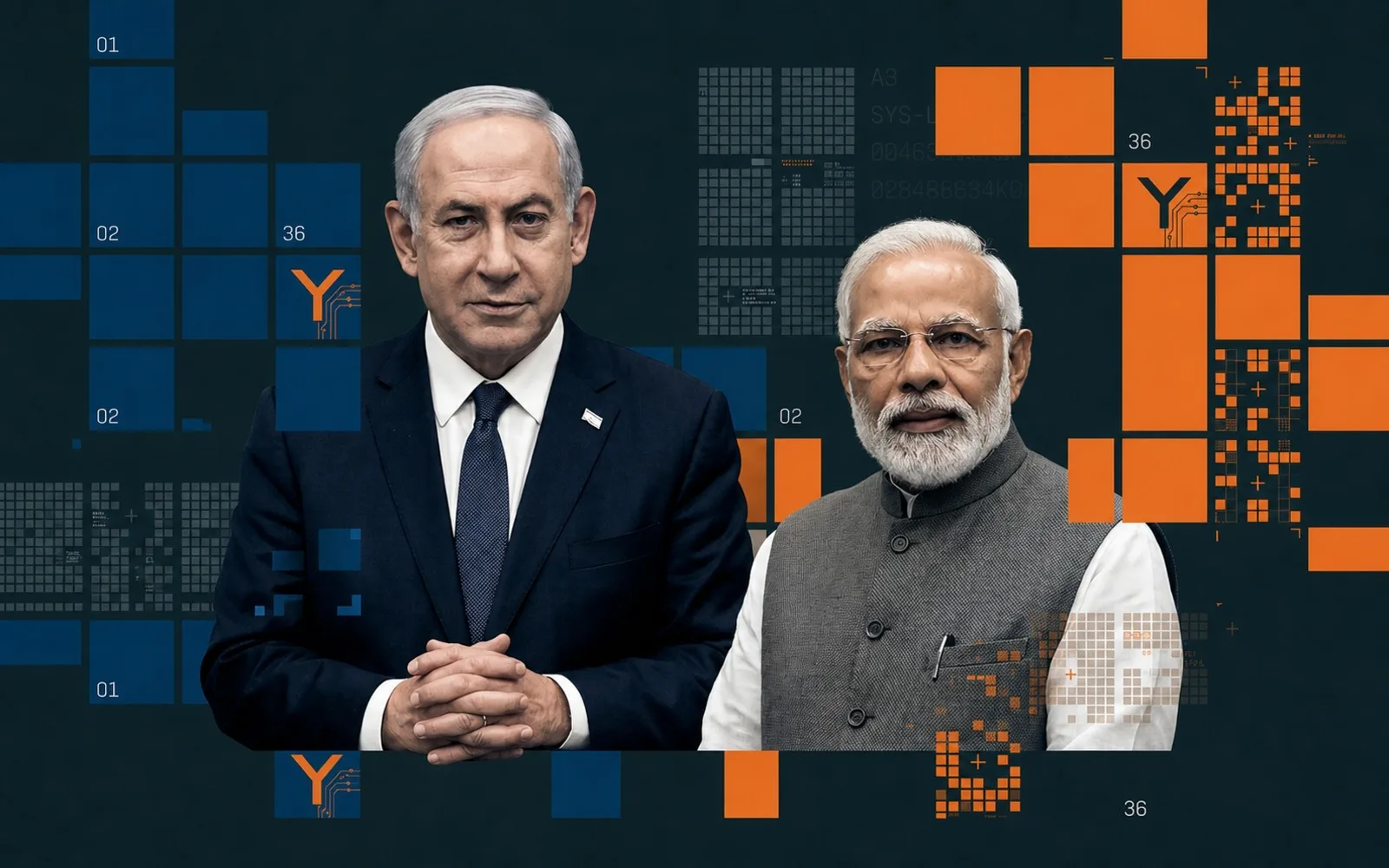
When Narendra Modi addressed the Knesset on 25 February this year, invoking biblical references to India and declaring that India stood with Israel “firmly, with full conviction”, the spectacle felt less like ordinary diplomacy than a script being revised in public. Benjamin Netanyahu called Modi “more than a friend … a brother”; Modi described two ancient civilisations meeting in partnership. Their language was intimate, civilisational and deliberate. Beneath it sat a hard strategic alliance built on defence, technology, trade and a shared political vocabulary of security.
"India and Israel were both born from partition-era upheaval, and each developed a national narrative in which a neighbouring people became more than a geopolitical adversary."
Every nation has an origin myth, and origin myths are structurally closer to cinema than to history: selective, dramatic and dependent on a villain. India and Israel were both born from partition-era upheaval, and each developed a national narrative in which a neighbouring people became more than a geopolitical adversary. Pakistan in parts of Indian nationalist imagination, and Palestinians in Israeli political discourse, are often rendered not as political communities with claims of their own, but as permanent problems to be managed.
The comparison should not be made lazily. India and Israel are different states, with different histories, populations and constitutional traditions. But their present governing ideologies increasingly invite comparison. Both have moved away from the secular-developmentalist language of their founding establishments—Congress in India, Labour Zionism in Israel—and toward a more explicit politics of civilisational majoritarianism.
V.D. Savarkar, the intellectual architect of Hindutva, is central to this genealogy. He was not a conventionally devout religious figure; rather, he treated Hindu identity as a political instrument capable of forging a nation. Theodor Herzl, the founding figure of political Zionism, contained a similar paradox: a secular European journalist who helped transform Jewish dispersal, history and longing into a programme for statehood. Neither analogy is exact, but both figures understood that sacred memory could be politically more powerful than secular argument.
Savarkar’s political imagination also gave institutional form to the idea of Akhand Bharat—an undivided India whose civilisational geography exceeded the borders of the Indian republic. That idea remains ideological rather than official state policy. Yet it is not politically irrelevant. It recurs in RSS and BJP discourse, and it has acquired renewed visibility under the current Hindu-nationalist order.
The architecture of majoritarianism
The political scientist Sammy Smooha used the term “ethnic democracy” for systems that retain electoral competition and formal democratic institutions while treating one ethnic or religious community as the nation’s core proprietor. The term has often been applied to Israel. It is increasingly invoked in scholarship and commentary on India as well.
The underlying structure is familiar: a majority community is presented as the authentic owner of the nation; minorities are formally citizens but repeatedly asked to demonstrate loyalty; contested territory becomes proof of the nation’s unfinished business.
In India, Hindutva anchors national identity in sacred geography and civilisational continuity. In Israel, Jewish peoplehood and homeland are central to the state’s constitutional and political self-description. The Citizenship Amendment Act of 2019 in India and Israel’s 2018 Nation-State Basic Law have each been criticised for sharpening the distinction between the nation’s titular community and those who live within its borders but do not belong to that community in the same way.
Kashmir and the occupied West Bank have become particularly revealing sites of comparison. While their histories are not interchangeable, both are places where sovereignty, demography, security and majoritarian national narratives are fused. Critics have drawn parallels between settlement-oriented thinking in the West Bank and post-2019 demographic and property politics in Jammu and Kashmir. The comparison is politically charged, but it is now part of the region’s own intellectual debate.
The neighbour, in such narratives, is rarely allowed full interiority. Pakistan becomes a recurring security premise in Indian majoritarian rhetoric; Palestine becomes, in much Israeli official rhetoric, a security threat before it is recognised as a people with political rights. The result is a politics in which military force is framed as defensive necessity and the unresolved political question disappears behind the vocabulary of terrorism.
From sentiment to strategy
The India-Israel relationship is not merely ideological affinity. It is material, institutional and increasingly technological.
Israel supplied India during the 1999 Kargil conflict, helping establish a defence relationship that became progressively more significant. India has since become Israel’s largest arms customer, while defence, cyber, surveillance, agriculture, water, artificial intelligence and advanced technology have become pillars of the partnership. Reports this year put India’s Israeli weapons purchases at more than $20 billion between 2020 and 2024, while bilateral trade reached approximately $3.9 billion in 2024.
Modi’s February visit formalised a further elevation of the relationship. India and Israel announced a “Special Strategic Partnership for Peace, Innovation & Prosperity,” explicitly linking security cooperation with AI, cybersecurity, semiconductors, quantum computing, biotechnology, defence platforms and space.
"Ancient civilisations become the moral backdrop for contemporary arrangements in arms, data, technology and strategic power."
This is the strange modern genre Modi and Netanyahu perform so fluently: the pitch deck dressed as scripture. Ancient civilisations become the moral backdrop for contemporary arrangements in arms, data, technology and strategic power.
That does not mean India has abandoned every reference to Palestinian statehood. Modi’s Knesset speech also referred to durable peace and the need to address “the Palestine Issue.” But its central political emphasis was unmistakable: India’s solidarity with Israel, its condemnation of Hamas’s 7 October attack, and a commitment to deepening the strategic relationship.
Why Bangladesh should care
Here the essay must abandon comparative distance, because this story is not entirely someone else’s.
The mural displayed in India’s new Parliament building in 2023, commonly described as depicting an expansive civilisational map, provoked concern across South Asia because it appeared to fold Bangladesh, Pakistan, Nepal, Afghanistan, Myanmar and Sri Lanka into a wider historical India. New Delhi’s position was that the artwork represented the reach of the Mauryan Empire and civilisational history, not a territorial claim. But the diplomatic and political reaction in neighbouring countries showed why the distinction cannot be dismissed as merely aesthetic.
The larger issue is not whether India is preparing to annex Bangladesh. There is no evidence for such a claim, and treating every symbolic gesture from New Delhi as an immediate prelude to invasion would be unserious.
"Akhand Bharat is not an official Indian foreign-policy blueprint. It is, however, a powerful ideological current within the broader Hindutva ecosystem."
The issue is political imagination.
Akhand Bharat is not an official Indian foreign-policy blueprint. It is, however, a powerful ideological current within the broader Hindutva ecosystem. In its most expansive versions, it imagines sovereign neighbours not as permanently independent political communities but as pieces of a civilisational whole temporarily separated by colonialism, Partition and history. Commentators and historians have noted that this imagery repeatedly places Bangladesh inside an imagined “Greater India,” notwithstanding Bangladesh’s distinct language movement, Liberation War and sovereign national story.
For Bangladesh, that matters.
A state’s sovereignty rests not only on territorial control or international recognition, but also on whether its neighbours’ political cultures treat its independence as settled. Bangladesh must insist that 1971 is not a footnote in a larger Indian civilisational epic. It is the founding event of a nation whose sovereignty was won through sacrifice, struggle and a democratic claim to self-determination.
Palestine offers no simple template for Bangladesh. The historical conditions are profoundly different. Bangladesh is an internationally recognised state with its own armed forces, diplomacy, economy and national institutions. It should not indulge in fatalism or collapse every India-Bangladesh dispute into an Israel-Palestine analogy.
But Palestine does offer a warning about political language. When one people’s sovereignty is imagined as temporary, its territorial claim becomes negotiable. When its resistance is described only as a security problem, its political rights vanish from the frame. And when a powerful neighbour writes itself as the sole protagonist of history, smaller nations risk being recast as unfinished business.
That urgency may soon acquire a practical diplomatic test. Prime Minister Tarique Rahman is reportedly likely to make his first bilateral visit to India as prime minister in the coming days, though the schedule has not yet been officially confirmed. The visit should not be judged by atmospherics, photographs or assurances of a “new chapter.” Rahman needs to secure a relationship grounded in reciprocity: credible movement on Sheikh Hasina’s extradition request; a clear political process for renewing the Ganges water-sharing treaty before its expiry in December; enforceable commitments on border killings, trade barriers and non-tariff restrictions; and a reset of connectivity and energy arrangements so that Bangladesh’s gains are transparent, commercially fair, and publicly defensible. Just as importantly, he should seek an explicit recognition that Bangladesh is not merely a strategic corridor or a subordinate appendage to a larger regional imagination, but an equal sovereign whose security, democratic choices and national narrative must be treated with respect. Reports indicate that trade, connectivity, energy, border management and regional security are expected to feature in the talks, while Dhaka has already stressed the need for a “conducive environment” to advance ties.
The task for Dhaka
Bangladesh does not need permanent hostility with India. It needs a clear-eyed relationship.
Trade, transit, water-sharing, energy, border management and regional connectivity remain indispensable. Bangladesh’s national interest requires engagement with India, not theatrical estrangement from it. But engagement must be paired with intellectual and diplomatic vigilance.
Dhaka should refuse the comforting idea that Akhand Bharat is always harmless domestic rhetoric. Ideas that circulate for decades in ideological organisations can eventually influence textbooks, public culture, electoral messaging, strategic assumptions and foreign-policy posture.
Modi and Netanyahu did not invent the political script that turns sacred geography into statecraft and neighbours into supporting characters. They have simply become unusually skilled performers of it. Bangladesh’s task is not to panic at every scene. It is to ensure, with confidence and clarity, that it is never cast as an extra in someone else’s civilisational production.