The shape that obsesses men in power
From Roman triumphs to a proposed Washington arch, monuments have long helped rulers turn military power and political myth into public spectacle.
The interstate system unspools for tens of thousands of miles, arteries for commerce, travel and the mundane. A long drive through the US highways in your gasoline machine can go on forever and ever, travelling like an ant on a Möbius strip.
And while travelling through cities and townships, particularly the great plains of the Midwest—where the land is flat and the buildings flatter—common sights you can spot are single-story houses, large warehouses, water tanks, and billboards for realtors and lawyers. And often, on a tall pole. A pair of Golden Arches, McDonald's—a veritable fast-food church.
The Nutshell
- McDonald's Golden Arches provide a starting point for examining how powerful figures use symbols and monuments.
- Triumphal arches have historically connected rulers to Roman prestige, military victories and national myths.
- Many grandiose projects were abandoned, repurposed or completed only after their creators lost power.
- Donald Trump's proposed Washington arch fits a broader pattern of leaders seeking to control their legacy through spectacle.
From its humble beginnings as a burger stand in California, the McDonald brothers aimed to provide high-quality food with consistency and speed. The Speedee Service System was a pared-down nine-item menu that put your order in your hand within minutes. That is what awed Ray Kroc, a struggling milkshake-mixer salesman. And that is where he saw opportunity. He pitched McDonald's to become a nationwide franchise.
Perhaps foreseeing the detrimental effects of expanding a business with strangers, the brothers agreed—but only with the inclusion of a clause. All changes needed to go through their approval. This was to ensure no dilution of standards and to keep their good business names from being sullied.
What followed was a rapid expansion of the franchise, spiralling around the Midwest. Ray, along with another partner, Harry Sonneborn, adapted a real estate scheme to franchising, leasing/owning the land below the businesses—to collect rent on top of franchise fees.
Inevitably, greed and the drive to boost profits pushed Kroc to lower standards to cut costs—straining his relationship with the brothers. And in his tyrannical ambitions, he kept circumventing the brothers' vetoes.
This tension came to a head, and in the 1960's Kroc made his move to push the "meddlesome" brothers out completely. He bought out the brothers, settling with an oral claim to 1% of profits, but never honouring them. His despotic control over the franchise was so complete that he even forced the McDonald's to rename their own original restaurants. The same year, the Golden Arches logo was trademarked.
Their new advertising tagline said, "Look for the golden arches"—painting a picture of a great, family-friendly fast-food restaurant with healthy food and a great atmosphere.
"I felt like I was eating America itself."
Now, the logo is crystallised into the brand, as the brand became synonymous with fast food in every corner of the world. It is a monument to American Capitalism so iconic that, when the first branch opened in Moscow after the fall of the Iron Curtain, one Muscovite commented after his first Happy Meal, "I felt like I was eating America itself."
As all-encompassing as the Golden Arches are, they are rare in general as actual monuments. But weirdly, whether dictators, monarchs, tyrants, or even CEOs—leaders of legend or infamy—they all seem to have an edifice complex.
And there seems to be an unusually strong interest in building arches.
Roman Arches: Ground Zero
The first freestanding monumental arch was a Roman invention. In 196 BCE, General Stertinius built three to commemorate his military victories in Spain (then Hispania)—funded with the spoils of war. The Roman Senate at the time did not favour him with a triumph. So Stertinius took it upon himself to build self-aggrandizing monuments to his exultation.
As the Roman conquests expanded, arches continued to be erected. By the 4th century CE, roughly 36 arches were built in the Roman Empire. Most, curiously, were constructed late in the empire's lifespan—during the decline. And the motivations of arches shifted from exulting conquests to claiming victories in civil wars.
The fate of Stertinius and his arches is lost to the sands of time. 5] The last great arch of Imperial Rome (315 CE) to survive to the present is the [Arch of Constantine, erected to commemorate Constantine's victory over Maxentius—an imperial rivalry for the throne. It was also a patchwork monument built from spolia—reusing stripped-off parts from earlier emperors' monuments. Rome, at that point, could no longer produce sculpture at the level of its peak; thus, several past glories were cannibalised to prop up one last one: monuments to triumph that signal decline.
Art imitates Rome; Rome imitates power.
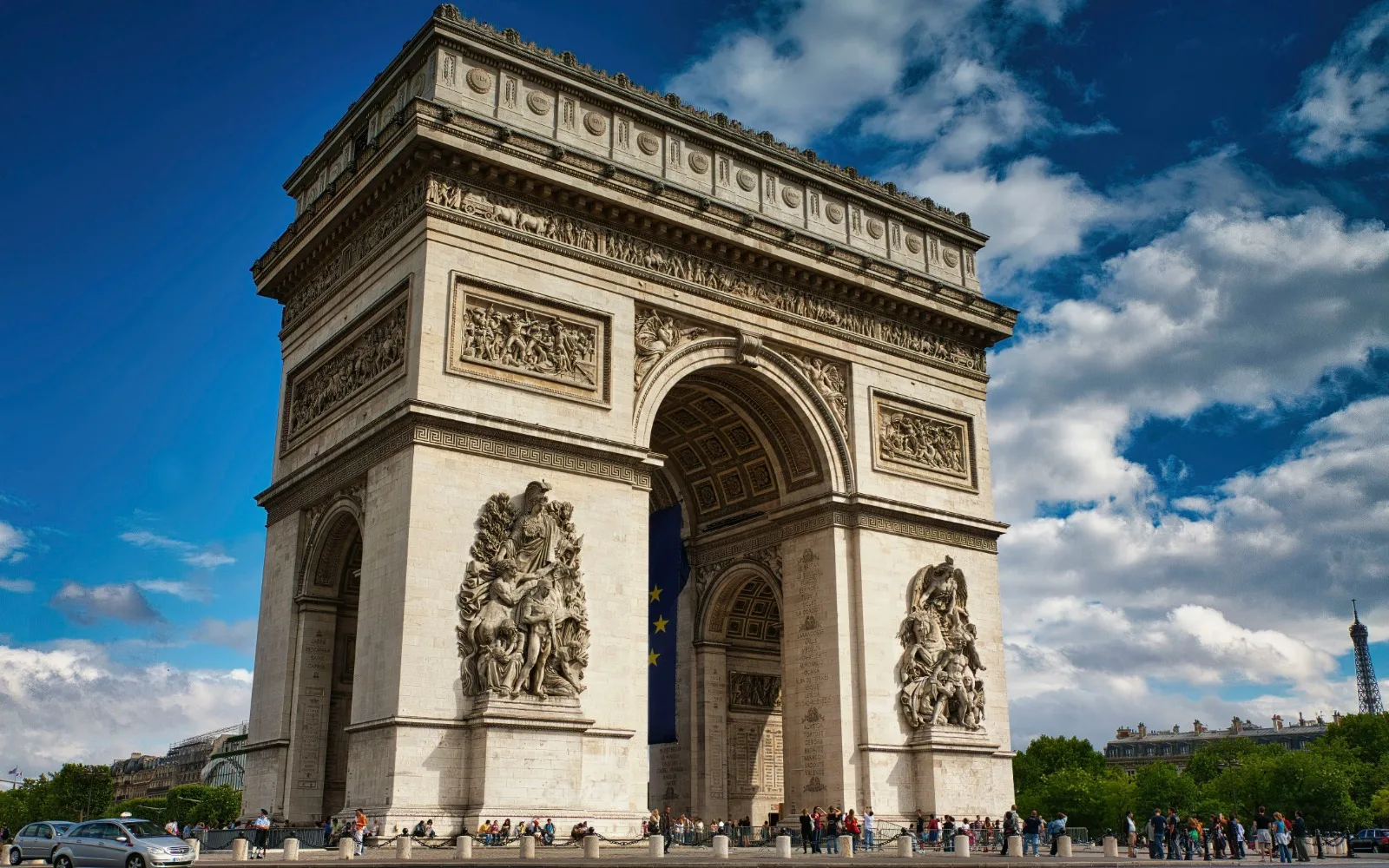
The best and notable example of a monumental arch—the one that practically launched a thousand imitators—is Napoleon's Arc de Triomphe.
The Arch of Triumph was commissioned in 1806 after Napoleon's decisive victory at Austerlitz over Austria and Russia a year before. He promised his soldiers they would return home marching under triumphal arches.
But, in truth, the arch was also a way to project his military dominance and imperial lineage from the Roman Empire for his own nascent one. The arch emulated Roman architectural iconography, modelled after the Arch of Titus, but dwarfing the predecessor at 164 feet. A clear attempt to evoke the Roman Empire's sense of glory and power without rehashing its collapse.
Napoleon never saw the project finished, as construction dragged on and on. It is said that in 1810, for his wedding to Marie-Louise, he had a full-size fake arch built out of wood and painted canvas so the wedding procession could pass under something. This vanity project would not be finished until 1836—22 years after his abdication and exile, and 15 years after he died. However, Napoleon would get to pass under his arch posthumously: his funeral hearse passed under the arch at last when his repatriated body returned to France in 1840.
The Roman general commemorates his military victories in Spain after being denied a triumph by the Senate.
The monument celebrates Constantine's victory over Maxentius and reuses sculpture from earlier imperial monuments.
The arch is intended to celebrate victory at Austerlitz and evoke the grandeur of Imperial Rome.
Construction finishes 22 years after his abdication and 15 years after his death.
His funeral hearse travels under the monument when his body is returned to France.
The arch still stands, no longer a monument to Napoleon's glorious conquests, but to France itself, an icon of national identity.
Napoleon built the arch to capture the grandeur of the Roman Empire—to borrow, in some sense, the symbolic strength of the Roman Empire. This impulse to ape the Roman Empire is not uncommon. Rome functions as a shared myth of "Western civilisation"—a pre-Christian European empire that can be claimed as ancestral, secular, and militarily dominant all at once. A useful package for ethno-nationalist storytelling.
Future arches largely reflect Napoleonic envy—built directly to rival the Arc de Triomphe.
Napoleon Envy and authoritarian spectacle
Napoleon's contemporary monarch in England, George IV, wanted his own triumphal arch celebrating British victories in the Napoleonic Wars. Designed by the king's favoured architect John Nash, the arch was the ceremonial gateway to Buckingham Palace, clad in white marble—one side depicting the victory at Waterloo and the other celebrating the victory at Trafalgar. A statue of the king on horseback was meant to crown the arch in a vainglorious apogee.
The vision never came to be. The budget ballooned, and George IV died before it could be completed. A more frugal version was finished, lacking the king's visage on horseback at the top. By the 1850s, Queen Victoria, looking to expand the palace, had the arch dismantled stone by stone and moved to Hyde Park—simply to get it out of the way.
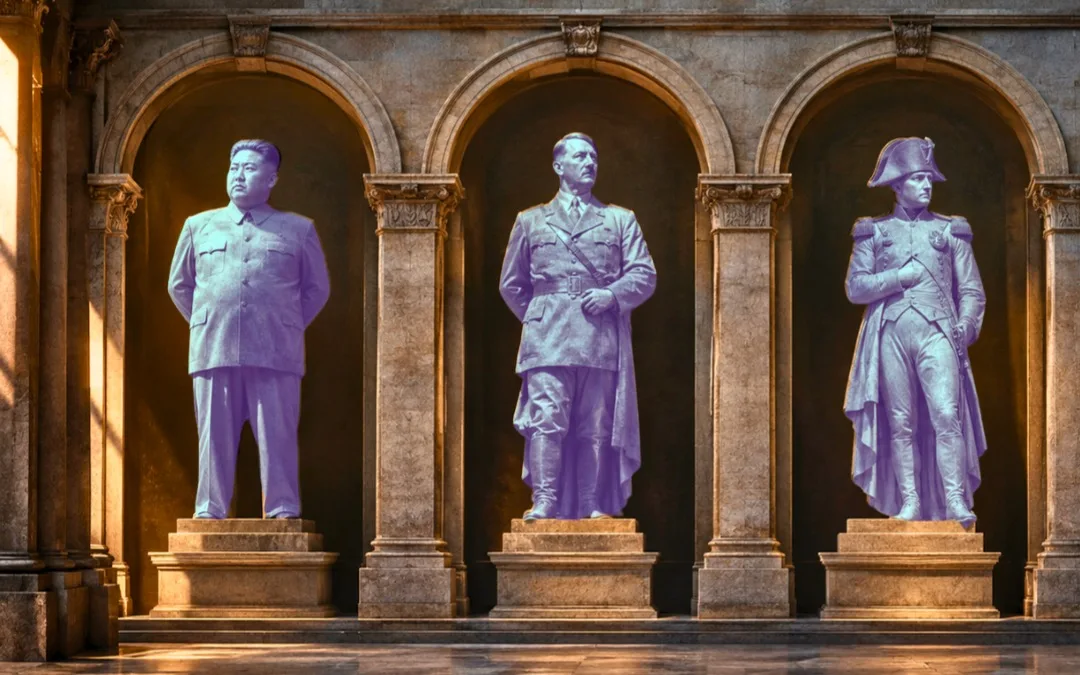
The next case is in post-Weimar Germany. The fascist push for ethno-nationalist mythologising led Adolf Hitler to claim a direct, unbroken lineage, through the Kaisers to the Holy Roman Empire, and declared Berlin the capital of the Greater Germanic Reich. And to mark the gateway to the empire, the would stand—one greater and more ostentatious than France's Arc de Triomphe. The Berlin Arch was planned to be nearly 400 feet tall and roughly 40 times the volume of the Arc de Triomphe.
The Nazis lost the war; the arch was never built.
Even North Korea's dictator Kim Jong-Il built an arch to pay tribute to his father's legacy. Kim Il-sung, the predecessor leader, commemorated his military heroism in the anti-Japanese struggle and Korea's liberation. Kim Jong-Il oversaw and unveiled the arch on his father's 70th birthday. Intended to best the French Arc de Triomphe, the arch is 197 feet—the 2nd tallest arch on the planet.
Kim Il-sung's claims, however, are maybe more myth than record. He spent the tail end of the actual war (1941–45) not fighting in Korea but stationed in the Soviet Union. Korea was liberated with the help of Soviet troops, and the USSR installed him as the liberation hero to build a friendly regime. [11]
The arch merged a national myth into a physical totem.
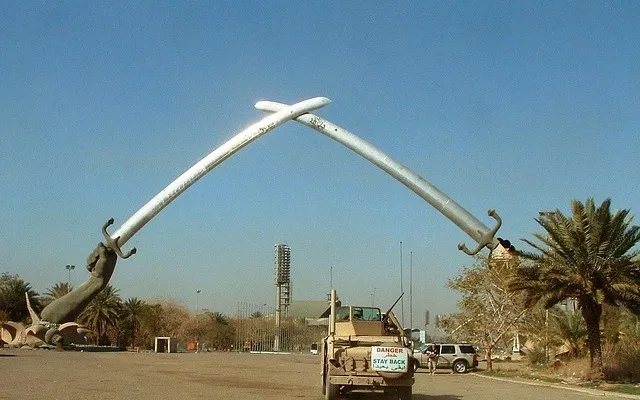
Not to be outdone, Saddam Hussein built an arch to commemorate his "victory"—a stalemate at best—in the Iran-Iraq War he himself instigated. Completed in 1989, the arch is two forearms rising into hands holding giant crossed swords. Saddam Hussein's own forearms served as the model for the arms. The swords, 24 tons each, were recast from melted-down rifles of dead Iraqi soldiers of the war. The base was adorned with captured Iranian helmets.
Plot Twist—Not All Arches!
These leaders dreamed of plucking the prestige and power from aping the Roman Empire. But ironically, that goal was rarely completed. The arches would never be built, completed posthumously, or, in the best case, repurposed to be a monument to things more remarkable than military glory.
That said, not all arches are built the same—such as the arch in Mexico City.
The project was spearheaded by the dictator Don Porfirio Díaz in 1910. He wanted to cement his popularity and tie his legacy to the country. His birthday also coincided with the centenary of Mexico—further lending legitimacy and credence to his contribution to Mexico's independence in his mind. And an arch would secure his place in the nation's history.
A complicated figure, Don Porfirio reigned for 30 years—a period termed the Porfiriato. It ended the long-standing political instability of the earlier decades and spurred economic growth after years of economic stagnation. The modernisation of infrastructure ran parallel to the brutal suppression and land seizures of the poor population. Wealth and plenty concentrated among the elite and foreign interests. Decades of authoritarian rule culminated in a rigged election. Revolution toppled him just months after construction on the arch began.
Unlike other arches, this arch would be completed with a different motive. In the 1930s, the abandoned frame was turned into a monument to the Revolution, completed in 1938. It now serves as both a mausoleum for Revolution heroes and a museum housed underneath. [13] It is fitting irony that a dictator's vain legacy project turned into a celebration of his own toppling. An arch that is neither Napoleonic nor Roman, but a symbol of the democratic need to vanquish oppression and inequality of power.
Enduring vanity, not eternal memory
Here is a story. A friend pursuing a PhD in the US, while out to lunch with his coworkers, brought up the topic if people in the West often thought about the Roman Empire. To test out the hypothesis, they asked the most typical, average coworker, "How many times a week do you think of the Roman Empire?" And he answered, "2-3 times per week."
The myths of the Roman Empire endure, with people twisting its history to fit their agenda. Perceptive readers may notice the pattern present in these leaders erecting arches in their name. It reflects the need to create a legacy, expand mythmaking, and gain legitimacy by association with something greater—easily referenced, easily connecting with many minds in the population.
But it is a common misconception that monuments are built to conserve history. A concept attributed to any regime's own fallen symbols—Confederate generals, Lenin, Saddam, the Shah of Iran, and even Bangabandhu Sheikh Mujib—torn down the moment the glorified figure loses power.
Monuments are not how we record history. Books are. Museums are. Ken Burns' 12-part miniseries are. Statues are how we glorify people.
These attempts to memorialise by building arches ring hollow, and can only be diminished to self-aggrandising, valour-cosplaying, vainglorious attempts of narcissists to impose a mythic legacy on history—nothing more.
Masud "Mass" Hoque is a statistician whose curiosity extends beyond data driven research, into the myriads of cultures, literature, science, and the stories that shape them. This is a condensed version of an article that appeared on his Substack Mass o Menos, reproduced here under special arrangement.