What Are the 15 Points Behind Bangladesh’s New Education Plan?
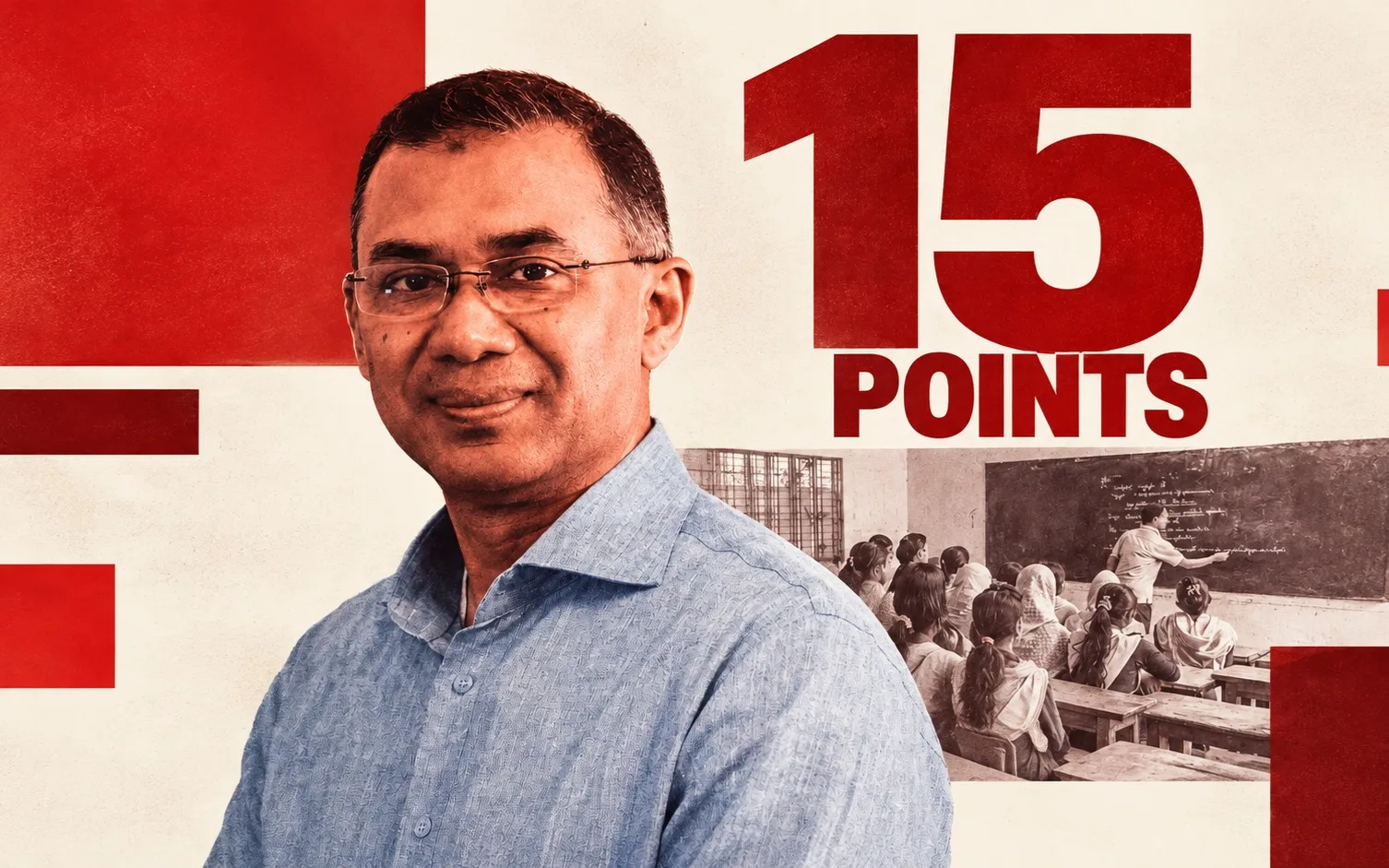
Prime Minister Tarique Rahman has given 15 directives aimed at improving the quality of education, reducing school dropout and creating a more effective learning environment. The government has already begun implementing the directives through a time-bound action plan, with particular attention to classroom teaching, teacher accountability, practical learning and keeping politics out of educational institutions.
In a Nutshell
- Prime Minister Tarique Rahman gave the directives during his visit to the Ministry of Education on July 28.
- Before his visit, the officials had already identified several reasons behind secondary-school dropout, including poverty, child marriage, dependence on coaching, smartphone addiction and a lack of enjoyable learning.
- The government has now begun developing a time-bound action plan to implement the 15 directives.
Context
Implementation of the 15 points has already started. Uniform lesson plans and class routines are being introduced. At the same time, work has begun on teacher monitoring, performance incentives and a code of conduct for MPO-listed teachers. The proposed National Education TV Channel is also being developed.
The 15 Points
- Ensuring quality teaching in classrooms.
- Introducing uniform lesson plans across schools and colleges.
- Introducing uniform class routines to create greater consistency.
- Monitoring teachers' classroom activities, including through live monitoring.
- Increasing teacher accountability for students' academic performance.
- Providing subject-based training to improve teachers' skills.
- Introducing rewards for good teaching performance.
- Increasing sports and co-curricular activities alongside academic education.
- Making schools more attractive to students to encourage regular attendance.
- Reducing secondary-school dropout, particularly by addressing its underlying causes.
- Developing enjoyable learning methods so education is less dependent on memorisation and coaching.
- Formulating a code of conduct for MPO-listed teachers, including restrictions related to political activity.
- Establishing a dedicated National Education TV Channel for educational content.
- Strengthening the link between education and practical skills, including greater attention to technical and vocational learning.
- Creating a politics-free educational environment so teachers and students can focus on learning.
Why It Matters
The 15 points address how students are taught, how teachers are held accountable and why students leave school. At the same time, addressing poverty, child marriage, and other causes of dropout requires solutions beyond the classroom. Keeping educational institutions free from political activity has also been emphasised. The government argues that excessive political involvement among teachers has affected attention to classroom responsibilities and contributed to poor academic outcomes.
What We Think
Uniform routines and monitoring can create accountability, but the quality of education cannot be measured solely by whether a lesson plan was followed. The 15 points are broad enough to address several long-standing problems at once. It remains to be seen whether this actually improves the student learning experience or remains just another unimplemented plan.