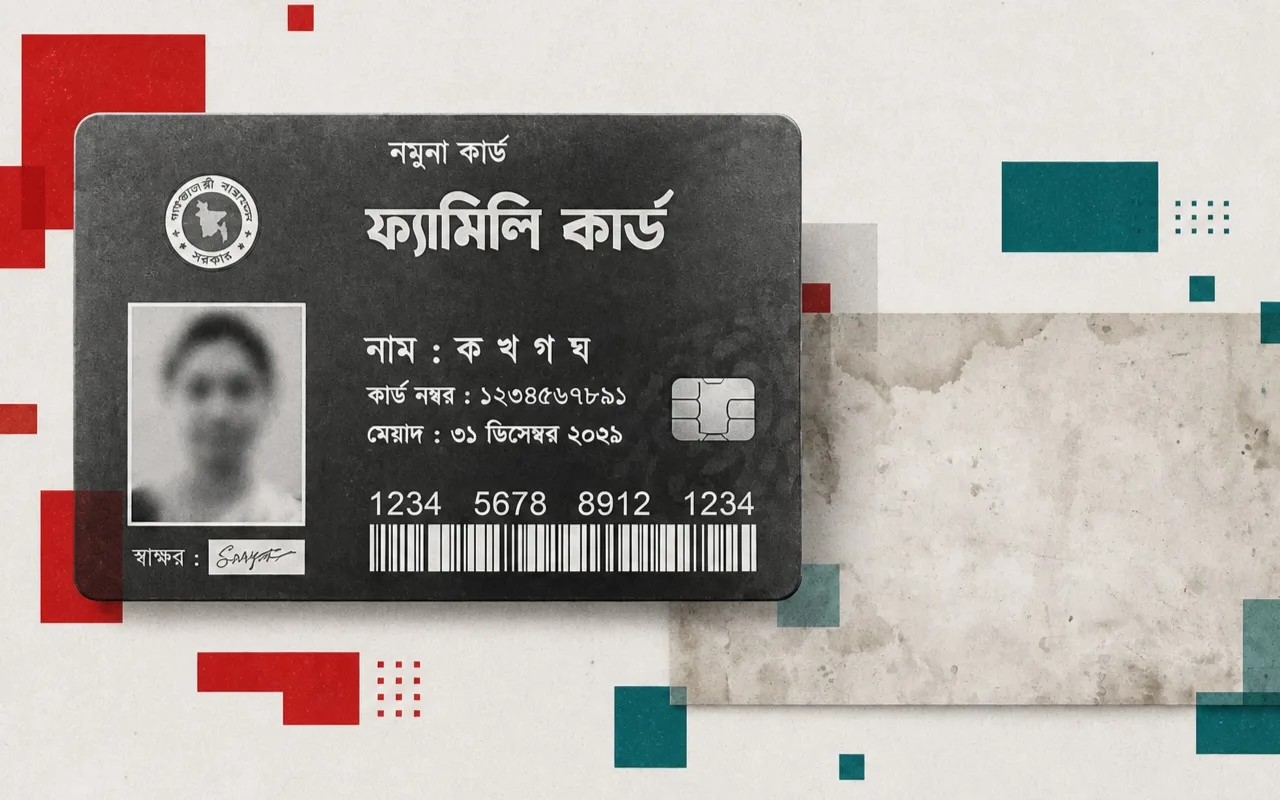
BNP's Family Card scheme is politically intelligent, emotionally resonant, and administratively ambitious. It speaks to hunger, inflation, women's insecurity, and the state's long failure to build a coherent welfare system. That is precisely why it has captured so much attention. But the more closely the scheme is examined, the clearer a harder truth becomes: this is a large welfare promise being built inside a political and administrative culture that still runs on low-level corruption, local discretion, and patronage. For that reason, the Family Card may produce some immediate relief, but it is likely to fail as a durable reform project.
BNP has presented the Family Card not as a narrow subsidy tool but as the centrepiece of a wider restructuring of governance. In January 2026, the party unveiled an eight-sector agenda that linked the Family Card to farmer support, health, education, employment and skills, sports, environment, and welfare for religious leaders. In this narrative, the card is not just a payment channel. It is the symbolic point where the state meets the household.
That symbolism matters. The Family Card is designed as a database-driven digital identity and welfare instrument that would deliver Tk 2,000 to Tk 2,500 a month to selected households, with the card issued in the name of the mother or female head of household. The programme's own description goes further, presenting the card as a platform that could integrate multiple bene fi ts, including food support through TCB, education stipends, and agricultural subsidies, eventually connecting to a dynamic social registry and a broader universal social ID system.
This is why policy advocates and some commentators have treated it seriously. Supporters have argued that a household-based welfare design is more realistic than fragmented beneficiary lists because poverty, job loss, food insecurity, health shocks, and inflation are usually managed at the family level rather than by isolated individuals. Others have argued that routing transfers through women can improve expenditure on nutrition, health, and children's education while also modestly shifting bargaining power within the household.
A serious reading of the scheme requires acknowledging that parts of the policy logic are sound.
One line of argument, reflected in policy commentary and programme documents, is that Bangladesh's welfare landscape is too fragmented, too duplicative, and too dependent on inconsistent local lists. A single registry, a single smart card, and digitally traceable transfers could reduce duplication and create a clearer map of need.
Another defense of the scheme comes from its inflation-buffer logic. Tarique Rahman has argued publicly that the Family Card would not itself generate inflation because the state is not printing money for the transfers and because the money would circulate domestically, especially among women and marginal farmers. A more sympathetic economic reading has suggested that even a modest recurring transfer can stabilize consumption, prevent nutritional collapse, and act as a partial shield during inflationary periods, even if it does not lift families permanently out of poverty.
This is why the best criticism of the scheme has not been that welfare is wrong. It has been that welfare without governance discipline becomes another arena of political distortion. One Prothom Alo op-ed made the point sharply: the real question is not whether the Family Card is conceptually useful, but whether Bangladesh can overcome the design deficiencies that have undermined earlier social safety nets.
The criticism has come from several directions. Economists and commentators have raised the issue of financing from the beginning. At full scale, the Family Card could cost around Tk 5,000 crore per month, or Tk 60,000 crore annually, and official planning documents indicate an ambition to lift social protection spending to 3 percent of GDP by 2028 from 1.87 percent.
Reporting has also suggested that the five-year cost may reach Tk 1.34 trillion. Critics have therefore asked a simple but decisive question: where is the credible financing plan?
Another stream of criticism concerns the limits of fixed nominal transfers. Economic commentary has pointed out that support of this kind can help households survive, but unless benefits are adjusted with prices, their real value erodes over time. In other words, what begins as relief can quietly become symbolism. A programme that is politically popular in year one can become inadequate by year three if inflation outruns its design.
Policy analysts have also highlighted the targeting problem. The Family Card's architecture relies on proxy means testing, field data collection, verification by social service staff, and local selection committees. On paper, this looks like a defense against patronage. In practice, analysts have warned that such systems can still misclassify households, especially in urban settlements and informal labour markets where income is unstable, shared, or hidden from formal records.
Once local discretion enters the process, technical targeting becomes politically negotiable.
This is where the historical memory of Bangladesh's welfare administration matters.
Transparency International Bangladesh's study of TCB's earlier family card programme found governance failures including irregularities in enrolment, corruption in beneficiary selection, exclusion of eligible households, and weaknesses in oversight. That study did not examine BNP's current scheme directly, but it is highly relevant because it documents the institutional environment into which any new card system is being inserted.
This is also why some of the optimism around digitalization should be treated carefully. Smart cards, QR codes, NFC systems, OTP verification, and mobile wallet transfers can reduce some forms of leakage. But they do not eliminate the politics of access. Someone still controls the list, the verification, the address match, the appeals process, the committee recommendation, and the local certification that turns technical eligibility into actual inclusion.
A digital system can reduce middlemen at the payment stage while leaving gatekeeping intact at the enrollment stage. In a country where poor households often experience the state through brokers, clerks, party workers, ward-level influence, and petty payment demands, that distinction is crucial. Corruption does not disappear because the final transfer is digital; it merely migrates upstream.
BNP has sold the Family Card as proof that it has moved beyond slogans and into policy. Its January agenda linked the card to structural reform, democratic restoration, and an inclusive economy. Tarique Rahman has repeatedly defended the scheme against concerns about inflation and budget pressure, insisting that it would strengthen the local economy rather than distort it.
The political appeal is obvious. The card offers BNP a way to reach poor and lower-middle- income households not only through rhetoric but through a visible benefit associated with party leadership. Women are central to this strategy. Media reporting around the manifesto period explicitly noted that BNP was courting women voters through the Family Card and employment promises. The party's broader messaging on girls and women's empowerment also suggests that this is not an accidental design feature but part of a deliberate electoral and ideological repositioning.
Opposition and sceptical commentary have focused less on rejecting the poor as beneficiaries and more on doubting the state's ability to deliver fairly. Commentators have questioned whether the scheme will lift the poor or strain the economy, and whether a major programme launched without a dedicated revenue source can remain viable. Policy voices have similarly argued that unless there are strong grievance systems, periodic recertification, transparent dashboards, and a clear consolidation roadmap for existing schemes, the Family Card may simply add another large programme to an already crowded and manipulable welfare landscape.
The most interesting thing about the Family Card is that it is trying to do three things at once.
First, it is trying to soften the cost-of-living crisis through direct support. Second, it is trying to renegotiate the gender contract by making women the named recipients of state support. Third, it is trying to transform welfare from scattered relief into infrastructure: registries, payment rails, identity systems, and linked benefits.
This is politically sophisticated. A party that was long associated with grievance politics is trying to become the author of a technocratic welfare state. The message is that BNP is no longer only protesting exclusion; it is designing the machinery of inclusion. Yet this sophistication contains its own vulnerability. Once welfare becomes infrastructure, infrastructure becomes power.
Whoever controls the registry controls recognition. Whoever controls recognition controls entry into the social contract.
That means the Family Card is not only a poverty tool. It is also a state-building device and a constituency-making device. Poor households, women, farmers, and other targeted groups are being turned into administratively visible blocs that can be addressed, tracked, claimed, and politically narrated. This can expand citizenship. It can also formalize dependence.
The strongest argument against the long-term success of the Family Card is not ideological. It is administrative and political. Bangladesh does not usually fail because it lacks policy ideas. It fails because workable ideas are inserted into systems where low-level corruption is routine, informal discretion is normal, and accountability weakens as programmes travel downward through the administrative chain.
The Family Card's formal design tries to limit patronage through data collection, verification, and digital delivery. But the actual experience of poor citizens is shaped by far more ordinary encounters: who helps fi ll out forms, who verifies addresses, who gets called when a card stalls, who resolves a mismatch, who asks for a small payment to speed up a file, who recommends a household to the committee, who decides whether an exclusion is corrected or ignored. This is the terrain on which large welfare schemes succeed or collapse.
And this is where BNP is least likely to prevail. The party may be able to design a smart card. It may be able to fund an initial rollout. It may even be able to create a registry more coherent than what exists today. But it is unlikely to eliminate the petty corruption, favoritism, and local partisan brokerage that seep into beneficiary selection and programme administration at the ward, union, and upazila levels. Once that happens, the scheme loses its moral claim. A programme sold as rights-based reform becomes just another list to be manipulated.
In the short run, the Family Card may still deliver something real. Some households will receive money. Some women will gain a more direct relationship with the state. Some nutritional stress may be reduced. But that is not the same as institutional success. A welfare system fails not only when it pays nothing, but when it cannot build trust, fairness, and predictable access across time and geography.
That is why the most plausible conclusion is bleak. The Family Card is a smart answer to a real crisis, but it is being implemented in a political order whose smallest corruptions are also its most durable ones. BNP may market the scheme as a new social contract. In practice, it is likely to become another ambitious reform trapped by old habits. It will fail not because welfare is a bad idea, nor because digital systems are useless, but because the party will not be able to stop the low-level corruption that turns rights into favors and citizens into supplicants.