BNP’s first 6 months: Thoughts?
As the BNP government completes its first six months in office, its 180-day action plan faces sharply divided reviews. While the administration highlights progress on welfare initiatives, youth employment, and economic reforms, opposition leaders heavily criticize the government for soaring commodity prices, utility crises, and unfulfilled political pledges.
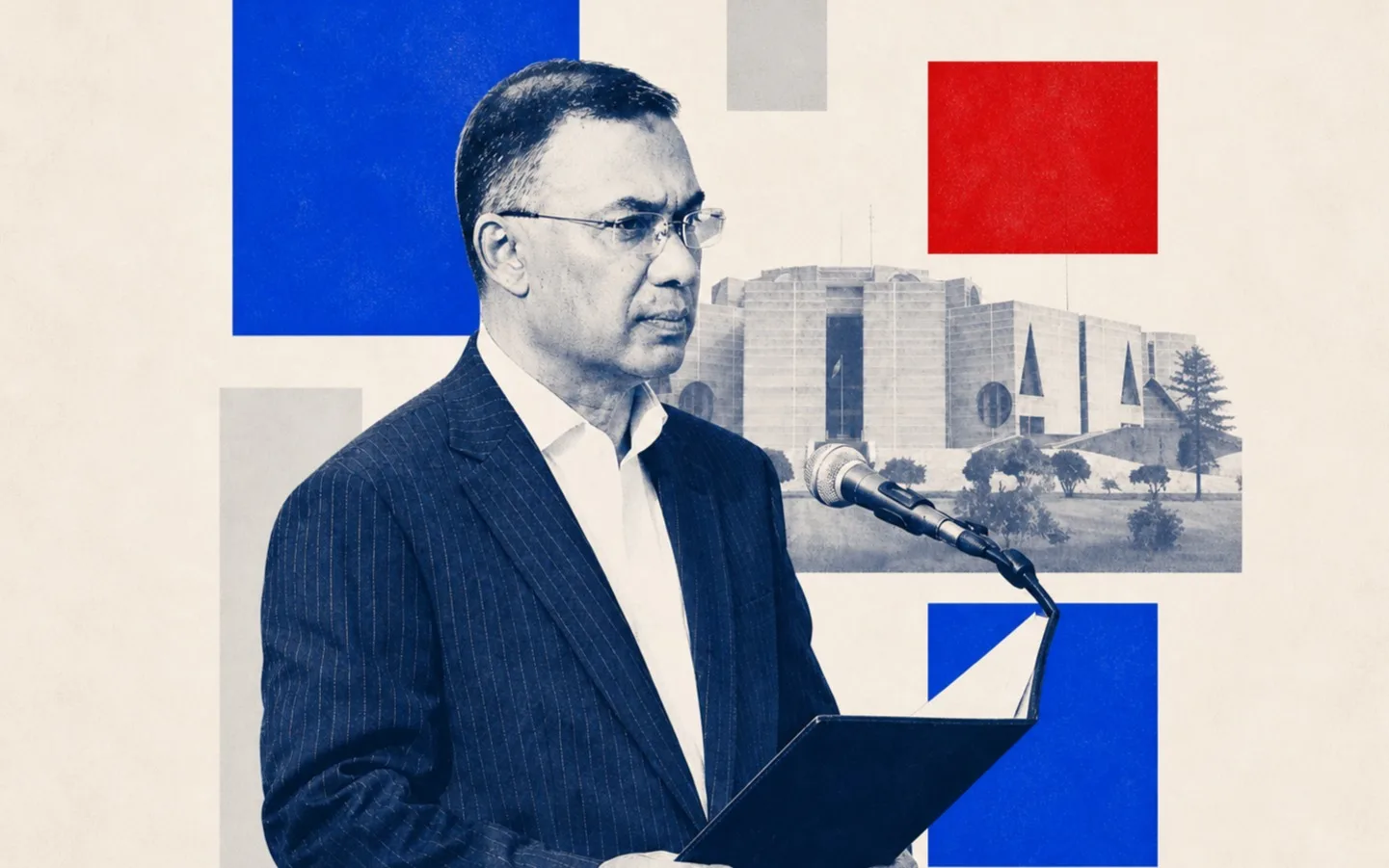
The BNP government came to power with an ambitious 180-day action plan, prioritising 11 key sectors. Now that the six months are up, the verdict is in on how far they have fared in carrying out these election pledges.
In a Nutshell
According to the report published on the PMO Bangladesh official Facebook page.
● The Family Card rollout has begun nationwide, with 70,861 cards distributed by June 2026; eligible women receive Tk2,500 per month.
● Farmer Card is in its pre-pilot stage, reaching 20,832 farmers, while Tk5.12 crore in incentives has been directly transferred to 20,483 beneficiaries.
● Youth employment financing is nearing its initial target: 9,450 trained young people received Tk94.6 crore in loans, against a Tk100 crore target for 10,000 people.
● A Tk500 crore startup fund has been announced, offering collateral-free loans of up to Tk1 crore at 4% interest.
● Malaysia is set to reopen its labour market to Bangladeshi workers from late August, with Bangladesh selecting recruiting agencies to curb irregularities.
● Agricultural measures include expanded farmer databases, new crop varieties, and loan waivers of up to Tk10,000, including interest, for eligible farmers.
● The government has launched a major tree-planting drive, targeting 25 crore trees in five years; it says 2.23 crore saplings were planted in the first 180 days.
● Healthcare expansion is underway, including recruitment plans for 100,000 health workers, 5,000 doctors, larger upazila hospitals and digital Health Cards.
● Education spending has increased sharply to Tk1.36 lakh crore, alongside the One Teacher, One Tablet programme, new digital classrooms and plans for 600 residential model institutions.
● Investment and administrative reforms are advancing, including the Invest Bangladesh Act 2026, a unified investment framework, and cost-cutting in government protocol—though major pledges such as one crore jobs, full Family Card coverage, and institutional reforms remain unfinished.
As the BNP government completes its first six months in office, Nutshell Today has reached out to three key figures to hear their perspectives on the government’s performance and priorities.
We asked them a simple question: “How do you see BNP’s first six months in government?”
Our three respondents are Saleh Shibly, Press Secretary to the Prime Minister; Asif Mahmud Sajib Bhuiyan, official spokesperson of the National Citizens Party (NCP); and Mia Golam Porwar, Secretary General of Bangladesh Jamaat-e-Islami.
Saleh Shibly:
“We are actively implementing every single clause and every single point of that election manifesto. We have made tangible progress on each point. Whether you look at the Family Card, the Farmer Card, cards for Islamic scholars, or the Sports Card—we are delivering on every single initiative.
To put it concisely, these cover the material aspects of day-to-day public life required for running a government.
Beyond that, if you look at our broader achievements and progress, I would put it this way: what a government needs most is public trust and faith in state administration and governance. Under this government led by Tarique Rahman, people have come to believe that the transformation Bangladesh aspires to achieve is truly possible under the leadership of the Honourable Prime Minister Tarique Rahman.
This restoration of public trust and confidence in the government and the Prime Minister is a major achievement.
This restoration of public trust and confidence in the government and the Prime Minister is a major achievement.
Second, restoring and establishing human dignity in both the state and society is another significant accomplishment. In the past, human dignity was nonexistent in society; a person’s political identity was all that mattered. But Tarique Rahman has firmly established that every individual is a citizen of this country and society, has a voice, and deserves respect. Tarique Rahman is now one of the common people.
When citizens navigate crowds and sit in traffic on the streets, Tarique Rahman is right there with them, moving through the same traffic without special privileges. Just as ordinary citizens wait for traffic laws to be enforced, Tarique Rahman waits too. He believes that regardless of whether one is a ruler or ruled, every citizen holds equal rights in this society.
Third, people are now living in a country free from a culture of fear. Previously, anyone could get a threatening phone call at any moment, be picked up at will, or be subjected to enforced disappearance and abduction. People no longer live under that terror. People now feel confident that custodial abuses will no longer happen in Bengal. That is another major milestone.
In conclusion, what the people of Bangladesh truly sought was a qualitative shift away from conventional politics. Under the leadership of Prime Minister Tarique Rahman, that qualitative transformation in politics has successfully begun in Bangladesh.”
Asif Mahmud Sajib Bhuiyan:
“Well, looking at BNP’s first six months across two aspects: first, the political front—the people's political aspirations regarding reforms and the state's long-term...
First, the public's political aspiration was centred on reforms. A referendum took place alongside the election, in which the people gave their mandate, but the government failed to implement it.
In fulfilling the people's political aspirations, they have utterly failed and engaged in deception.
Second, regarding what directly impacts our everyday lives—day-to-day state governance—BNP has also demonstrated complete failure. We had hoped that, at the very least, they would manage basic necessities well, starting with price controls on essential commodities, but they have completely failed there too.
Even as we speak about their six-month mark, the country is facing crises in power and gas, and skyrocketing commodity prices.
Even as we speak about their six-month mark, the country is facing crises in power and gas, and skyrocketing commodity prices.
Therefore, on both fronts, their six-month performance has been very poor. From our end, the recommendation is that BNP address these issues immediately. If necessary, they should make major structural changes within the party, the government, and the cabinet. Ultimately, if such conditions persist, they will remain extremely distressing and burdensome for the country and its people.”
Miya Golam Porwar:
“We don't see success anywhere. They have moved toward dividing the nation. They betrayed the trust of the people who stood together in the anti-fascist movement. They disregarded the referendum mandate. The Prime Minister is now denying the mandate of the very referendum they themselves called, claiming it is unconstitutional. Ministers are echoing this.
This is duplicity toward the public.
They failed to control commodity prices; there are acute power and gas crises. They shamelessly politicised appointments to autonomous government posts. Looting is rampant.
Right down to the grassroots level, under the guise of family and farmer cards, there is partisan distribution and looting of public funds through contracting, rice allocations, and relief programs.
The opposition isn't even in their focus; they are already overwhelmed merely managing their internal divisions and spoils.
As a result, corruption, politicisation, repression of dissenting voices, obstruction of rallies and processions, disruptions of Shibir's meetings on campuses during July commemoration programs, attacks, and vandalism have returned.
The very atrocities the July Uprising sought to end are recurring, and blood is being shed on campuses once again. In these six months, "morning shows the day"—they have demonstrated in six months how their five-year tenure will unfold.
The very atrocities the July Uprising sought to end are recurring, and blood is being shed on campuses once again.
There is no gas, and stoves do not burn. They are failing to explore new gas fields, and where reserves exist, there is no investment to extract them. We do not see any success. The only reason the economy maintains a pulse is that our remittance fighters abroad work tirelessly to send funds home, which barely keeps the economy alive.
The government should immediately address these issues politically by convening a session of the reform council within the ongoing parliament to implement the July Charter. Otherwise, street movements and the government's stance could push the country toward confrontation.
We do not want to go in that direction; we believe these matters should be resolved inside parliament.”