Chattogram Drowns Even When It Barely Rains
Chattogram, a city built below sea level, squeezed by tides, and stripped of its canals, is now flooding from rainfall that should barely wet the streets. Years of promises and thousands of crores later, Chattogram remains as vulnerable as ever.
In a Nutshell:
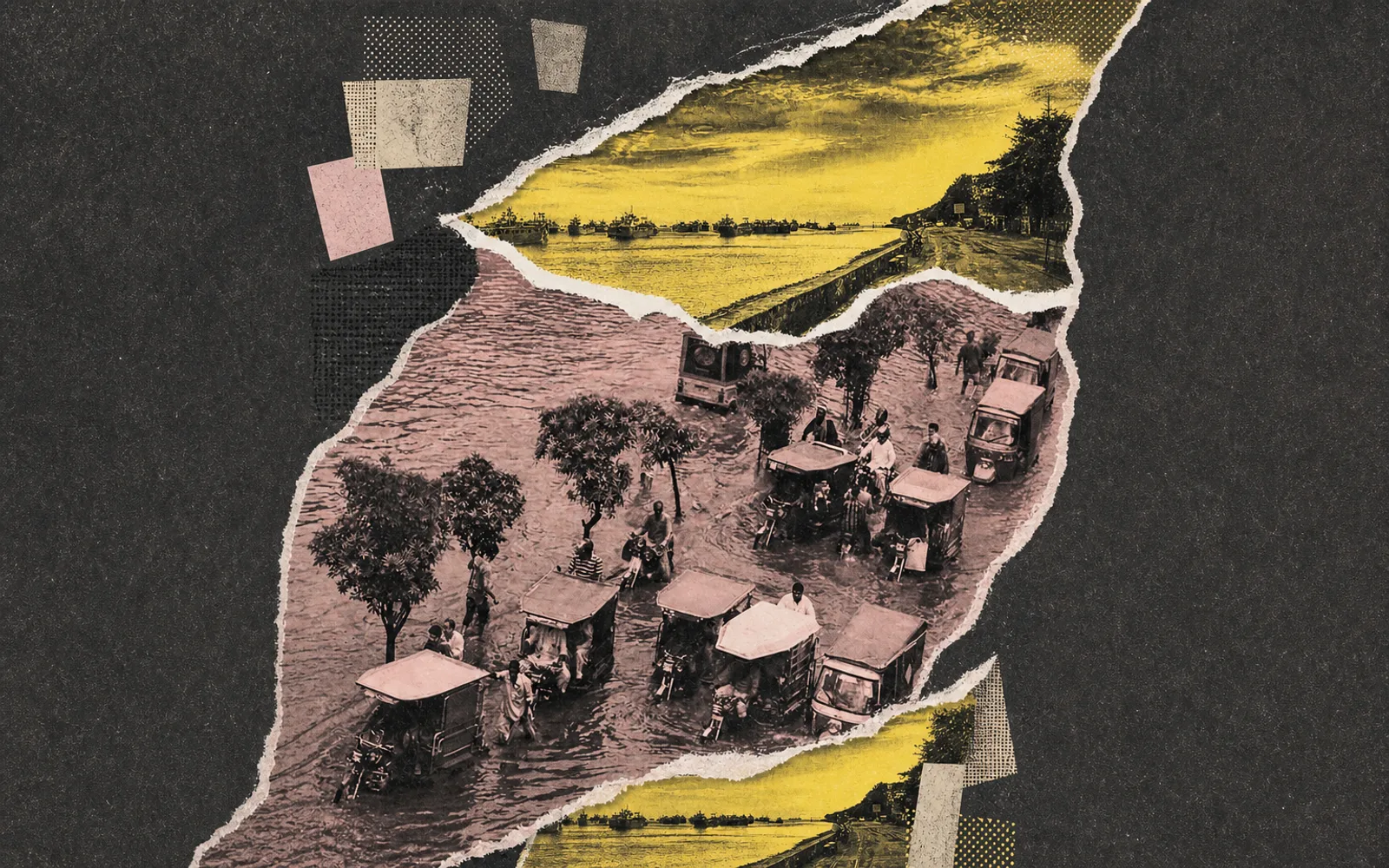
- Heavy rain and high tides flooded Chattogram on August 17, 2026, with 189mm recorded in 24 hours and 81mm falling in just three hours during morning rush, submerging Katalganj, Bakalia, Chawkbazar, New Market, Agrabad, and Halishahar, with water reaching knee to waist level, and even the Akhtaruzzaman Chowdhury Flyover was affected.
- Chattogram's canals have shrunk from 104 historically to just 57 today, due to illegal filling and encroachment.
- The Awami League government launched its flagship 36 canal project in 2017 at Tk 5,616 crore with a June 2020 deadline, but the deadline was pushed to June 2022, then June 2024, and finally June 2026, while the cost nearly doubled to Tk 8,626 crore, with three other megaprojects worth over Tk 14,000 crore combined also missing their original targets.
- The interim government launched an eight-point emergency plan in January 2025, including sluice gate construction, canal dredging, and hill cutting crackdowns, and claimed 88% project completion with waterlogging reduced by 75% by November 2025.
- When the interim government's term ended, the flagship 36 canal project stood at roughly 95% complete, with the WDB flood control project still incomplete and its deadline already extended to 2026, leaving unfinished work for the incoming BNP government.
- The current BNP government has continued these projects, with the flagship canal project confirmed 95% complete by mid 2026 and PM Tarique Rahman personally apologizing to residents in parliament.
Context
Chattogram goes underwater almost every monsoon, even from moderate rainfall, because it sits low near tidal rivers that block drainage during high tide. Decades of hill cutting, canal filling, and paving over open land have destroyed the city's natural ability to drain water. Three different governments have launched projects to fix this, spending over Tk 14,000 crore in total. Yet flooding keeps returning every year, raising hard questions about whether the money and effort are solving the root problem.
What Has Been Done by Three Governments
The Awami League government bears the heaviest blame here. It launched the flagship 36-canal project in 2017 without proper feasibility studies, commissioning a study only a year after construction had already begun under the Bangladesh Army's Engineering Construction Brigade. It then let the deadline slip three times over nearly a decade, from 2020 to 2022, then to 2024, and finally to 2026, while the cost nearly doubled from Tk 5,616 crore to Tk 8,626 crore due to what officials themselves later admitted were flawed and incomplete design specifications. Over 14 fiscal years, the City Corporation under Awami League mayors spent just Tk 324 crore total on canal excavation and drainage, an amount experts called wholly inadequate and often spent on routine work done merely to show effort rather than solve the underlying problem. The interim government acted with far more urgency and transparency. Within months of taking office, four advisers, Syeda Rizwana Hasan, Muhammad Fouzul Kabir Khan, Faruk-e-Azam, and Adilur Rahman Khan, personally visited Chattogram in January 2025, inspected canals and drains, and launched an eight-point plan with clearly divided responsibilities: district administration and police were tasked with stopping hill cutting, the City Corporation with cleansing canals and drains, CDA, WDB and the Army's 34th Engineer Construction Brigade with building sluice gates against tidal surges, and the Port Authority with dredging the Karnaphuli. The Port Authority independently funded dredging using two cutter suction dredgers and an amphibious dredger, completing 5.5 million cubic metres of work by February 2025. The government also funded proper feasibility studies for the first time, securing the Netherlands Embassy funding for a Dutch firm to study canal restoration across all 41 wards, something that had never been done rigorously before. By November 2025, it reported waterlogged spots falling from 113 in 2023 to just 21, each lasting only 2 to 4 hours instead of 8 to 9. The BNP government has largely maintained this momentum rather than starting from scratch, pushing the flagship project to 95% completion, launching a nationwide canal-excavation program, and drafting a new 25-year master plan. Following the April 2026 flooding, PM Tarique Rahman personally apologised to Chattogram’s residents in parliament, telling MPs, “for this suffering, I sincerely apologise to all citizens living in Chattogram city,” and pledged that “we are trying to resolve this problem as quickly as possible”. But execution credibility remains shaky across all three governments, since claims of progress rarely match what residents experience on the ground.
Why it matters
This crisis matters far beyond Chattogram's streets. The city is Bangladesh's main port and second-largest economic hub, so repeated flooding disrupts businesses, transport, and trade, costing residents and shopkeepers real money every monsoon. The fact that three different governments, with very different politics, have all struggled to fix this shows the problem isn't really about who's in power, but about weak coordination between government agencies and poor long-term planning. Specifically, the Chattogram Development Authority, the Chattogram Water Supply and Sewerage Authority, the Chattogram City Corporation, the Bangladesh Water Development Board, Bangladesh Railway, and the Chittagong Port Authority all manage overlapping parts of the same drainage network without a single coordinating body between them, and this communication breakdown is repeatedly cited by experts as the single biggest driver of the crisis. Climate change adds urgency, as rising sea levels are expected to worsen tidal flooding over the coming decades, meaning today's incomplete fixes may already be outdated. For any government trying to prove it can deliver results, Chattogram has become a very public test, and so far every administration has claimed progress that residents on the ground haven't fully felt, creating a serious trust gap between official numbers and daily reality.
What we think
The evidence points to a conclusion that should worry every Chattogram resident: this is not primarily a rainfall problem; it is a governance problem. The same six disconnected agencies that failed to coordinate under the Awami League continue to fail to coordinate today, regardless of who sits in power. Real progress will only be visible when the flagship 36 canal project's 2026 deadline is actually met, something that has failed three times before, and when official waterlogging statistics finally match what residents experience during an actual flood rather than contradicting it. Citizens should press specific, answerable questions rather than accept vague assurances, such as what happened to each of the interim government's eight initiatives and why LGRD State Minister Mir Shahe Alam called reports of flooding baseless in April 2026, just months before the city flooded again in July and August. Governance failure is not the whole story. Careless disposal of plastic, polythene, and bottles into drains and canals repeatedly blocks the very systems meant to carry rainwater away. PM Tarique Rahman noted that even freshly cleaned canals can be clogged again within 7–10 days as waste is dumped into them. Residents, therefore, cannot rely only on megaprojects and government action; avoiding littering, reporting illegal canal filling and joining local clean-up efforts are also essential. Until the underlying tidal geography and lost canal network are addressed through long-term measures like retention ponds, and until residents also take basic responsibility for keeping drains clear, Chattogram will likely remain vulnerable to even modest rainfall for years to come.