Should Expatriates Get to Vote in Local Government Elections?
Bangladesh Labour Party says expatriates deserve a say in local elections back home, and warns it won't accept any local poll schedule until that happens.
In a Nutshell:
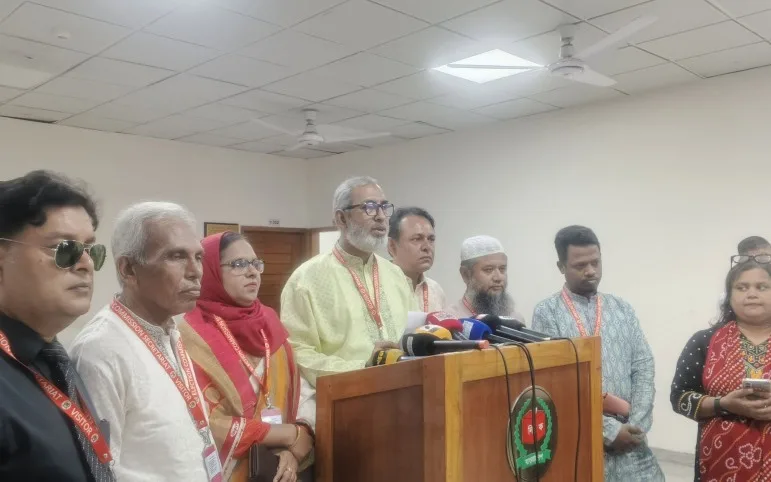
- Bangladesh Labour Party submitted a 10-point memorandum to the Chief Election Commissioner at Agargaon, demanding voting rights for expatriates in local government elections.
- The party wants the postal voting system already used for national elections extended to union parishads, upazila parishads, municipalities, city corporations and zila parishads.
- Party chairman Mustafizur Rahman Iran said expatriates' "homes, land, businesses and family interests" are tied directly to their home constituencies, making local votes personally relevant to them.
- Labour Party leaders say they will not accept any local election schedule announced before expatriate voting rights are secured.
- SUJAN central coordinator Dilip Kumar Sarkar called the demand "logical," while noting Bangladesh's dual citizenship candidacy rules are inconsistent between national and local elections.
Context
Bangladeshi expatriates gained legal voting rights back in 1972, but no working system existed until the interim government rolled out postal voting for the February 2026 national election. About 767,000 expatriates registered and voted through that system. Local government elections currently have no postal voting provision at all. The Election Commission's own draft rules exclude it, citing cost and logistics across thousands of local bodies.
Why it matters
This fight over local election access is not just about paperwork. It is about whether nearly 10 million expatriate Bangladeshis, who send tens of billions of dollars home each year, get any political voice over how their own villages and towns are run. Local bodies like union parishads decide things that hit expatriate families directly, including roads, land disputes, sanitation and welfare services. Excluding expatriates from these decisions while depending on their remittances creates what analysts call a one sided relationship, where diaspora money flows in but diaspora voice stays locked out. The demand also exposes a legal inconsistency Dilip Kumar Sarkar flagged. Dual citizens cannot even run for parliament, but face no such bar in local races, raising fairness questions about how Bangladesh treats its diaspora across different levels of government. With the EC already committed to a seven phase union parishad rollout starting November 12, any last minute demand to add postal voting could delay or reshape that plan, testing how much political pressure from smaller parties and civil society groups can move an already finalized EC rulebook.
Dilip Kumar Sarkar from SUJAN
"I think this is a logical demand," said Dilip Kumar Sarkar, SUJAN's central coordinator, on the demand for ensuring expatriate voting rights. "We see that in the national parliament, dual citizens have no opportunity to become candidates. But in local government elections, that opportunity exists. Many consider this inconsistent," he added, flagging the mismatch between national and local candidacy laws for dual citizens. "But on the question of voting rights, there is a view that yes, their voting rights should remain intact," he said. On why implementation has stalled, Sarkar said, "This is the responsibility of the Election Commission to execute. They would be able to say what obstacles they are facing in doing this". He concluded, "From our side, we believe that if the Election Commission or the government takes a sincere initiative, this is not an impossible matter. Even if it is time consuming, it is possible".
What we think
Expatriate voting in local polls could shift real power in diaspora heavy unions, but rushing it risks repeating national level problems like slow ballot returns and low registration awareness. Observe whether the EC treats this as genuine reform or political theatre, since even SUJAN admits the EC has never clearly explained its actual obstacles. The real test is whether smaller parties can shift an already finalized rulebook, or if this demand is mostly about raising the party's own profile.