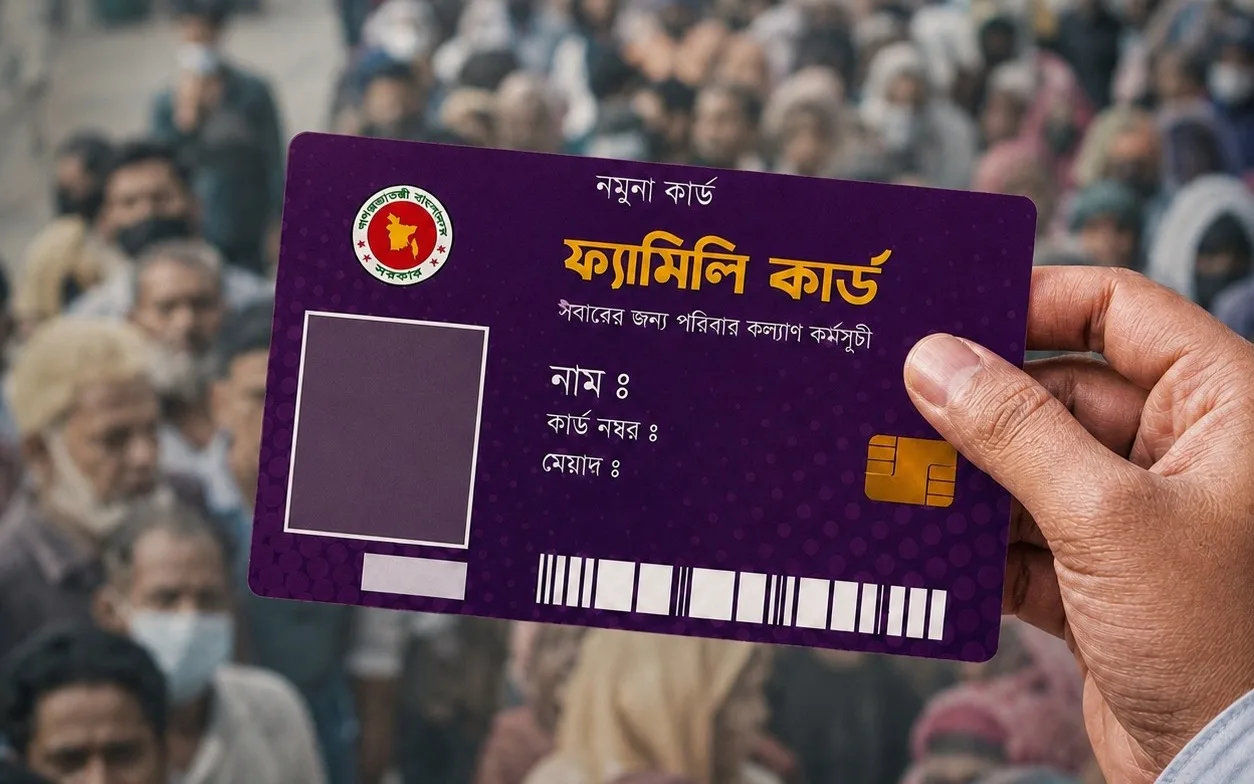
In a Nutshell:
- Official Launch: Prime Minister Tarique Rahman will officially inaugurate the flagship programme on August 16 at Ward 8 of Latifabad union in Kishoreganj Sadar upazila.
- Massive Scale: The initiative aims to support 1.6 crore underprivileged families over the next four years
- Real-Time Tracking: A newly integrated Dynamic Social Registry will continuously update household data based on changing socio-economic conditions.
- Pilot Success: Following a pilot phase that began in March across 56 areas, authorities have successfully identified and corrected early enrollment errors.
Why it matters
As a cornerstone of the current government’s social welfare agenda, the Family Card promises a robust safety net designed to grant the poorest households access to education, healthcare, and entrepreneurial support, with a Dynamic Social Registry ensuring transparency by tracking these benefits over time. However, the programme's long-term integrity relies on eliminating fraud, a challenge highlighted during the pilot phase when the Finance Ministry found that roughly 18% of verified recipients—including over 5,000 "double-dippers" already enrolled in other welfare schemes, alongside dozens of government employees and pensioners—were entirely ineligible. While authorities successfully rectified these early anomalies, particularly in Jashore and Netrokona, they are now implementing strict data cross-checking through the Cabinet and Finance Divisions to prevent future double enrollment. Moving forward, the program's actual impact on poverty reduction will be rigorously analysed through independent evaluations by the Finance Division, the Implementation Monitoring and Evaluation Division (IMED), and various universities to ensure public resources exclusively reach those who need them most.
What we think
The Family Card Programme represents a vital lifeline for millions trying to break free from the cycle of poverty. The integration of a Dynamic Social Registry is a smart, pragmatic move—continuous cross-checking protects public funds and reassures genuine beneficiaries during periods of socio-economic volatility. Opening the program to independent institutional research will also help policymakers identify structural flaws early. However, catching anomalies in a pilot phase is one thing; scaling that oversight is another. The pilot proved that the system can successfully identify ineligible beneficiaries like government employees and pensioners. The true test of this flagship initiative will be its consistency. Strict, uncompromising monitoring must remain a permanent fixture as the program officially expands this August, ensuring aid strictly reaches those who need it most.