Three Years Into Israel's Genocide, Life in Gaza Is Still About Survival
A US-brokered ceasefire has been in place since October 2025. Palestinians in Gaza are still being killed, detained and displaced, and almost every system that once made ordinary life possible has been damaged or destroyed.

Reading
THE THIRD YEAR IN FIGURES
- 74,245+ Palestinians killed, almost half of them children (Ministry of Health)
- 1,462 killed since the ceasefire took effect (Ministry of Health)
- 1.9 million of Gaza's 2.1 million people displaced by mid-2026 (UNICEF)
- ~70% of Gaza under Israeli military control or access restrictions (Euro-Med Human Rights Monitor)
- 92% of economic establishments damaged or destroyed; unemployment at 78% (UNCTAD)
- 98% of schools damaged or destroyed (UNICEF)
- 19 of 36 hospitals are functioning, none at full capacity
In the third year of Israel's genocidal war on Gaza, Palestinians are working out how to live, work, study and get medical care when nearly every industry has been destroyed by constant strikes. A US-brokered "ceasefire" has been in place since October 2025, but it exists only in name. The Israeli military continues to detain, kill and displace Palestinians
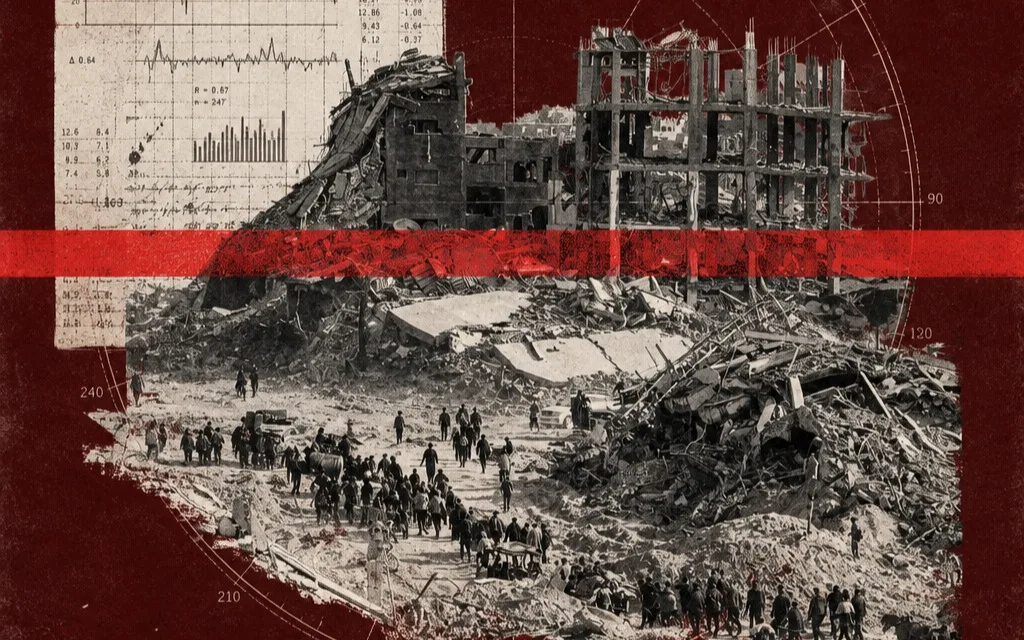
The figures from Gaza's Ministry of Health show the scale of the devastation. Around 2 million Palestinian civilians have borne the brunt of a war that multiple rights groups and prominent political scientists such as Norman Finkelstein have called a genocide. More than 74,245 Palestinians have been killed. Almost half of them are children.
The ceasefire came after President Trump pressured Israeli Prime Minister Benjamin Netanyahu to agree to it. The situation has barely improved since. According to the Ministry of Health, 1,462 more Palestinians have been killed since it took effect.
For those still here, what does life look like three years into surviving a genocide?
Survival has become the new normal
Daily life in Gaza is a struggle to survive, with access to basic services shrinking. Since early August, 91% of households have experienced moderate to high water insecurity due to damage to Gaza's water and sanitation infrastructure. There is no functioning electricity grid, so families depend on generators and fuel.
People are struggling to sleep, cook, wash, store food and water, and protect themselves from the weather. As of September 2026, 94% of Gaza's population still urgently needed shelter and basic household assistance, and 65% of households were living in tents or makeshift shelters.
Where people are allowed to live
Survival increasingly depends on where Palestinians are allowed to live and move. By mid-2026, around 1.9 million of Gaza's 2.1 million people had been displaced, many of them several times since the war began, according to UNICEF. Under the October 2025 ceasefire, the Yellow Line became a military demarcation marking areas of Israeli deployment and restricted access.
By September, Euro-Med Human Rights Monitor estimated that Israeli military control and access restrictions covered around 70% of Gaza, leaving more than two million Palestinians concentrated in less than 30% of the Strip. More than 800,000 people were displaced from Rafah during Israel's May 2024 operation, according to the UN. Almost all of the city, apart from western Mawasi Rafah, is now under Israeli control.
For the displaced, finding shelter does not mean finding somewhere they can eventually return to. As Israeli-controlled areas expand, homes and farmland remain out of reach, and families are building their lives around displacement rather than around a place they can call home.
An Economy Almost Erased
There is little economic life left to return to. UNCTAD estimated in September that 92% of Gaza's economic establishments had been damaged or destroyed since October 2023, and that unemployment had reached 78%. Gaza's GDP per capita stood at just $212 in 2025, around 17% of its 2022 level. Agriculture and industry were operating at only 6% of their 2022 output, and construction had fallen to 1%. Prices remained around 200% above pre-October 2023 levels.
With formal jobs and incomes disappearing, families increasingly rely on humanitarian assistance, debt, and informal work. Physical cash has become scarce, pushing people towards digital payments and e-wallets.
Children Losing Their Childhood
For Gaza's children, three years of war have meant three years without anything resembling a normal childhood or education. Nearly 98% of schools have been damaged or destroyed, according to UNICEF. By April, around 700,000 children aged four to 17 had missed almost three consecutive years of in-person education, and around 200,000 had no access to education at all.
Children have adapted as best they can. Palestinian adults now run informal classes in tents and shelters.
Healthcare is Still Out of Reach
All 36 hospitals in Gaza have been damaged by bombardment and strikes. At the time of the report, 19 were functioning, none at full capacity. Shortages of medicine, medical equipment, diagnostic supplies and fuel have disrupted cancer treatment, dialysis and care for chronic illness.
Around 12,400 patients had been medically evacuated since October 2023, while tens of thousands more still needed treatment unavailable inside Gaza. Overcrowding, inadequate shelter, unsafe water and poor sanitation are raising the risk of disease in a health system already struggling to respond.
The Ceasefire Has Not Ended the Devastation
The October 2025 ceasefire has done little to restore ordinary life. The fighting may have changed in scale, but the destruction, displacement and deprivation have gone so far that Palestinians are still struggling to get from one day to the next.
Surviving in Gaza means living a life in which almost every structure that once made ordinary life possible has been damaged or destroyed. Homes are no longer places families can return to. Schools no longer function as they should, and children continue their education in shelters and temporary learning spaces. Formal work is hard to find in an economy this badly devastated. Hospitals cannot operate at full capacity because of damaged infrastructure and shortages of essential supplies.