From CD shops to Vice City: Why GTA VI means more to Bangladesh than just another game
For a generation of Bangladeshis, Grand Theft Auto arrived alongside their first family computer. More than two decades later, GTA VI is bringing them back to Vice City - only now they are returning as adults.
There was a time in Bangladesh when buying a video game meant going to a CD shop.
You might have heard about it from a school friend, watched an older cousin play it, or recognised the cover from a computer store window. Then came the ritual: take the disc home, install it on the family PC, hope the machine could run it, and disappear for the afternoon.
For thousands of Bangladeshi children in the 2000s, that game was Grand Theft Auto: Vice City.
Long before Steam libraries, cloud saves and midnight digital releases, games travelled through neighbourhood computer shops, copied discs, cousins and gaming cafés. Vice City, followed by San Andreas, arrived during the formative years of PC gaming in Bangladesh, when access to new games was still uneven and discovery often depended on word of mouth.
GTA was particularly well suited to that moment. It gave young players something many earlier games did not: somewhere to go.
The missions mattered, but so did everything between them. You could steal a motorbike, drive towards the beach, look for a helicopter, get spectacularly lost or type in a cheat code and see what happened. A friend who discovered a tank spawn or an inaccessible rooftop had valuable intelligence to bring to school the next morning.
For many players, GTA was their first experience of a digital world that seemed to exist whether or not they were following the story.
That sense of freedom was especially intoxicating in Vice City. Rockstar's fictional city was an exaggerated take on Miami: palm trees, pastel hotels, sports cars, gangsters, talk radio and 1980s pop culture. None of it had much to do with Dhaka, Chattogram or Sylhet.
Somehow, it became familiar anyway.
Part of the appeal was simple escapism. A child whose daily movement was structured around school, home, traffic and family routines could spend an evening roaming wherever they wanted. GTA offered a kind of freedom that was difficult to explain to anyone who had not experienced it at the right age.
Bangladesh also did something with Vice City that says more about the game's cultural reach than sales figures ever could: it made the game speak Bangla.
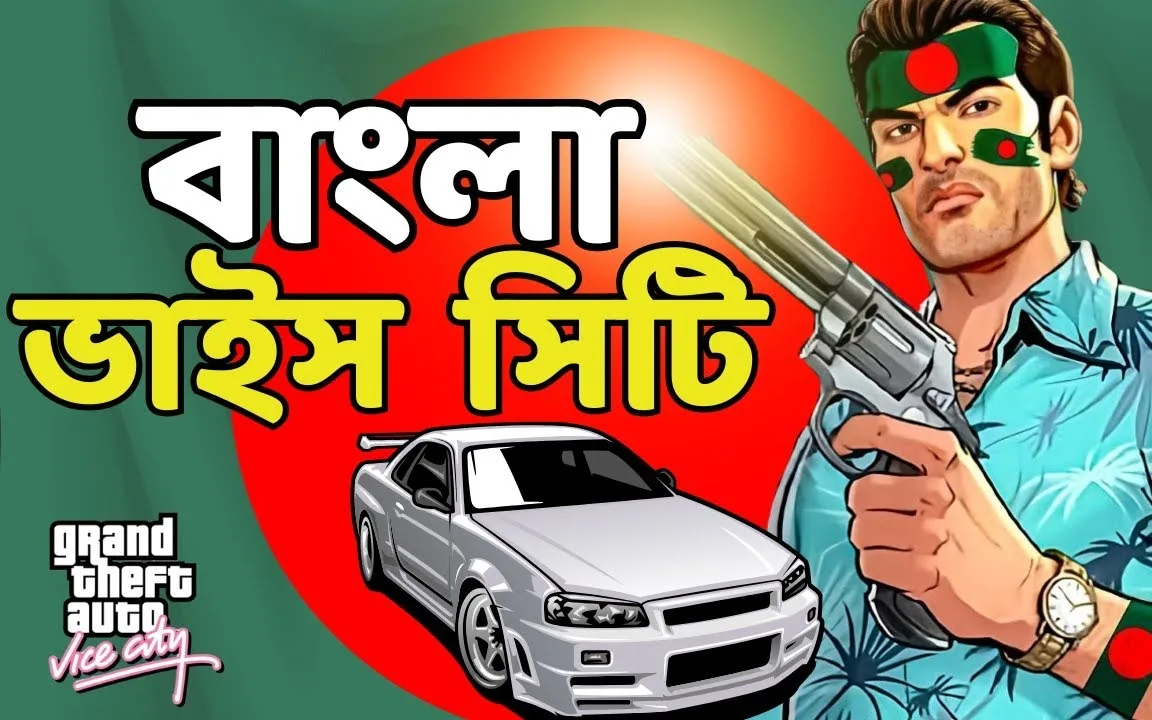
In the mid-2000s, an unofficial Bangla-dubbed version of Vice City began circulating locally. American criminals suddenly spoke in Bengali accents and dialects. Dialogue and jokes were reworked for a local audience, and copies travelled through the same CD-shop ecosystem that had spread the original game.
The result became a cult object in its own right.
What made that localisation remarkable was not that localisation itself was new, but that Bangladeshi fans created their own version without any official Bengali release from Rockstar. They adapted the dialogue, accents and humour for a local audience and turned a global blockbuster into something recognisably their own.
Then came San Andreas.
If Vice City introduced the idea of an open world, San Andreas seemed impossibly large. Three cities, countryside, deserts, aircraft, trains, bicycles, casinos, gyms and, perhaps most importantly, mysteries.
This was before every question could immediately be answered on YouTube. Rumours travelled slowly. Bigfoot was supposedly hiding somewhere in the forest. Someone's cousin knew where the fighter jet was. Cheat codes were written in notebooks or memorised.
Much of what people now remember about these games happened outside the games themselves.
GTA was technically a single-player experience, but in Bangladesh it was often social: friends taking turns at one computer, cousins watching from behind the chair, gaming cafés full of noise, school conversations about discoveries made the night before.
By the time Grand Theft Auto V arrived in 2013, the environment had changed. Broadband was becoming normal. YouTube was reshaping gaming culture. Consoles were easier to find. GTA Online turned Los Santos into a place players could keep returning to rather than a story they completed and left behind.
The players changed too.
Someone who first played Vice City as a schoolchild may now be in their thirties, with a career, a family and significantly less free time. A teenager who bought GTA V at launch is now an adult. Younger players have grown up knowing GTA through online multiplayer, streamers, memes and role-playing servers.
Few franchises have managed to remain relevant across those different versions of gaming culture.
That is the unusual position Grand Theft Auto VI occupies.
Rockstar is taking players back to Vice City, now part of the wider fictional state of Leonida, with Jason and Lucia at the centre of the story. The game is scheduled for release on November 19, 2026 on PlayStation 5 and Xbox Series X|S.
For Bangladeshi players who grew up with the original, the choice of setting gives the release an extra charge.
The new Vice City is almost absurdly detailed compared with the blocky streets that appeared on CRT monitors two decades ago. Yet the outlines are instantly recognisable: beaches, palm trees, highways, nightlife and Florida excess.
The technology has changed beyond recognition. The memory attached to the place has not.
GTA VI also arrives into a Bangladesh very different from the one that encountered Vice City. Gaming is larger, more visible and more connected to the global industry. Esports has an audience. Gaming cafés remain part of the culture. Streamers and content creators have turned games into spectator entertainment as well as something people play themselves.
Access, however, remains uneven.
The GTA games that became ubiquitous in Bangladesh spread partly because PC software circulated cheaply and informally. GTA VI launches into a console generation where the cost of a current PlayStation or Xbox can still be substantial for many households. There is no announced PC release date.
That means the game may become culturally unavoidable before it becomes personally playable.
Some people will own it on day one. Others will play at a friend's house or a gaming café. Many will experience its opening weeks through Facebook clips, YouTube videos and livestreams. PC players may simply wait.
Bangladesh has participated in global gaming culture this way for decades: sometimes as consumers, sometimes as spectators, often by finding its own route in.
This is why GTA VI feels bigger here than another blockbuster launch.
Its return closes a strange circle. The children who once bought Vice City from a CD shop are about to see the city rebuilt with technology their younger selves could scarcely have imagined. Some will boot it up after work rather than after school. Others may introduce it to younger siblings, nieces, nephews or children of their own.
And beneath all the technical ambition of Rockstar's new world will sit an older one: a computer desk, a cheap disc, friends crowded around a monitor, and the discovery that a video game could feel like somewhere you had actually been.
For Bangladesh, the road back to Vice City has taken more than twenty years. The city may be fictional, but the memories attached to it are not.