Hefazat Sets Up Committee to Unite Seven Islamic Parties
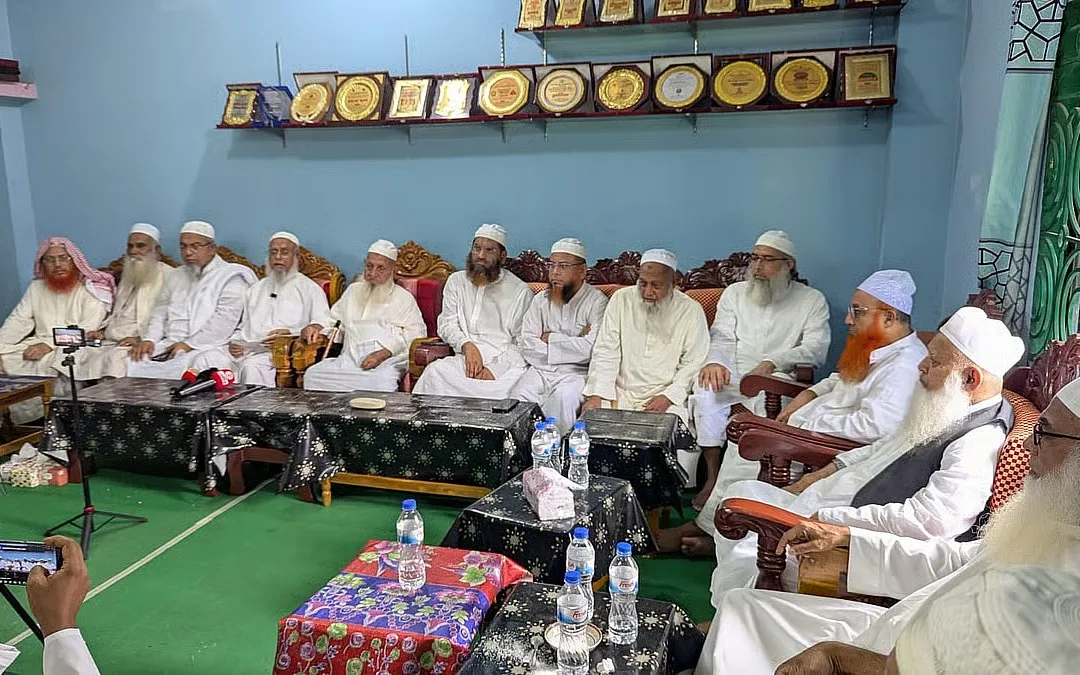
Hefazat e Islam has formed a 24-member liaison committee to work through unresolved differences among seven Qawmi-based Islamic parties and finalise a framework for their proposed unity. The parties began discussions in July and will meet again in Dhaka on October 22 after failing to settle key conditions at Sunday’s meeting in Chattogram.
Reading
In a Nutshell
- The seven-party unity process began on July 16, when Hefazat brought together Islami Andolan Bangladesh, Jamiat Ulama e Islam Bangladesh, Khelafat Majlis, Bangladesh Khilafat Majlis, Bangladesh Khilafat Andolan, Islami Oikya Jote and Bangladesh Nezame Islam Party, with the parties agreeing in principle to work towards unity.
- The parties submitted separate proposals by August 3, which a seven-member Hefazat subcommittee reviewed and combined into a draft framework. A September 27 meeting was then expected to settle the framework.
- The draft covered the alliance’s leadership structure, how leadership would change, whether members could remain in or later join other political alliances, and the nature of their joint political activities. The parties also remain divided over the extent of Hefazat’s role once a political platform is formed.
- The September 27 meeting made progress but did not resolve those differences. Hefazat has now formed a 24-member liaison committee, with its Secretary General Sajidur Rahman as convener, three representatives from each party and two additional Hefazat leaders.
- The committee’s first meeting will be held in Dhaka on October 22, when it is expected to work through the outstanding provisions and finalise the proposed unity framework.
Context
The disagreements have been visible since the parties submitted their proposals. Jamiat Ulama e Islam proposed that the new platform has no relationship with Jamaat e Islami, while Islami Andolan proposed no political understanding with other groups. Bangladesh Khilafat Andolan and Islami Oikya Jote wanted the Ahl e Sunnat wal Jamaat creed to form the ideological basis, while Bangladesh Nezame Islam argued against imposing conditions on members’ relationships with other alliances. Bangladesh Khilafat Majlis has stressed that individual parties should retain freedom over their political decisions.
That debate is tied to where the parties stood around the February election. Jamiat contested with the BNP-led alliance, while Bangladesh Khilafat Majlis, Khelafat Majlis and Bangladesh Nezame Islam were in the Jamaat-led 11-party alliance. Bangladesh Khilafat Andolan was initially part of that alliance but later contested independently, while Islami Andolan and Islami Oikya Jote also contested separately. The proposed seven-party platform is therefore bringing together parties that have recently operated through different political arrangements.
Why It Matters
The proposed unity has to reconcile parties that entered the February election through different alliances. That makes the unresolved question of whether members can maintain other alliances a central issue: it could determine how much political independence each party retains within the new platform.
The same question extends to Hefazat itself. Some parties want it to step back from political decision-making because it is a non-political organisation, leaving the seven parties to control the platform while Hefazat acts as a mediator.
What We Think
The liaison committee now has a specific job: to settle these differences between parties into an agreed framework before October 22. If the parties settle the rules on alliances, leadership, and Hefazat’s role, they will have a defined structure to move forward with. Until then, the seven-party unity remains a proposal under negotiation.