Jharkhand's Recruitment Fury Reaches the Assembly Gates
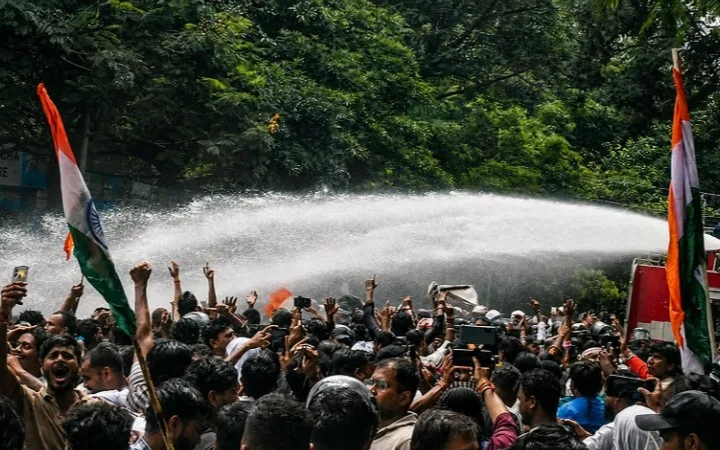
Students marched on Ranchi's Vidhan Sabha on August 10 after six rounds of talks and a partial government climbdown failed to satisfy protesters demanding a CBI probe into alleged JPSC and JSSC exam fraud.
In a Nutshell:
- The protest began on July 25, 2026, under the JPSC-JSSC Reforms Manch, after candidates alleged the 14th JPSC preliminary results were manipulated, including a viral OMR sheet showing a candidate who scored just 48/200 still qualifying.
- Alleged irregularities included late-night results with no signatures from JPSC members, an answer key revised four times, unpublished category-wise cut-offs, and suspected digital tampering of OMR scanning data during processing.
- CID raids on July 21-22 targeted JPSC's office and outsourcing agency TSR Data Processing Pvt Ltd (TDPL), a firm previously blacklisted by JSSC, leading to multiple arrests and the resignation of ex-JPSC Chairman L. Khiyangte.
- Protesters' core demands include cancellation of the 14th JPSC prelims, a CBI/ED or retired-judge probe, JPSC-JSSC structural reforms, published cut-off marks, a "not attempted" OMR option, and action against responsible officials.
- Student leader Devendra Nath Mahto's indefinite hunger strike, begun August 2, ended after Sonam Wangchuk's personal appeal, though the broader agitation continued.
- The Cockroach Janta Party (CJP), fresh off a similar national movement, extended support on August 2 and sent a delegation to Ranchi by August 7, framing itself as a backing "pressure group" rather than a political claimant.
- A CID report resurfaced showing 120 of 150 questions in the 2024 JSSC-CGL paper were leaked, undercutting an earlier official "clean chit," just as protests peaked.
- Congress and BJP both separately voiced support, with BJP MLAs protesting outside the Assembly on August 6 and AJSU MLA Nirmal Mahto demanding President's Rule.
- Six rounds of government talks failed to resolve the standoff. By August 9 the state claimed to have met 98% of demands, offering to cancel the 14th JPSC exam, an ED probe, fast-track courts, and an expert reform panel, but rejected a CBI probe into JSSC-CGL.
- Three JPSC members, Ajeeta Bhattacharya, Anima Hansda and Jamal Ahmad, resigned on August 9 amid the pressure.
- Students rejected the government's offer as insufficient and proceeded with the "Vidhan Sabha Gherao" on August 10, breaking barricades to march toward the Assembly as prohibitory orders and heavy security were enforced.
Why it matters
This protest has evolved from a narrow grievance over one exam into a referendum on institutional trust in Jharkhand's entire recruitment apparatus, exposing a pattern of alleged fraud, cover-ups, and outsourcing failures that predates the current government. The scale of political mobilization, spanning the ruling JMM-Congress alliance, opposition BJP, AJSU, and now an outside pressure group in CJP, signals that youth unemployment and exam integrity have become a potent cross-partisan flashpoint capable of destabilizing state governments, echoing similar paper-leak crises in Bihar, UP, and elsewhere in India. For Chief Minister Hemant Soren, the resignations of JPSC members and the CID's own findings undercut the government's earlier claims of clean processes, creating a credibility problem that could affect the JMM-Congress alliance's standing ahead of future elections. The involvement of national figures like Sonam Wangchuk and CJP also signals that local recruitment scandals increasingly attract national attention and networked solidarity, raising the political cost of inaction for state governments nationwide.
What we think
The Soren administration faces a genuine trade-off between conceding a CBI probe, which risks appearing to admit deep institutional rot and inviting central government scrutiny into a state it controls, and continuing to resist it, which risks prolonging unrest and eroding public trust further. Offering an Enforcement Directorate probe instead of CBI for JSSC-CGL, while cancelling the 14th JPSC exam, is a calculated middle path, but student leaders' rejection of the "98% demands met" framing shows this partial concession has not defused the core distrust issue. The government should weigh whether structural reforms, including the proposed IIT-ISM/IIM/XLRI expert panel and a retired-judge committee, can be implemented credibly and swiftly enough to outpace further mobilization, since delayed or diluted reforms historically reignite such movements. It must also account for reputational risk from allowing outsourcing agencies like TDPL, despite prior blacklisting, to retain sensitive contracts, since this operational failure is now central to public anger and could recur without procurement reform. Finally, with external actors like CJP embedding themselves in the movement, Jharkhand's leadership should consider that continued stonewalling could nationalize a state-specific issue, inviting sustained opposition and civil-society pressure well beyond the exam calendar itself.