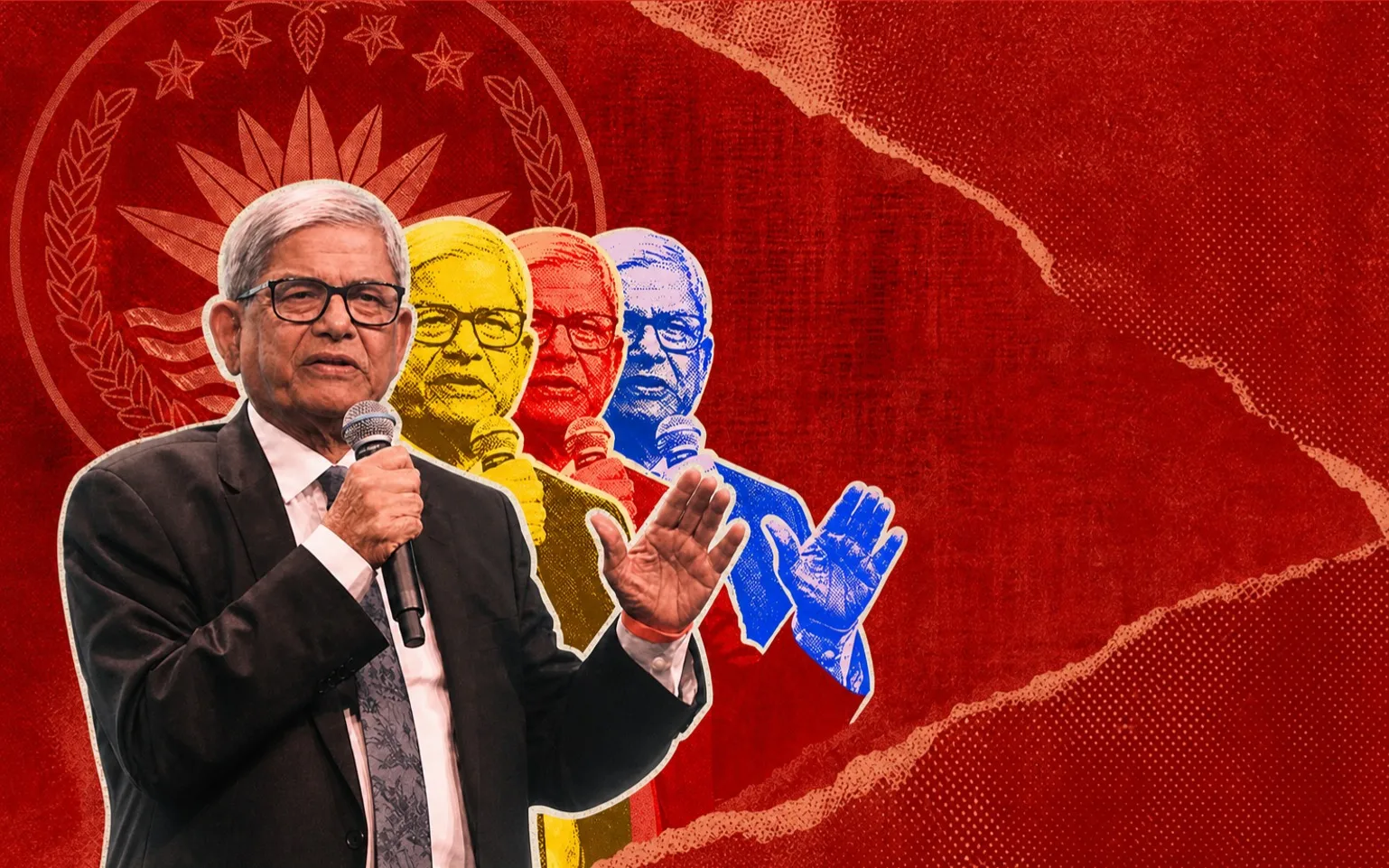
There are a couple of videos of Mirza Fakhrul Islam Alamgir from the final days before Bangladesh’s 2018 election that I have returned to many times.
I remember two versions circulating then. But one image has stayed with me: Fakhrul looking into the camera, his voice hoarse, almost broken, asking his fellow citizens to go out and vote. There is nothing particularly sophisticated about the production. No soaring music. No carefully manufactured presidential lighting. Just an ageing opposition politician talking about something that should have been utterly ordinary in a democracy—the act of walking into a polling station and marking a ballot.
Except there was very little that felt ordinary about voting in Bangladesh by then.
The December 2018 election would become widely known as the “midnight election”, after allegations that ballot boxes had been stuffed before polling formally began. Transparency International Bangladesh found irregularities in 47 of the 50 constituencies it observed , including reports of ballots being stamped the previous night in 33. Human Rights Watch documented mass arrests of opposition activists, attacks on candidates and intimidation of voters. The government rejected accusations that the election had been rigged. The official result gave the Awami League-led alliance 288 of 298 seats contested.
So when Fakhrul asked people to vote, the poignancy came partly from the circumstances. He was asking citizens to believe in an institution whose credibility had already been hollowed out.
By then, the appeal itself had become difficult to separate from the circumstances around it. Opposition activists were being arrested, candidates attacked, polling agents pushed out, and the result seemed increasingly predetermined. What, then, did it mean to keep asking people to go to the polls?
Because democracy, in the end, depends upon people behaving as though democracy remains possible.
That, at least, is what I heard in Fakhrul’s voice.
That December, he was campaigning, often in an emotion-choked voice, urging supporters not to surrender to fear or arrest and to remain in the electoral contest. He kept insisting that people should vote. It would have been much easier to perform outrage. Anger is plentiful in Bangladeshi politics. What was more unusual was the appeal's stubbornness: go anyway.
Part of the burden had fallen on Fakhrul because so much of the BNP’s senior leadership had been removed from the public arena. Khaleda Zia was in prison. Tarique Rahman was in London, where he had been in exile since 2008. Even his voice had effectively been removed from Bangladeshi media: a 2015 High Court order prohibited the publication or broadcast of his speeches and statements, a restriction that remained until August 2024.
Fakhrul, therefore, became something more than a party secretary general. He became the daily voice of an opposition whose most powerful figures were either incarcerated or abroad.
In 1971, he was a young political activist back in Thakurgaon. In the first weeks of the war, he helped organise local resistance before crossing into India, where he and others helped set up youth camps and recruit young men for military training. Fakhrul has described their role less in terms of battlefield command than the quieter work of organisation: gathering young men, moving them toward the border, connecting them to training, keeping the machinery of resistance going.
That is why, when he invoked 1971 in the 2018 video and spoke of another struggle—this time for democracy—it did not strike me as a politician reaching for borrowed history. He was reaching back into his own life.
And this is where my own distance from the story begins to collapse.
Fakhrul and I come from the same place.
Thakurgaon is not merely the constituency attached to his name on television screens. It is where I was born and grew up. Fakhrul attended Thakurgaon Government Boys’ High School. Generations later, so did I.
Then there is one of those family stories that means little to the historical record but changes how history feels when you grow up with it. Fakhrul’s father, Mirza Ruhul Amin, was known locally as Chokha Mia. I grew up hearing that my paternal grandfather and Chokha Mia had gone to school together. My grandfather lived in the hostel, and the stories handed down to us involved none of the things that later make biographies: ministries, elections, parties. They involved boys, food, mischief—Chokha Mia appearing at the hostel and eating with them, sometimes helping himself rather enthusiastically to whatever was available.
Before politicians become photographs on banners, they belong to somebody’s town. Somebody remembers them as boys.
Perhaps that familiarity has shaped the way I see Fakhrul. But familiarity is not evidence, and admiration is not evidence either. He is not above politics. He has spent decades as a fiercely partisan BNP politician, defended his party through its own contradictions, and made arguments that should be subjected to the same scrutiny as anyone else’s.
What has always interested me instead is something smaller: his temperament.
He rarely seems particularly interested in making himself the story.
That sounds insignificant until you spend enough time listening to politicians. Politics is populated by people with an astonishing capacity to narrate themselves. Every movement becomes something they led, every victory something they delivered, every disagreement an attack on them. Occasionally you encounter politicians who begin referring to themselves in the third person, which may be the terminal stage of the disease.
Fakhrul’s public language has generally been different. Listen long enough and the recurring nouns are the country, democracy, rights, the party, the people. There is simply less self-mythologising than Bangladeshi politics has trained us to expect.
It was a useful quality during the years when the BNP appeared perpetually close to breaking.
By Fakhrul’s own count, 117 cases were filed against him during fifteen years of Awami League rule. He has said he was imprisoned eleven times and spent roughly three and a half years in jail. His 2026 election affidavit listed 50 cases in its legal-history section; he had been discharged in 47 and acquitted in the remaining three.
Nor has his public career been defined by the familiar personal-corruption scandal. That is not proof of purity—nothing is. His affidavit declared annual income of about Tk 1.18 million and assets of roughly Tk 15.3 million in his own name, while his wife declared substantially more . Fakhrul himself challenged voters in Thakurgaon during the campaign to identify an occasion on which he had improperly taken money. It was a politician’s claim, not independent evidence. Still, after decades near the centre of Bangladeshi politics, the distinction is worth noticing.
So is another habit: his repeated insistence that Bangladesh belongs equally to people who do not look, worship or vote alike.
This should be banal. It should be the minimum price of admission to democratic politics. Yet in a country where political identity has repeatedly been built by deciding who belongs more than somebody else, the minimum matters. Fakhrul has repeatedly spoken of equal citizenship for religious minorities and ethnic communities, including during this year’s campaign.
Which helps explain the peculiar sadness surrounding him now.
Fakhrul is not disappearing. Quite the opposite. As I write this on August 20 afternoon, members of Parliament are voting to choose Bangladesh’s next president. Fakhrul is the ruling BNP’s candidate, and with the party commanding a decisive parliamentary majority, his victory is regarded as virtually certain. Voting began at 2 p.m. and is due to end at 5.
Yet his nomination has already meant leaving the political role through which most Bangladeshis came to know him. He has resigned as BNP secretary general and from its Standing Committee.
There is an irony to the timing.
For most of Fakhrul’s years at the top of the BNP, he stood before microphones explaining loss: arrests, court cases, failed rallies, elections his party said could not be trusted, a chairperson in prison, an acting chairman thousands of miles away. His job was to keep a political organisation together while its supporters wondered whether it would ever return to power.
Then Hasina fell in August 2024. Tarique Rahman returned from exile. The BNP won the 2026 election and formed the government. Fakhrul finally saw the party he had spent so many bleak years holding together return to office.
And almost immediately, he began leaving partisan politics.
During the election campaign, the seventy-eight-year-old had already suggested that this would be his final parliamentary contest. The presidency, then, feels less like another rung on a political ladder than an exit with honours.
He deserves the rest.
But I understand why some BNP supporters experience his departure almost as bereavement. They are not mourning a man who has disappeared. They are mourning the absence of a particular voice inside the party—the one that, more often than not, lowered the temperature.
Whether the BNP retains that instinct without him is a more interesting question than who inherits his title.
Bangladesh has just lived through a political order in which institutions increasingly became extensions of one party and ultimately one leader. The lesson cannot simply be that the wrong people accumulated too much power. It has to be that nobody should.
Fakhrul, at his best, has seemed to understand that distinction.
The presidency will test it. If elected, he will no longer represent merely the people who voted BNP. He will become head of a state containing people who admire his party, people who despise it and millions who belong to neither camp.
And here, finally, I have to put down the armour that comes with being a journalist.
I remember that video from 2018—the broken voice asking people to vote at a moment when believing in the vote required an extraordinary act of faith. I remember the stories about Chokha Mia and my grandfather, boys sharing food in a school hostel before any of them knew what history would make of their families.
And I think about a man from our small northern district, educated in the same school I attended, who spent some of the darkest years of Bangladesh’s democratic life insisting, sometimes almost implausibly, that democracy was still worth fighting for.
The journalist in me will keep watching what he does next.
But the boy from Thakurgaon can be happy.