Moody’s Changes Bangladesh’s Outlook to Stable
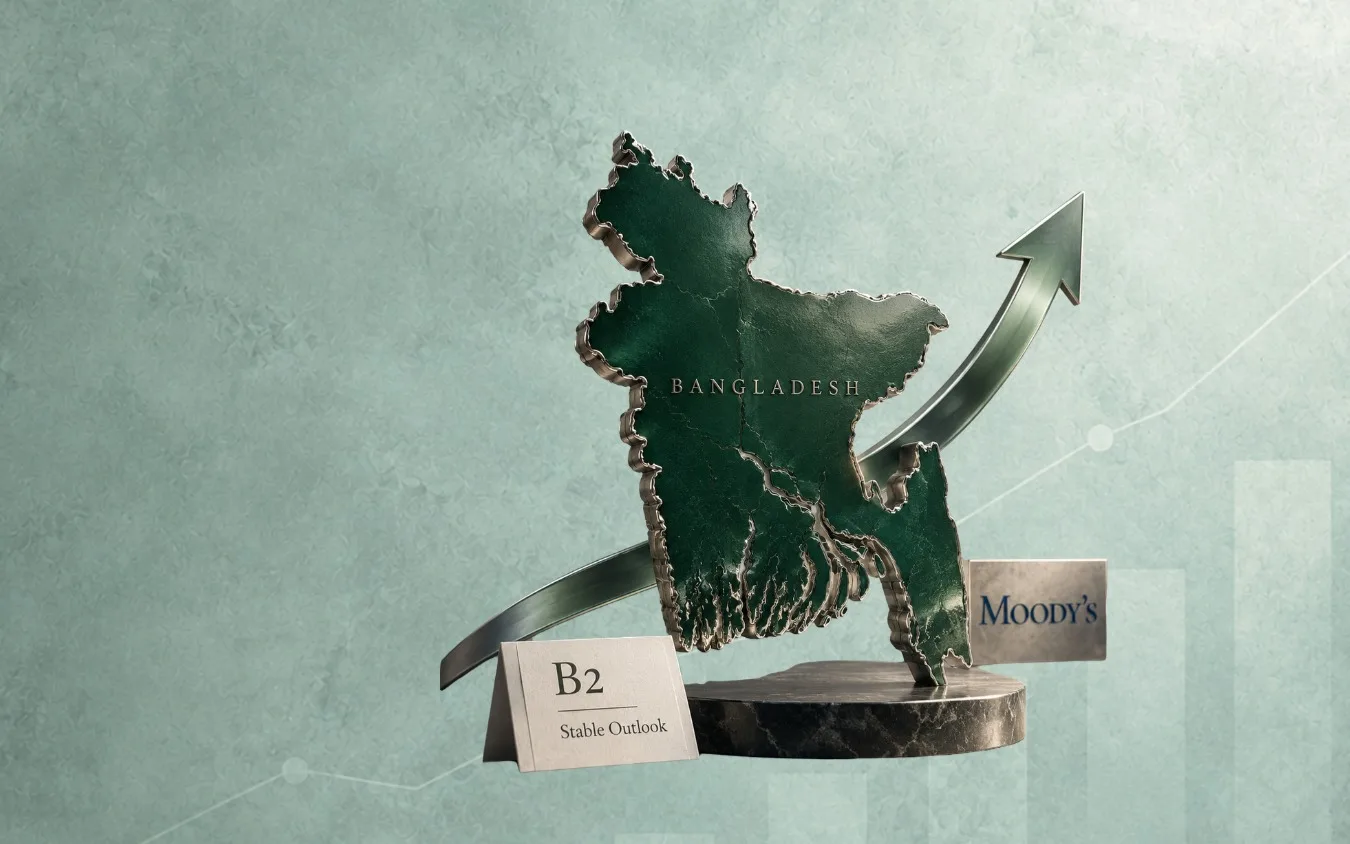
Moody’s Ratings has changed Bangladesh’s sovereign outlook from negative to stable, while keeping the country’s long-term credit rating at B2. The agency cited stronger foreign-exchange reserves, higher remittance inflows and reduced political uncertainty, while continuing to flag weaknesses in the banking sector and government revenue system.
In a Nutshell:
- Moody’s has changed Bangladesh’s sovereign outlook from negative to stable, but its B2 credit rating is still the same.
- The agency linked the change to stronger foreign-exchange reserves, record remittance inflows and a more flexible exchange-rate system.
- Bangladesh’s foreign-exchange reserves reached around $32.9 billion by mid-2026, compared with about $21.4 billion at the end of 2024.
- Moody’s expects economic growth to gradually recover, reaching 4.3% in FY2027, although inflation is expected to remain high in the near term.
- Yet major risks remain, particularly weak banks, low government revenue, debt affordability and energy-supply problems.
Context
Yet major risks remain, particularly weak banks, low government revenue, debt affordability and energy-supply problems. Moody’s is an international credit-rating agency that assesses how likely governments, companies and other borrowers are to meet their financial obligations. Its sovereign ratings are used by investors and lenders as an indicator of credit risk. In simple terms, how risky it may be to lend money to a country. The ratings run from Aaa, the highest level, down to C, which represents the lowest-rated obligations. Bangladesh’s B2 rating therefore is in the lower-rated category, even though its outlook has now moved from negative to stable. A stable outlook means Moody’s currently sees a relatively low likelihood of the rating changing in that period.
Why It Matters
Bangladesh has improved in areas such as reserves and remittances, but with its unchanged B2 rating, Moody’s continues to see major structural problems, particularly in the government's ability to raise revenue and the banking sector which remains a particularly serious concern, with Moody’s estimating system-wide non-performing loans at around 32.8% and potential recapitalisation needs of around 10% of GDP.
What We Think
The improvement in reserves and remittances gives the country some breathing room, while the unchanged B2 rating shows that problems have not disappeared. Thus, for Bangladesh, the more important question now is whether the improvements being recognised by Moody’s can be sustained while the banking sector, tax collection and energy vulnerabilities are addressed.