No Bars Will Hold
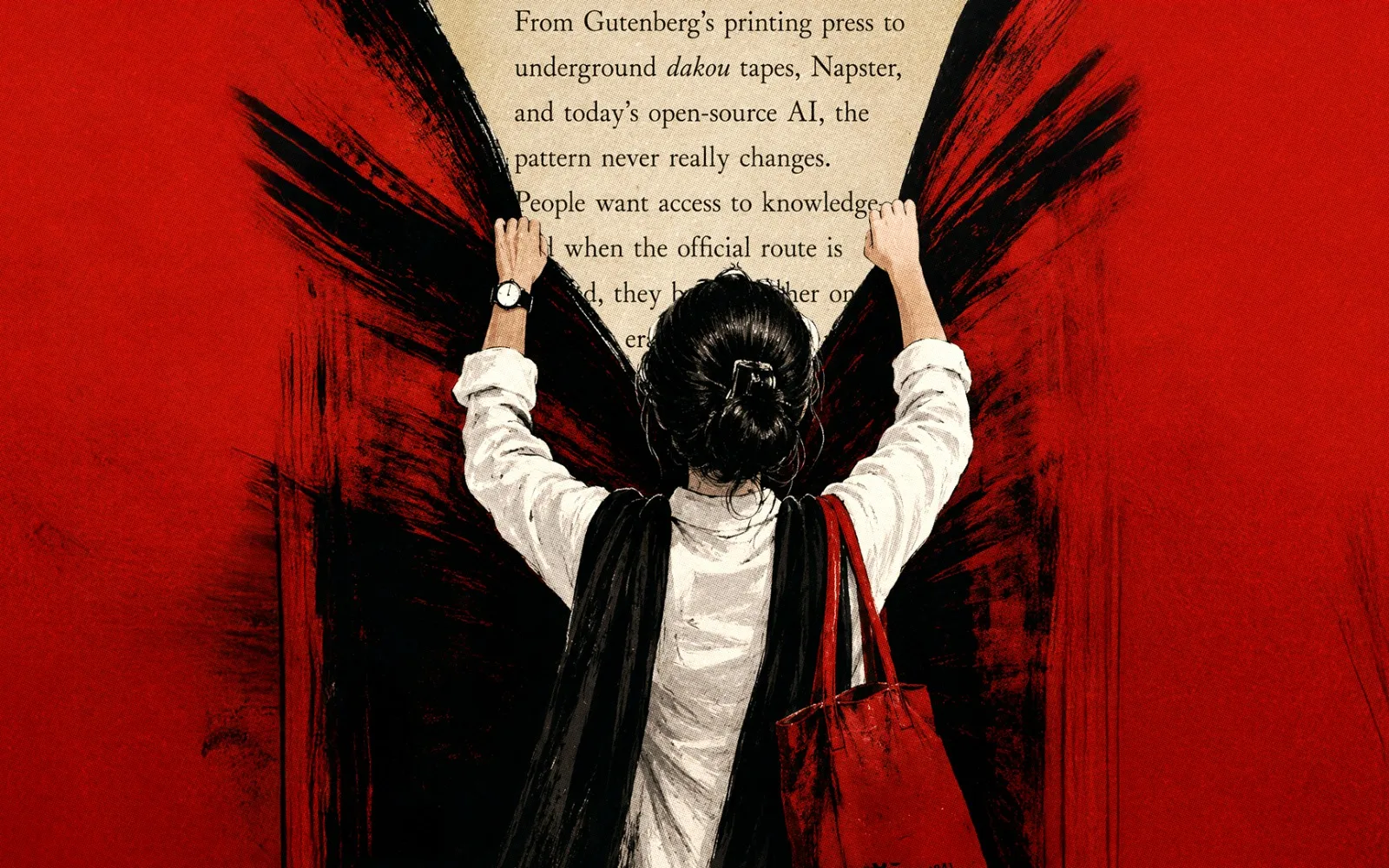
Across centuries, informal networks and open projects have repeatedly widened access to knowledge, culture and technology when formal systems kept them out of reach.
Around 1440, Johannes Gutenberg first introduced movable type for printing presses. This technology enabled cheap, mass printing, far outpacing the hand copying in monastic scriptoria. Gutenberg's press produced 180 copies of the Bible in a single run—cheap, fast, and clean. Scripture, law, and philosophy were no longer the exclusive property of the church, the court, or the academy.
The printing press made books cheaper and more disseminable. This, in turn, made restricting information difficult for the first time in history. Within decades, suppressed ideas circulated across the continent. Institutions no longer monopolised science, the arts, and the humanities. This not only upset a long-standing order of medieval scholasticism, but it also helped build the road to the Renaissance.
Gutenberg did not set out to destabilise the existing order. He set out to solve a problem of access. The destabilisation was a consequence—and in retrospect, it was inevitable. Where there is a barrier between people and the knowledge they desire, someone, somewhere, will find a way through.
Gutenberg did not set out to destabilize the existing order. He set out to solve a problem of access.
In the 1980s, surplus tape cassettes destined for plastic recycling were finding their way to China. These were "dakou" tapes, or notched tapes marked to prevent resale, containing the pop, punk and rock music sweeping the West. Post-Tiananmen (1989), the Chinese government cracked down; the cultural atmosphere became actively hostile to Western influence. Rock, punk, and alternative music had no legal path into China. And yet, dakou remained—now playing Nirvana, Metallica, even the Velvet Underground in the boomboxes of Chinese youth. It was being sold from the back of bicycles, street carts, and in flower shops, even. At its peak, an estimated 45 to 150 million tapes flowed into China annually.

An entire generation's encounter with music genres arrived not through diplomacy or commerce, but through discarded plastic. It was not offered, nor did anyone organise to receive. It was simply discovered, enjoyed, and passed on. Cultural transmission, like knowledge and information, is a force. And even when a legal barrier is constructed, its path through is inevitable.
Napster, launched in 1999 by a nineteen-year-old named Shawn Fanning, was a reflection of the impulse seen with dakou, but digital and global in scale. At its peak, roughly eighty million users were sharing music files across a peer-to-peer network. Following suits from the RIAA and, notably, Metallica, Napster met its end in 2001. Yet nothing fundamental changed. Napster was replaced rapidly by the next wave of digital piracy infrastructure. When internet access was scarce and expensive, whoever had access downloaded and passed it around. The CDs in local shops were also pirated. And when I gained access to the internet, I heavily relied on Limewire and then BitTorrent myself, to satisfy my teenage hunger for rock & roll and metal music that I could not obtain legally otherwise. Piracy was not a workaround, but the only method of procurement.
Piracy had become, across much of the developing world in the 2000s, the only viable avenue to access digital goods.
This was not an isolated experience. Piracy had become, across much of the developing world in the 2000s, the only viable avenue to access digital goods. In the software domain, the pattern was stark. Microsoft's Bill Gates acknowledged in 2007 that widespread piracy of Windows in China had, paradoxically, entrenched the platform. Users habituated to pirated software became a paying market, over time. In the early 2000s, Canonical, the company behind Ubuntu Linux, shipped free OS discs globally rather than waiting to be pirated—deliberately filling the vacuum that proprietary pricing had created across Africa and the developing world. In my undergraduate years, we were taught SPSS and SAS on older, cracked versions of the software. The classroom itself was running on piracy.
The dynamic extended into knowledge itself. Wikipedia, launched in 2001, displaced the commercial encyclopedia industry by making reference information freely available to anyone with an internet connection. Critically, the platform was designed with low-bandwidth access in mind from early on—text-only versions and zero-rated mobile partnerships brought it to users (like me) in countries like Bangladesh, where data costs made conventional web browsing in the early days of the internet prohibitive.
Khan Academy, founded in 2008, applied the same logic to education, providing free instructional content that has since reached learners across more than 190 countries. At the more legally contested end of the spectrum sits Sci-Hub, created in 2011 by Kazakhstani researcher Alexandra Elbakyan, who, as a graduate student in Kazakhstan, found herself unable to access the papers her own research depended on. By 2022, the platform hosted over eighty-five million papers and is, for much of the research community, the primary means of accessing scientific literature. It is the repository where I most often have the highest number of browser tabs open, searching for academic papers on curiosity at the time. The legal status of these three projects differs substantially. Their underlying motivations and consequences do not.
Making knowledge and tools affordable
The impulse for democratisation was not confined to the digital. In 2005, Nicholas Negroponte's One Laptop Per Child (OLPC) project attempted to build a hundred-dollar computer for children in the developing world, when at the time a typical retail price for a laptop was considerably in excess of $1,000. The execution fell short of its ambitions; they struggled to deliver a laptop at the target price of $100. I recall seeing their first model, the XO-1, in the newspaper, and being drawn to it—its distinctive rugged design, its focus on accessing Wikipedia and as an e-book reader, and a price that, at roughly 7,000 taka, seemed amazing.
If OLPC fell short, the market eventually caught up to its vision. Today, Chromebooks, closest to the vision of OLPC, are retailing in the $100–$150 range. The Raspberry Pi goes further still, delivering a fully functional computer for as little as $35, designed explicitly for education and tinkering. It is now deployed in schools and maker spaces across the developing world.
In the present moment, as a flurry of abstruse technology emerges, we are observing the widest expression of this long-standing pattern. Ollama and the broader open-source large language model ecosystem are doing to artificial intelligence what Napster did to music distribution—proving that emerging technology does not require institutional control to function.
Open source reaches beyond software
The open-source 3D printing movement has applied the same pressure to physical manufacturing—communities sharing designs freely, printing prosthetic limbs for children in developing countries who could never have afforded them otherwise.
Comma.ai, founded by George Hotz, who jailbroke the iPhone and cracked the PlayStation 3 as a teen, released OpenPilot—an open-source driver assistance system. A friend of mine who struggles with driving has fitted his Honda Civic with self-driving capabilities without additional hardware, guided only by a passionate community working to make closed technology open and accessible. This is the pattern: one breach, then a flood of contributors who make it their own.

Not every frontier has been breached. Nuclear energy, quantum computing, and space technology remain largely institutional—their complexity and safety requirements forming barriers that have held strong. And yet the impulse persists. In the 1990s, David Hahn built a makeshift nuclear reactor in his garden shed. In 2008, fourteen-year-old Taylor Wilson built a working fusion reactor in his parents' garage. The barrier has not yet yielded, but the attempts have already begun. The pattern is paused or lagging, but not gone.
The barriers that still hold
From Gutenberg to the dakou cassette to the peer-to-peer network to the open-source self-driving model, the same idea reasserts itself across every medium and every era. Information yearns to be free—people want access. And when formal channels deny it, informal ones inevitably emerge. The technologies change. The legal frameworks shift. The moral valence of any given act of appropriation or sharing can be genuinely argued or contested. But the underlying phenomena—dedicated communities forming around the project of making technology cheaper, freer, and more widely available—have always remained, and show no sign of disappearing.
It is not a feature of the digital age. It is a feature of the human one.
The digital age is barely a century old, nascent in the span of human history. Gutenberg predates it by four hundred years. The dakou generation never touched a computer. The pattern is not new—it is an ancient drive of humankind, powered by inexorable curiosity, the pull of community, and the compulsion to build, share, and contribute. The democratisation of knowledge and technology is not merely a possibility. It is an inevitability.
Masud "Mass" Hoque is a statistician whose curiosity extends beyond data driven research, into the myriads of cultures, literature, science, and the stories that shape them. His essays, reviews, and short fiction appear at Mass o Menos