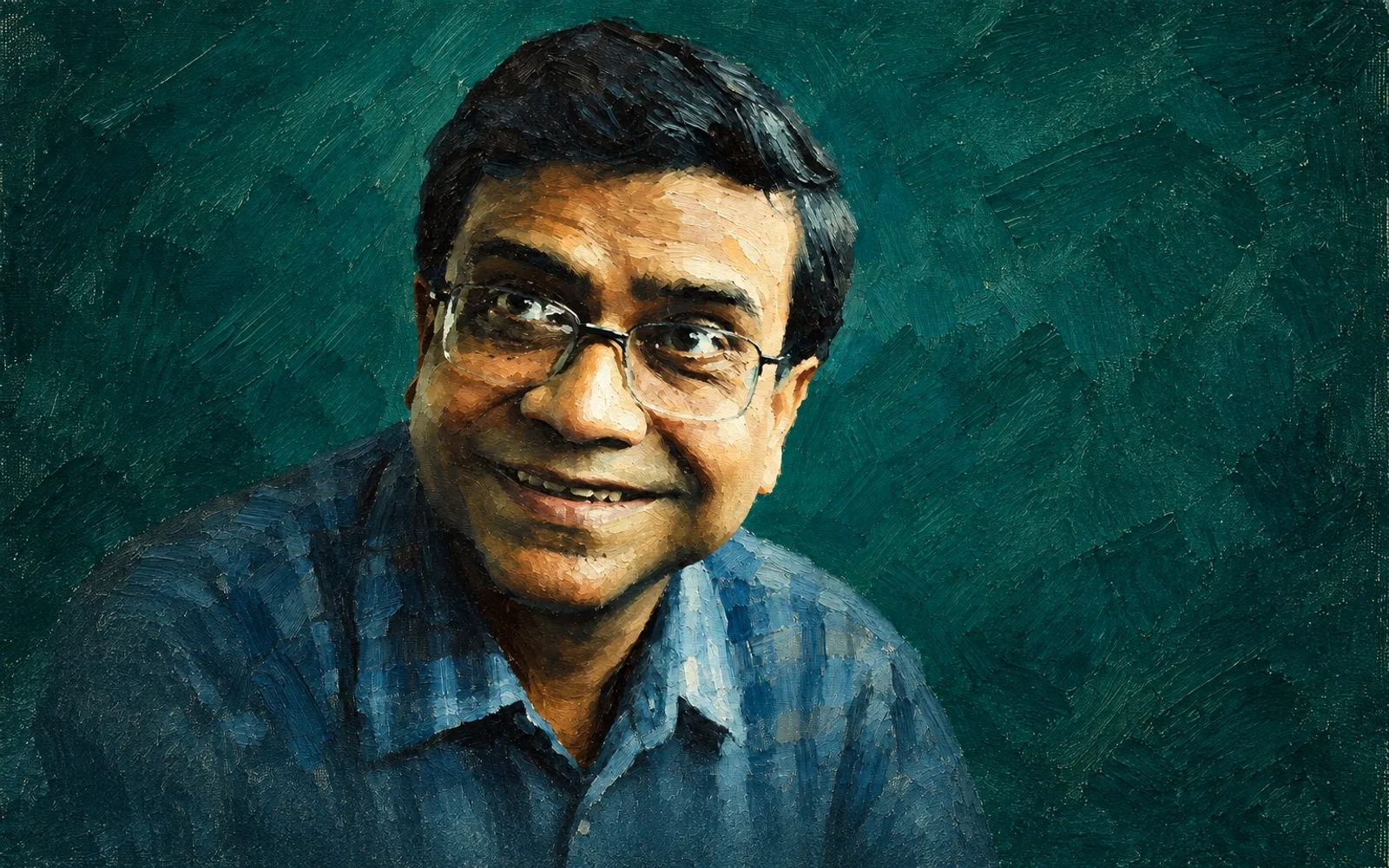
“One day in 1985, the sandal on the foot of Abdul Mojid, a young man from Lakshmi Bazar's Shyama Prosad Chowdhury Lane, lost conformity with circumstances and went phot and snapped.” The opening sentence of Shahidul Zahir's (1953–2008) debut novel, Jibon O Rajnaitik Bastobota (Life and Political Reality, 1988), appears through this minor domestic catastrophe, and then the prose does something quietly radical. Instead of moving forward, it circles back and hedges. Perhaps the sandal snapped not because of some failure related to the object. Maybe it happened because of some deeper conflict within life itself. Perhaps it was because of some friction between the post-independence political reality and the longings of the man who lived within it. The narrative begins in the mode of perhaps, and it never quite leaves it.
It would be tempting to read this simply as a distinctive style of storytelling. But there is something else at work here. I prefer to read it as Zahir's decisive philosophical move. An assertion that certainty, in the matter of history, psychology, and collective experience, is always a story we tell ourselves after the fact. The hoyto (perhaps) and the othoba (or) that thread through his prose are not verbal tics. They are the grammar of his worldview, a sustained argument that the partial view is the only honest one available to us.
The comparison most critics reach for when approaching Zahir is García Márquez, and it is reasonable to see why. Both writers traffic in events that exceed the natural, both situate their stories in specific, named communities, and both treat history as something that seeps into daily life like groundwater. But placing Zahir too comfortably under the umbrella of Latin American magical realism risks obscuring what is most unique about his project. Márquez's magic operates through declaration and narrative certainty. In One Hundred Years of Solitude (1967), Remedios the Beauty ascends bodily into heaven while folding laundry, and the prose reports it with the calm confidence of a municipal record. The impossible does not destabilise the world; it becomes part of its unquestioned reality. Márquez thus creates a kind of mythic fullness, a world that can be imagined completely even when it cannot be explained.
Zahir's strangeness works differently. In “Kothay Pabo Tare” (Where Will We Find Her, 1999), Abdul Karim tells the people of his moholla the story of his friend Shefali from Mymensingh. The moholla, as well as the reader, is drawn into a riddle by Shefali's story. Maybe she is a real person. Maybe she is merely a figment of his imagination. Perhaps, in the dullness of life, he finds some refuge in Shefali and Mymensingh. The uncertainty is not a narrative gap waiting to be filled; it is the story. Zahir does not resolve the boundary between reality and imagination; he makes the boundary itself uncertain. If Márquez makes the impossible certain, Zahir makes even the possible provisional.
The formal tradition Zahir actually belongs to is less García Márquez, more W.G. Sebald, whose narrators approach historical trauma sideways, through unreliable documents and digressive memory. Or perhaps Faulkner's Yoknapatawpha, where community knowledge is always distorted by grief and self-interest, often more emotionally true than factually reliable. Yet these comparisons too are imprecise, because Zahir invented something none of them quite had. The sustained collective narrator, the amra (we) that speaks not for one person's consciousness but for a community's shared, fragmented, perpetually uncertain knowing.
Se Ratey Purnima Chhilo (It Was Full Moon That Night, 1995) opens with the village people remembering the moon of that night. Not one person remembers. The village people remember, in aggregate, imprecisely, with the moon standing in for the event they cannot quite bring themselves to name: the night a family was killed. This amra, the moholla, the community—may be Zahir's most original formal contribution to Bengali literature, and arguably to South Asian fiction broadly.
What the amra voice captures is the original texture of how people come to know history. Not through official accounts or heroic narratives, but through rumour, partial witness, hearsay, and the slow accretion of neighbourhood conversation across decades. In “Prothom Boyan” (First Narrative, 2002), Abdur Rahman searches for a lamppost with a hurricane lantern from his childhood. But as the story progresses, it is hinted that behind his search for the lantern lies a girl named Supiya Aktar, with whom he has an unfulfilled romance. This clue stirs the moholla. They discuss it, interpret it. “Tara boley je,” Zahir narrates—they say that—perhaps he is searching only for the lantern; perhaps there was no girl; perhaps there was, but her name was not Supiya, maybe Shamima or Sultana… The story leaves these possibilities suspended, much as a community carries the past through fragments rather than certainties.
This epistemological modesty bestows Zahir's fiction its extraordinary texture. Bakhtin's concept of dialogism, the novel as a space where multiple voices and consciousnesses coexist without resolution, makes sense here. However, Zahir's amra takes it further. It is not merely a plurality of individual voices but a collective consciousness that speaks together precisely because no single member of it can speak reliably alone. The village people remember the moon because the moon is what they can agree on. The killing beneath it remains, in some essential way, beyond their ability to narrate directly.
The community as narrator
This plural epistemology is not essentially politically impersonal. In “Kanta” (The Thorn, 1995), Zahir follows three Hindu couples with the same names, Subodhchandra and Swapna, across three historical moments: the communal riots of 1964, the Liberation War of 1971, and the aftermath of the Babri Mosque demolition in 1992. Each time, the couples fall into the same neighbourhood well—the same dark water, the same kua, across thirty years. The geometry is exact and unsettling. Through this repetition, Zahir makes a political statement about the unresolved crisis surrounding minority identity and belonging in Bangladesh. Whether the story's historical pattern fully accounts for that crisis is another question; what matters here is how the argument is made. Zahir does not state the political claim directly. He makes it accumulate through repetition, recurrence, and formal symmetry.
He makes this argument through accumulation rather than declaration, which is why the story survives its own political content. You cannot quote “Kanta” in a pamphlet. But you cannot finish it without understanding that something systemic has been named.
Nearly the same indirection functions throughout Jibon O Rajnaitik Bastobota. The novel's timeline spans from Pakistan-era Lakshmibazar through the Liberation War and into post-independence Bangladesh, and its central preoccupation—the rehabilitation of those who collaborated with the Pakistani military—is rendered not through statement but through accumulation of communal circumstances. Badu Maulana, the local collaborator, returns after liberation to his familiar piety. Abdul Mojid watches. The moholla watches. Everyone understands what has happened; no one utters it directly. This is how Zahir writes about political complicity. He depicts the silence around it rather than breaking the silence himself.
Mafizuddin Mia in Se Ratey Purnima Chhilo is perhaps the most politically complex figure in Zahir's fiction. A village strongman who plants trees along Suhasini's borders, organises the community, and exploits it simultaneously, Mafizuddin is admired, resented, mourned, and never fully understood by the village people who narrate his life. The resemblance to Sheikh Mujibur Rahman—one of the organisers of Bangladesh's independence movement who became the country's undisputed leader and, eventually, an authoritarian ruler—is present in the architecture of the character rather than in any explicit declaration. Zahir neither lionises nor condemns. He shows Mafizuddin through the village's collective uncertainty, making that uncertainty itself a politically significant and unsettling choice for its time.
Zahir's fiction, thus, manifests what literature can do that other forms of writing cannot. It can hold uncertainty open. It can refuse the satisfactions of an answer. It can let the sandal strap snap, circle the moment from various probable angles, and resist the temptation to tell us what it means—because the people of Lakshmibazar, the people of Suhasini, the people of the moholla are still trying to figure that out themselves.
Saiful Islam Sazid is an English graduate and co-editor of Jonappor, a little magazine. Reach him at saifulislamszd@gmail.com.