Reading
Four journalists were among at least 10 people injured in an attack at Rajshahi University on Sunday night. Witnesses alleged that Jatiyatabadi Chhatra Dal leaders and activists attacked students and journalists outside Shaheed Ziaur Rahman Hall. Several reporters were reportedly assaulted while trying to record the presence of weapons.
The allegations are serious. So is the available evidence.
Video footage reviewed by The Daily Star reportedly identified at least seven people, including six leaders of the university’s Chhatra Dal unit. Yet the case filed by the university administration names no suspects.
Chhatra Dal central leadership formed a two-member investigation committee and expelled three RU unit leaders and activists over their alleged involvement. That response should be acknowledged.
But a party inquiry is not a criminal investigation.
A party committee can determine whether members violated organisational discipline. It cannot establish criminal liability, collect evidence under the law or impose judicial punishment. Expulsion may protect the party’s reputation. Only the justice system can protect the public.
The university has formed a five-member committee, while police say they have begun investigating. These are necessary steps. Their value will depend on whether they produce credible findings and legal consequences.
The decision to file the case against unidentified persons is particularly difficult to understand. Appearing in a video does not automatically make someone guilty. Identities must be verified, witnesses questioned and due process protected. But where footage and eyewitness accounts exist, the authorities should explain why no suspects were named.
“Unidentified” should describe a genuine lack of evidence. It should not become an administrative loophole.
The incident also raises questions about the university administration and police. The university proctor acknowledged that the authorities failed to control the situation, while Transparency International Bangladesh called for accountability for the alleged attackers and the failures of the university administration and law enforcement.tbsnews+1
Campus violence rarely begins with a single blow. It grows from an expectation that political affiliation will delay intervention, soften consequences or persuade institutions to look elsewhere.
Bangladesh has seen this pattern before. Student organisations acquire informal power, university authorities become cautious, law enforcement waits for political signals, and investigation committees arrive after the injured have reached hospital.
No political leadership can monitor every activist on every campus. The proper test is what happens afterwards.
Does the ruling party protect the accused or cooperate with investigators? Does the university identify suspects when evidence supports doing so? Do police act without waiting for political permission? Does the case lead to prosecution, or does another committee report disappear when public attention moves elsewhere?
This is where the BNP and the government have an opportunity.
While in opposition, the BNP criticised political intimidation and demanded the right to speak, organise and report without fear. Now in government, it must ensure those principles apply when scrutiny becomes inconvenient to its own supporters.
That is not a higher standard imposed on the BNP. It is the standard the BNP demanded from others.
Chhatra Dal’s disciplinary action is therefore welcome but incomplete. The organisation should provide relevant evidence to police, instruct members to cooperate with investigators and make clear that no local leader may pressure witnesses or university officials.
The government should avoid turning the case into a partisan defence exercise. This does not require a minister in Dhaka to pronounce anyone guilty. It requires the authorities to ensure an independent investigation in which political identity neither establishes guilt nor provides immunity.
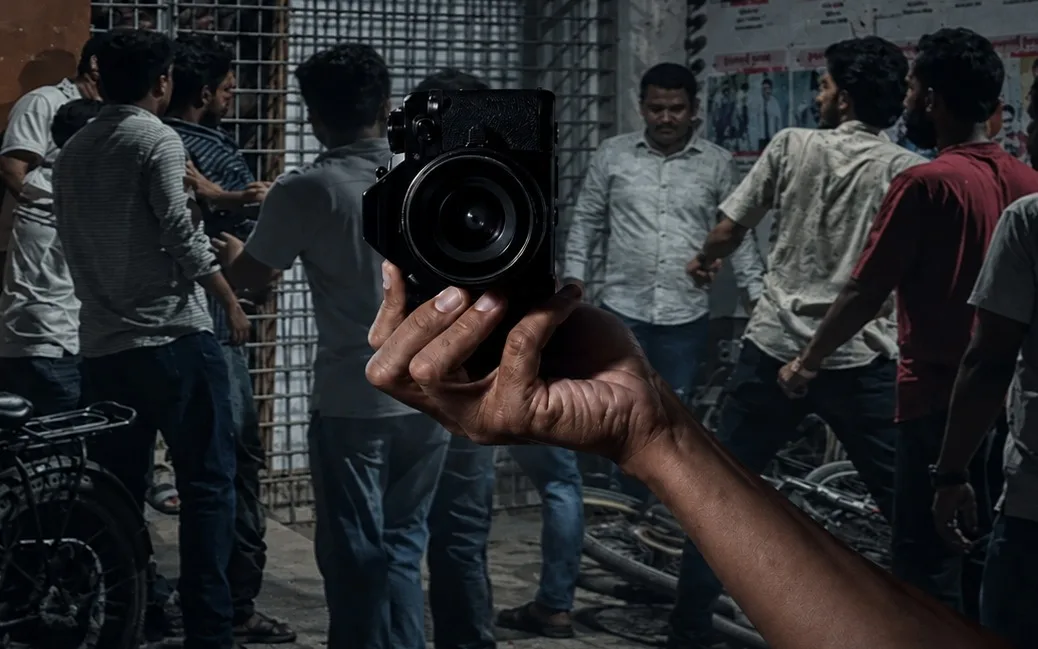
The injured journalists were documenting an incident. Their cameras did not create the confrontation, and reporting it cannot reasonably be treated as participation in it.
Journalists will sometimes record things political organisations would prefer to remain unseen: weapons, arguments, slogans and acts of violence. That discomfort is not a failure of journalism. It is often the point of journalism.
The camera is not the enemy. It merely has an inconvenient memory.
Campus journalists are especially vulnerable. They study alongside the people they cover and often lack the protection available to senior reporters. An assault can affect not only their safety, but also their education, housing and everyday life.
Protecting them requires more than statements issued after an attack. Universities need security protocols, rapid complaint mechanisms and disciplinary systems that do not depend on the political identity of the accused. Police must intervene when violence begins, not arrive later to receive a case against unnamed persons.
The authorities should preserve the footage, interview witnesses and investigate every alleged participant. The university should complete its inquiry promptly and publish its findings, subject to legitimate legal restrictions.
Those accused deserve due process. Those injured deserve more than statements. These principles can coexist.
Press freedom is often discussed through censorship, restrictive laws and government directives. But it can also be weakened by a weapon on a university campus, a police officer who withdraws and a case that recognises the crime without identifying the people allegedly visibly committing it.
The BNP and Chhatra Dal can demonstrate that the political culture has changed by allowing the law to work, including against their own members.
A party probe may determine who embarrassed the organisation. An independent investigation must determine who broke the law.