Rokeya Sultana:‘Time to put Madonna on a pink bus?’
In the first Lunch in a Nutshell interview, Ekushay Padak laureate Rokeya Sultana reflects on Bangladesh’s cultural branding problem, the need for stronger institutions and her hopes for the country’s artists.
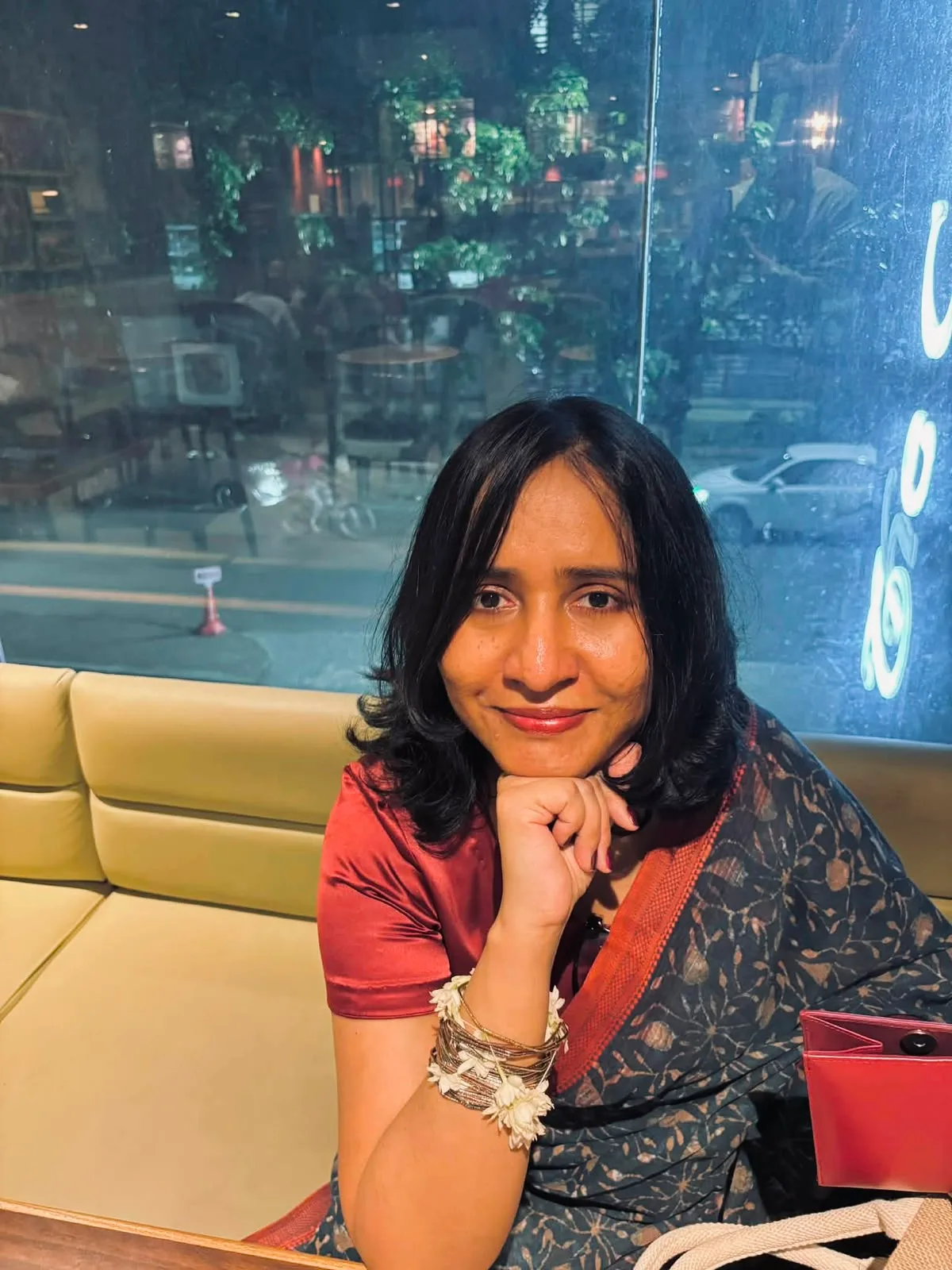
I’m pacing the floor in the lobby of Renaissance Dhaka Gulshan Hotel as I wait for Rokeya Sultana. The award-winning artist and printmaker had joked about being easily side-tracked by her art, and even though I’d double-triple confirmed her arrival, there was always that niggling worry. It dissipated soon enough when I spotted her glide in through the entrance, a sight in her all-white shalwar set, with a calligraphed long koti on top, carrying a brightly coloured patchwork tote. Arm in arm, we marched for the elevators. Our destination? The soon-to-be-relaunched Sear restaurant on the 18th floor, our exclusive hospitality partner for our very first Lunch in a Nutshell. Having spent years reading Lunch with FT interviews by Financial Times, I'd been dreaming of doing something in a similar format, and what a better way to begin than by sharing a meal with this badass artist?
Rokeya Sultana's highlights:
- Ekushey Padak, 2025 — Bangladesh's second-highest civilian honor, in the painting category.
- First Bangladeshi woman artist to win major accolades at the Asian Art Biennale and the National Art Exhibition.
- Fulbright research grant (2012) — nine-month residency at the University of Nebraska–Lincoln.
- Residency scholarship at L'Atelier Lacourière et Frélaut, Paris (2003).
- Extensive international exhibitions across Poland, Germany, Morocco, Oman, France, Iran, Egypt, Turkey, Taiwan, Nepal, Korea, Jordan, Denmark, Pakistan, India, the US, and Japan.
- Works held in major public and private collections in Bangladesh and abroad.
Sear is done up in dark walls and flooring with gold accents, sleek surfaces and modern fixtures that do double shifts as lighting and décor. One imagines the sultry glamour of the space when it comes alive in the night time, and the live band is in swing. For us, who have arrived here for lunch, the big attraction is the wraparound view of the Dhaka skyline. The esteemed artist is absorbed in the details of the panorama; where my jaundiced journalist eyes see fading nature and concrete takeover, she notices the triangle shapes of the roofs of the informal settlements along the banks of Gulshan lake, and under her influence, even I start considering if Jamal Ahmed’s acrylic dust technique would be the best way to capture the haze of pollution in the sky.
Cheersing over orange juice, I ask her about her for updates on the recent auction of her painting “Madonna on a Boat” from her iconic Madonna series through the prestigious British auction house Christie’s, in the UK. She bashfully informed me that the painting had fetched four times the expected price, selling at a whopping £3,556. “But you know, I wouldn’t even have known about it, had I been sitting in Bangladesh,” she begins, before segueing into a grievance she has voiced even prior to her receiving the Ekushay Padak in 2025, about the lack of institutional support for Bangladeshi artists. “We have to lobby for exhibitions, group tours, and we have to apply for grants and fellowships in the hopes of showing our work abroad. I was very pleased to hear about the Christie’s sale, and I’ve been fortunate enough to have participated in exhibitions abroad, and to have received some amount of international recognition, but you know, I have dreams of seeing my work up in MoMa, or the Tate [gallery], for example as do my fellow Bangladeshi artists, and if there was an organization that was engaged in finding and facilitating the exposure, to act as a curator, of sorts, or to mediate with foreign curators…Bangladesh is very rich in art and artists, but we lack the means to put our work out there.”
She is momentarily distracted by our first course, a watermelon feta salad, a delightful Machu Picchu style pyramid of watermelon cubes sitting on a balsamic reduction, with crumbled feta and red radish microgreens. As visually appealing as the confection is, it becomes a deconstruction in the act of consumption. The separate elements work less as a symphony and more like a roll call of flavours and textures that announce themselves and exit stage left with each bite. Once again, while I am trying to decide if this salad works, Rokeya Apa is lost in the colours, shapes and construction of the dish, so it is fair to say that Senior Sous Chef Towhidul Islam is playing to his target audience’s preferences.
With food in front of us, we discuss favourite cuisines, and our guest initially gives us the ‘safe’ answer of Bangali cuisine, before gathering courage and talking about how during her residency at L’Atelier Lacourière et Frélaut in Paris, France, she learned to love a good steak, cooked medium rare. “During my time there, I’d be thrilled, imagining the historical greats, like Matisse and Picasso, who did their printmaking with the atelier.” This brought us back on track with her dreams of seeing the Bangladeshi art scene get more recognition on the global stage. “In 2024, I had an exhibition at the Gandhi Memorial Centre in the USA, facilitated by the renowned singer Milia Ali, who connected me to the Centre, and as grateful as I was, I felt sad because we don’t have an equivalent institution anywhere else. You don’t have a Jashimuddin Centre, or one for Bhashani, or one named after one of our poets or leaders…even in Dhaka, they have the Alliance Francaise, or the German Cultural Centre, but we don’t have a cultural institution [that I know of] in a foreign country, where we could truly showcase our work, and provide a platform for Bangladeshi creatives – I am not just thinking about my field of visual arts – to have a meaningful cultural exchange.”
"We, the artists - in any field - need that institutional backup to showcase the beauty of Bangladeshi art in the international scene."
Our second course arrives, a pair of grilled jumbo prawn skewers each, served Vietnamese style on a glazed stone block. The taste of the succulent, sweet, sour and tangy prawns unlocks a core memory for Rokeya Apa, who recalls her Rawalpindi days. In the fierce noon heat, when the day was washed in a chrome yellow tint, corn on the cob, baked in the hot sand, with a little lemon and salt, was a treat she still recalls with fondness, along with the hunter beef her mother used to prepare, also with generous use of local limes (khatta). We spend a little time talking about favourite restaurants of the 80’s and 90’s (Royal Orchid and Kintuki FTW!) before – and I am starting to sense a theme here – she talks about how Bangladeshi cuisine deserves more global attention. Would she say then, that Bangladesh as a country needs better branding? The answer is an emphatic YES.
The main course of Pollo Assado arrives, and after a few minutes of exclamation on the geometric perfection of the char marks on the grilled vegetables accompanying the chicken, and the balance of green, yellow, red and earthy undertones in the sauce, the mood shifts. I ask her about her thoughts on AI art (she is against it), for some reason, we land on the topic of pink buses. I express my anger at the lack of civic sense that necessitates such a move in the first place; she thinks it is a positive addition, but worries for the safety of the female bus drivers and conductors. “I fear the struggle these women will have to face upon entering this male dominated arena. The other (male) drivers are definitely not going to take this ‘encroachment’ lightly.” I cannot resist mentioning that a certain mother-daughter duo has possibly founds its next canvas, and she instantly catches my reference. “I think it’s time to put Madonna on a pink bus. Let’s see what she has to say.”
Our final course is dessert, and it’s a classic cheesecake. By this time, I have come to expect the rhapsodies about the plating, and Rokeya Sultana does not disappoint. The swirling chocolate ganache garnish, and the bright pink smear of raspberry coulis have fired her imagination in 3D, and she talks about how there is “art in everything” in Bangladesh, with every form having a function. I talk about the role of art in the July Revolution, and she gets truly emotional. ‘I have lived through ’71, and never thought (or hoped) that I would see anything like it again, and then there was 2024. I still tear up when I think of mothers stepping out into the streets to support their children, and the children of other mothers.” This aspect sounds very much on-brand for Rokeya Sultana, whose work has largely centred on the role of women, and she affirms my guess when she talks about having covered the theme of mothers joining the street protests of 2024, in a recent art camp with Shilpakala.
We finish strong with a coffee for our guest while the cameras pack up, chatting away about her studios in Dhaka and in Australia, where her daughter Laura lives. “It’s been a long, arduous journey, getting here” she declares, standing up and producing a brightly coloured, quilted turban that matches her bag. “For a simple middle-class girl just trying to paint, to a newlywed determined to avail a foreign art scholarship, to a woman trying to balance motherhood with her calling…none of it has been easy. But I’ve been extremely fortunate in being able to get to live my dreams, see the world, and am so grateful for all the love I’ve received, and that’s why all of it has been worth it. My dream now is to see Bangladesh, all its beautiful art, take pride of place on the global stage.”