Same Script, Different Streets
Governments are talking about protests in a different language than they used to. After the upheavals in Nepal, Bangladesh, and Sri Lanka, are they quietly doing their homework, or are they just being extra cautious and going by the rulebook? Cases from India and France suggest the answer is a bit of both.
Reading
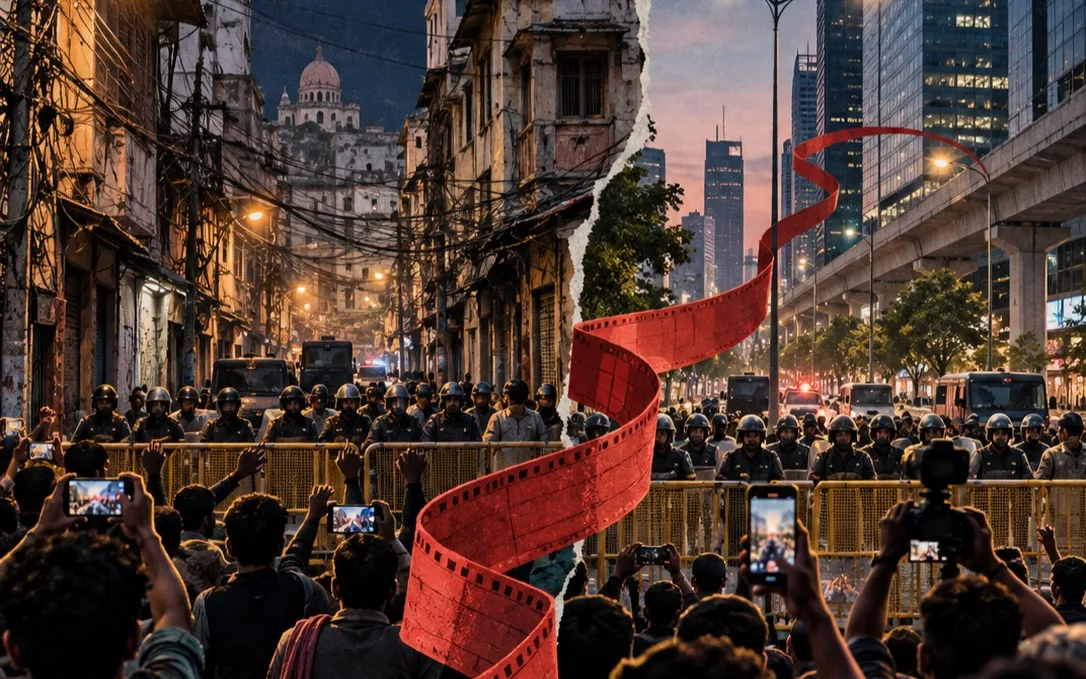
Nothing in these cases shows that governments are deliberately borrowing tactics from Kathmandu, Dhaka or Colombo. That link remains a question, not a finding. But those uprisings offer a useful lens: protests in Maharashtra, France and Bengaluru begin with everyday grievances and develop into confrontations. What matters is how the state handles a demand once the crowd arrives.
Tribal students marched from Nashik towards Mumbai for a week, demanding better food and facilities in Maharashtra’s residential ashram schools. Before setting off, they had spent 47 days protesting at Nashik’s Eidgah Maidan. They allege poor-quality meals, inadequate rations and food poisoning linked to the central kitchen system. They also want the tribal development minister to resign.
According to the students, Mumbai Police detained them before they could reach Azad Maidan or the governor’s residence. They also allege that officers entered Tilak Bhavan, the Maharashtra Congress headquarters, overnight on 4–5 October and detained some protesters without warrants. Police deny detaining anyone inside the building.
Forty-seven days of sitting still brought no answer. So they walked. The walk brought detention.
In Pune, the protesters are exam candidates. Maharashtra Public Service Commission aspirants have been demonstrating since early October over a leaked drug inspector examination paper. The commission cancelled the recruitment on 25 August, after interviewing 488 of the 506 shortlisted candidates.
The aspirants want chairman Vivek Bhimanwar to resign. He says he took office in April, after the alleged irregularities. On 5 October, the state government recommended that the governor establish a committee under Article 317 to examine the conduct of current and former commission chairpersons and members.
The grievance differs, but the frustration feels familiar. Paper leaks keep surfacing across India. These candidates, too, say they tried quieter channels first. The street becomes the last place to seek an answer.
France presents another version. School students began walking out on 21 September over teacher shortages and deteriorating buildings. Their complaints include overcrowded classrooms, missing substitute teachers, rats and inadequate cooling during the heatwave.
Al Jazeera reported on 6 October that at least 6,100 people had been detained, many of them minors. Officials reported injuries to 190 students and 715 police officers. A 15-year-old lost a hand to a stun grenade; prosecutors are investigating the circumstances. The interior minister calls the response proportionate. Rights groups, including Amnesty International, criticise the force used against minors.
These cases differ in scale, legal framework and police methods. Allegations of unlawful detention in Mumbai are not equivalent to a teenager losing a hand in France. The shared pattern is narrower: an everyday grievance, mounting mobilisation and policing that threatens to eclipse the original demand.
Official language matters, too. France’s interior minister has accused agitators of encouraging violence, while his ministry says the unrest no longer represents legitimate student demands. Maharashtra offers no clear equivalent: the available reporting does not establish that officials have portrayed the tribal students as political pawns.
Governments may have learnt to manage the street. That is not the same as learning to hear it.
In Bengaluru, the Cockroach Janta Party, founded by Abhijeet Dipke, offers another protest model. Its ‘chappal protest’ and People’s Tribunal oppose the Special Intensive Revision of electoral rolls, citing concerns about eligible voters being wrongly removed.
Reports put removals since 2025 at more than 130 million names. That figure alone does not establish wrongful deletion. The Election Commission says the exercise removes deceased, ineligible and duplicate entries, denies political manipulation and has instructed officials to accelerate registration for eligible people left out.
The tribunal has no legal standing. Its purpose is public testimony: bringing individual complaints into one room and giving affected voters a hearing.
Actor-activist Prakash Raj has encouraged participation. Dhruv Rathee is billed as a guest, alongside other activists and youth organisations. Familiar faces can carry a technical grievance to people who would never attend a union meeting or read a petition.
But attention can follow the guest rather than the grievance. Someone might arrive for a celebrity and leave without understanding why a voter’s name disappeared. The tribunal could counter that by keeping affected people, rather than prominent speakers, at its centre.
Celebrity-led mobilisation can overshadow quieter protests, including the tribal students’ march. It can also connect them: the inadequate meal, the leaked paper and the missing electoral entry become questions about whether public institutions work.
The test is simple: when the cameras leave, is the demand still on the table?
A tribal student wants a decent meal. An exam candidate wants a fair test. A French schoolchild wants a teacher. A voter wants her name protected.
None is necessarily asking the state to fall. They are asking it to work . When an ordinary demand ends in confrontation, the question is not simply how the street was managed. It is who was listening.
Nafew Sajed Joy is a Bangladeshi researcher, writer, and environmentalist with a keen interest in sustainability, development, and South Asian affairs. He can be reached at nafew.sajed@gmail.com