PM Tarique and WB President Discuss Development Support
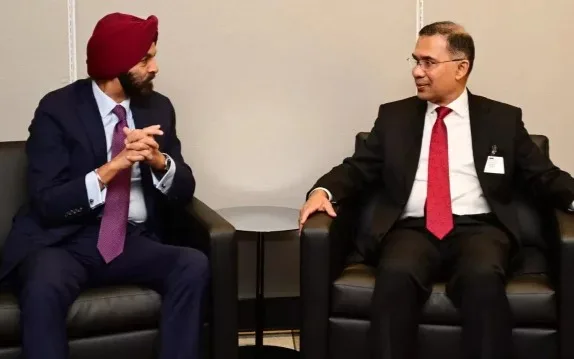
Prime Minister Tarique Rahman and World Bank Group President Ajay Banga discussed expanding World Bank support as Bangladesh seeks to protect development projects from energy and supply chain shocks, create jobs and strengthen social programmes.
In a Nutshell
- Tarique Rahman and Ajay Banga discussed Bangladesh’s development priorities, economic progress and expansion of World Bank cooperation.
- The World Bank agreed to support Bangladesh in dealing with disruptions linked to oil, gas and supply chains.
- Bangladesh will seek to expand youth entrepreneurship programmes using a model combining 50 percent grants and 50 percent concessional loans.
- The World Bank expressed support for the government’s Family Card and Farmers Card programmes.
- Bangladesh is seeking to keep development projects on track despite external economic shocks.
Context
The meeting comes as Bangladesh enters a difficult period for growth. The World Bank projects 3.9 percent GDP growth for FY26, while inflation reached 8.5 percent and the national poverty rate rose to 21.4 percent in 2025. The Bank has also identified weak private investment, low revenue mobilisation and financial sector stress as constraints on recovery.
Energy has become a more immediate pressure. The World Bank has warned that higher global energy prices can raise import costs, inflation and pressure on government finances. Bangladesh is now dealing with higher domestic fuel prices and a large subsidy burden. The government therefore discussed with the Bank how external oil and gas shocks could be managed without disrupting development projects.
The World Bank is already involved in Bangladesh’s financial sector reforms. In June, it approved $450 million to strengthen deposit protection, improve Bangladesh Bank supervision and prepare for bank restructuring.
Why It Matters
The World Bank meeting comes at a particularly awkward point in Bangladesh’s trade relationship with the US. The February reciprocal trade agreement cut the US tariff on Bangladeshi goods from 20 percent to 19 percent and created a route to zero tariff treatment for garments made with US cotton. But Washington later imposed a separate 10 percent forced labour tariff linked to raw material sourcing, taking the effective tariff on Bangladeshi garment exports to about 25.6 percent.
The problem is that Bangladesh cannot quickly replace the US garment market with other export sectors. Garments account for roughly 80 percent of exports, so diversification requires building sectors that can actually earn foreign exchange at comparable scale, not simply adding more products to the export list. That is where World Bank financing and private investment become relevant: Bangladesh needs capital to develop new export capacity while its largest existing export industry is facing higher costs in its biggest market.
What We Think
While World Bank funding is vital for diversifying Bangladesh's exports, it cannot instantly solve the immediate crisis of new US tariffs hitting the garment sector.
Since Dhaka recently made major trade concessions to Washington, its urgent priority must be fighting these duties to protect its most important market.
Ultimately, Bangladesh must balance defending its current export lifeline while using these high-level meetings to secure investments for new industries.