Teesta Is Not a Choice Between India and China
A proposed Chinese-backed restoration project could address erosion, flooding and irrigation, but it cannot resolve Bangladesh’s need for a binding water-sharing arrangement with India. Any deal must also protect communities, public finances and the river’s ecology.
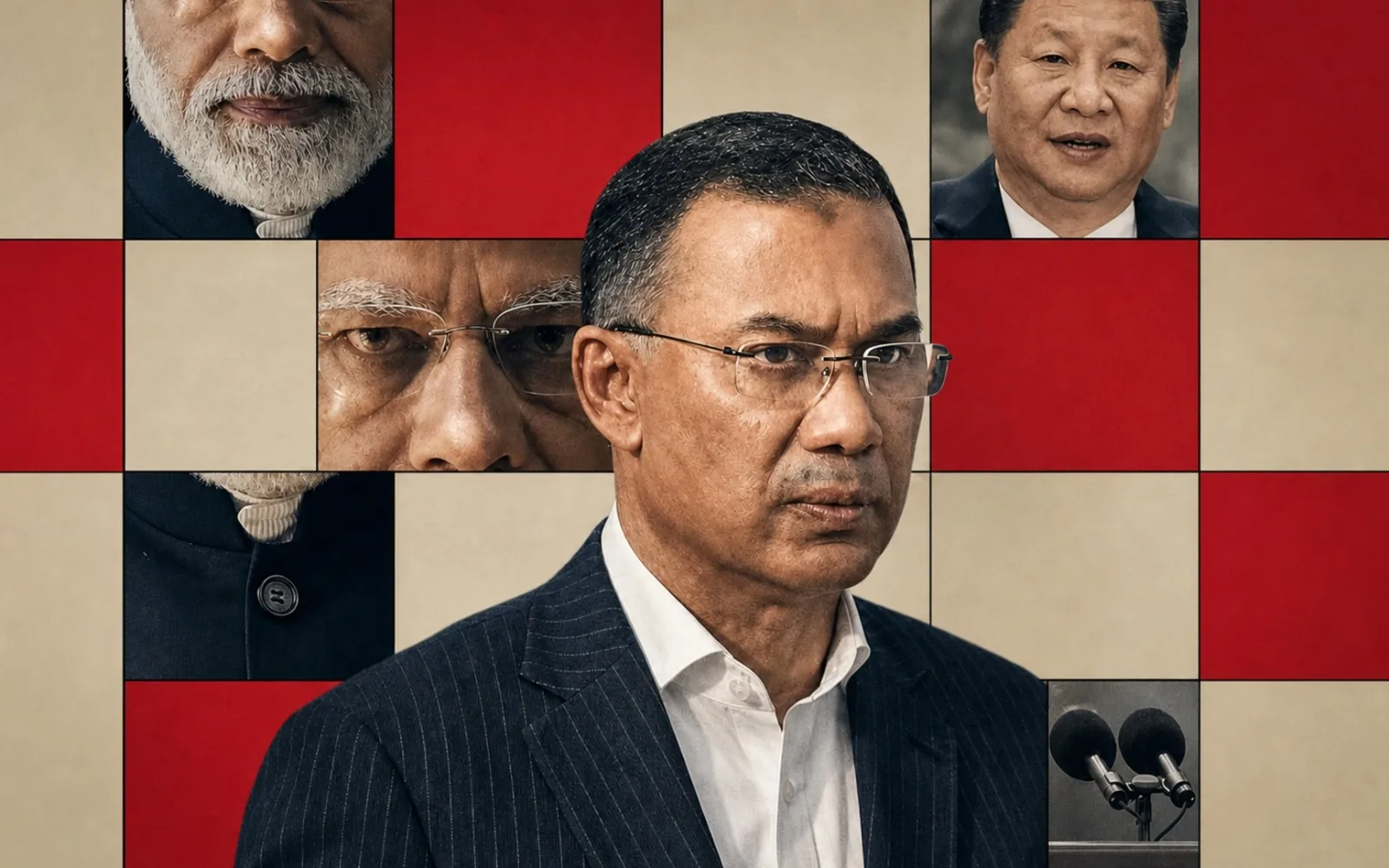
For fifteen years, Bangladesh waited to settle the Teesta question. It waited through summit declarations, Joint Rivers Commission meetings, ministerial visits and periodic assurances that an agreement was within reach. Meanwhile, in the northern districts, Teesta remained less a subject of diplomacy than a daily fact of uncertainty: too little water in the dry months, too much destructive force in the monsoon, and too little protection for those living along its banks.
The proposed agreement collapsed in 2011 because West Bengal refused to accept it. India has since maintained that its federal structure prevents New Delhi from overriding the state government. That may be constitutionally valid. But it cannot be Bangladesh’s permanent problem.
A shared river cannot remain hostage to the politics of one Indian state while millions of people downstream absorb the cost. The 1983 ad hoc arrangement allocated 39 percent of Teesta water to India and 36 percent to Bangladesh, but it never became a durable treaty. The 2011 draft agreement, reportedly based on lean-season sharing, also remained unsigned. Fifteen years later, Bangladesh’s turn toward China is therefore neither sudden nor mysterious. It is the consequence of a vacuum India allowed to endure.
China entered an empty space
China did not create Bangladesh’s Teesta crisis but a space created by Indian delay. The proposed Teesta River Comprehensive Management and Restoration Project offers what successive Indian assurances did not: visible momentum, financing and a large-scale plan for dredging, erosion control, embankments, irrigation, flood management and land reclamation.
Reports on the project have outlined dredging 140 million cubic metres of sediment and reclaiming 171 square kilometres of land along Bangladesh’s stretch of the river.
For a government under pressure to show that Teesta is not merely an election-time slogan, that matters.But Bangladesh must be precise about what China is offering—and what it is not.
Chinese engineers may help Bangladesh restore riverbanks, manage sediment, protect flood-prone communities and improve the use of available water. They may help reduce irrigation costs and make northern agriculture more resilient. But no downstream project, however ambitious, can solve the central political problem of Teesta: Bangladesh does not control the water arriving from upstream.
India’s Gajaldoba barrage, upstream hydropower development and wider Himalayan climate risks continue to shape the dry-season flow that reaches Bangladesh. The destruction of Sikkim’s Teesta-III dam in 2023 was a reminder that this is no longer only a dispute over allocation. It is also a basin-wide climate, dam-safety and disaster-management challenge.
Bangladesh needs river restoration. But it also needs water.
China may assist with the first. Only a binding arrangement with India can address the second.
India’s strategic anxiety
New Delhi’s concerns about a Chinese role near the Siliguri Corridor are understandable. The narrow corridor connecting India’s mainland to its northeastern states is among India’s most sensitive strategic spaces. Any Chinese-backed infrastructure project in northern Bangladesh will attract attention in Indian security circles.
The concern becomes more intense when Teesta is viewed alongside Chinese interest in Mongla Port and other Bangladeshi infrastructure. Indian analysts see the possibility of Beijing expanding its economic presence near the Bay of Bengal and India’s eastern frontier. But India should ask itself a harder question: what did it expect Bangladesh to do?
Should Bangladesh have allowed Teesta communities to wait indefinitely because India could not reconcile Delhi’s diplomacy with Kolkata’s politics? Should it have declined external finance while Indian proposals remained slow, incomplete or unrealised?
That is not how sovereign states behave
India cannot demand that Bangladesh limit its partnerships while leaving its own commitments unfinished. The Mongla episode is instructive. Bangladesh had offered India an opportunity to develop an economic zone there. India did not move with urgency. China showed interest. Dhaka looked to the partner willing to act.
This should not be misread as hostility to India. It is a verdict on delivery. The most effective Indian response is not public anxiety about Chinese influence. It is credible water diplomacy, rapid implementation of promised investments and a political decision to put a workable Teesta proposal back on the table.
Dhaka must not be naive
Yet Bangladesh should not turn a legitimate development partnership into a new dependency. Chinese money is not inherently harmful, just as Indian investment is not inherently benevolent. The real question is whether the agreement protects Bangladesh’s fiscal, environmental and strategic interests.
The Teesta project must not become another infrastructure venture in which the public carries the debt while a narrow circle of contractors, developers and land speculators captures the gains.
Before the project proceeds, the government should publish the full feasibility study, loan conditions, interest rate, repayment schedule, procurement framework, environmental assessment and resettlement plan. The public has a right to know whether the financing is concessional, whether contracts are tied to specific foreign companies, and whether cost overruns will ultimately be paid by taxpayers.
There must also be a clear answer to a basic question: who benefits from reclaimed land?
If new embankments, towns, industrial facilities and commercial areas are built along the river, riverbank communities cannot be reduced to day labourers in a project carried out in their name.
Farmers, fishers and displaced households should have legally protected rights to compensation, relocation, livelihoods and a share of the economic benefit created by the restoration.
The environmental questions are equally serious. Teesta is a living river, not an empty channel awaiting excavation. Large-scale dredging and river training may improve navigation or flood management in one location while accelerating erosion elsewhere. Straightening channels and hardening embankments can alter water velocity, sediment deposition, fisheries, floodplains and groundwater recharge.
A Chinese-funded project must therefore be independently monitored by Bangladeshi scientists, engineers, environmental experts and local representatives—not only by the agencies and contractors responsible for delivering it.
A national-interest doctrine
Bangladesh does not need to choose between India and China. It needs to choose Bangladesh.
That requires a clear set of conditions. First, Chinese assistance for Teesta must remain transparent, financially sustainable and under Bangladeshi operational control.
Second, no restoration agreement should be presented as a substitute for a water-sharing treaty with India. Third, Dhaka should demand real-time hydrological data, upstream reservoir-release information, flood-warning cooperation and dam-safety coordination with India and Sikkim. Fourth, the people living along Teesta must receive more than symbolic consultation. They must be protected from displacement and included in the project’s benefits.
Finally, Bangladesh should keep its options open. China may be a major partner, but Japan, multilateral lenders, European climate-finance institutions and regional partners should also have a role. Strategic autonomy is not achieved by replacing one dependency with another.
The impending renewal of the 1996 Ganges Water Treaty makes this moment especially important. That treaty was signed for 30 years and is due to expire in 2026. Bangladesh and India should not allow Teesta frustration to poison negotiations over another vital shared river.
Teesta has exposed the limits of old assumptions.
India cannot assume that Bangladesh will wait forever. China cannot assume that financing dredgers and embankments will purchase permanent strategic influence. And Bangladesh cannot afford opaque deals that exchange immediate progress for long-term vulnerability.
The river needs restoration.
The people need water. The state needs transparency.
That is the order in which Teesta should be discussed.