11-Party Alliance Announces Nationwide Marches Over Gas & Electricity Crisis
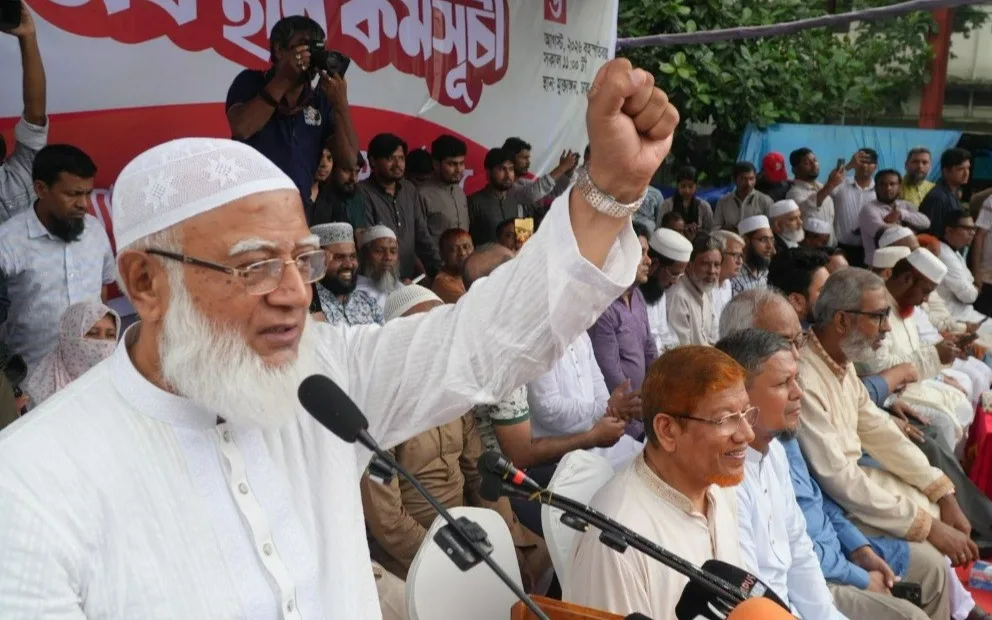
Eleven-party alliance held a Paltan sit-in and marched to the Secretariat, announcing nationwide long marches to protest gas and electricity outages and ‘ghost’ billing.
Reading
In a Nutshell:
- Eleven-party alliance (11 দলীয় ঐক্য) staged a sit-in at Paltan Zero Point protesting gas and electricity crises and pressing a 10-point demand, then marched to the Secretariat area, creating severe traffic disruption and public inconvenience.
- From the sit-in, opposition leader and Jamaat amir Shafikur Rahman announced a series of programmes: 5 September Dhaka–Chattogram long march, 19 September Dhaka–Rangpur long march and roadside rallies, 10 October Dhaka–Khulna–Jessore–Kushtia–Dhaka long march, 24 October Dhaka–Sylhet rail journey, and a Dhaka grand rally on 14 November.
- Shafikur framed the movement as a drive to ensure justice for “killers, looters and oppressors” responsible for past crimes, enforced disappearances and extrajudicial killings, vowing they will not be allowed to “swagger” in Bangladesh while he and his allies are alive.
- He warned the government against obstructing the announced long marches, saying any attempt to block them would be met by “double-strength” mobilisation, with the events designed to listen to people’s grievances and prepare them for a larger future movement.
- The alliance chose rail for the Dhaka–Sylhet programme, citing poor road conditions and anticipated public suffering if “hundreds of vehicles” travel by highway, and called for nationwide mobilisation of supporters to converge on Dhaka for the 14 November grand rally.
- Their 10-point demands include public hearings and punishment over “ghost” electricity bills of the last three months, cancellation of unjust charges (demand, meter rent, other fees), automatic refund of excess collections, and full transparency in power billing.
- They also demand suspension of gas billing where supply is absent, higher domestic gas production with reduced import dependence, a long-term national energy policy, new field exploration and drilling, and effective planning for alternative fuel supply.
- The alliance called for investigation into Maheshkhali LNG terminal failures, disclosure of losses, relaunch timelines, strict measures against system loss, theft and wastage, smart metering, disconnection of illegal lines, pipeline upgrades, and continuous energy supply to industry, business and power generation.
- At the Secretariat’s Gate 1, police stopped the procession, closed all gates, blocked visitor vehicles, and did not send any government representative despite Shafikur’s 10-minute appeal, prompting him to condemn the non-response and end the programme after a brief extension.
- Demonstrators chanted slogans like “Give gas, give electricity, or leave the chair” and the opposition leader accused the government of engineering a gas crisis to justify future price hikes, vowing they will not allow further tariff increases.
Why it matters
This mobilisation signals a strategic escalation by the Islamist-led eleven-party alliance, using everyday grievances over gas, electricity and utility billing to widen its political base and reposition itself as a defender of middle- and lower-income consumers. By framing the campaign around “ghost bills,” service disruptions and impending price hikes, the opposition is linking governance failures in the energy sector with broader questions of accountability, corruption and authoritarianism, thereby converting technical policy issues into mass-political grievances. The long marches and rail journey across key regions—Chattogram, Rangpur, Khulna, Jessore, Kushtia, Sylhet—are designed to rebuild organisational capacity on the ground and create a narrative of nationwide resistance culminating in a Dhaka grand rally, which could test the interim government’s tolerance for sustained street politics. At the same time, demands for a long-term national energy policy, investigations into Maheshkhali LNG, and transparency in billing highlight structural weaknesses in Bangladesh’s energy governance and public communication. How the authorities respond—dialogue, technocratic fixes, or coercive control—will shape not only the trajectory of this particular alliance but also the broader pattern of state–citizen contestation over essential services in a period of economic stress and political flux.
What we think
For the Bangladeshi authorities, this episode underscores the need to treat energy-sector discontent as a political risk, not merely a technical or pricing problem. The eleven-party alliance is using concrete, easily communicable demands—fair billing, uninterrupted gas and electricity, transparent investigations—to cut across ideological divides and tap into widespread frustration, which could make repression alone both costly and counterproductive. Strategically, the government should weigh whether limited, visible concessions (audits of “ghost bills,” temporary relief measures, clearer timelines for resolving Maheshkhali LNG and supply disruptions) could defuse momentum without emboldening more radical agendas. It must also factor in regional optics: marches touching major corridors like Dhaka–Chattogram and Dhaka–Sylhet, coupled with rhetoric about justice for past abuses, risk international attention on governance and human rights if mishandled. A proactive approach would combine credible technical reforms, improved public communication about energy constraints and pricing, and a calibrated security posture that avoids excessive force while protecting key installations and traffic flows. Above all, the government should recognise that the opposition is trying to convert service-delivery failures into a platform for “larger movement”; closing that political opportunity requires rebuilding trust around essential utilities before the November grand rally becomes a focal point for broader anti-regime mobilisation.