Context
BRICS began as BRIC, a grouping of Brazil, Russia, India and China that held its first summit in Russia in 2009. South Africa joined in 2011, turning BRIC into BRICS. The group later expanded, adding Egypt, Ethiopia, Iran, and the UAE in 2024, followed by Indonesia in 2025. Saudi Arabia has been invited but has not formally joined.
The group was initially focused on giving emerging economies a greater voice in global economic governance. Over time, its agenda expanded to include trade, development, finance, energy, technology and political cooperation.
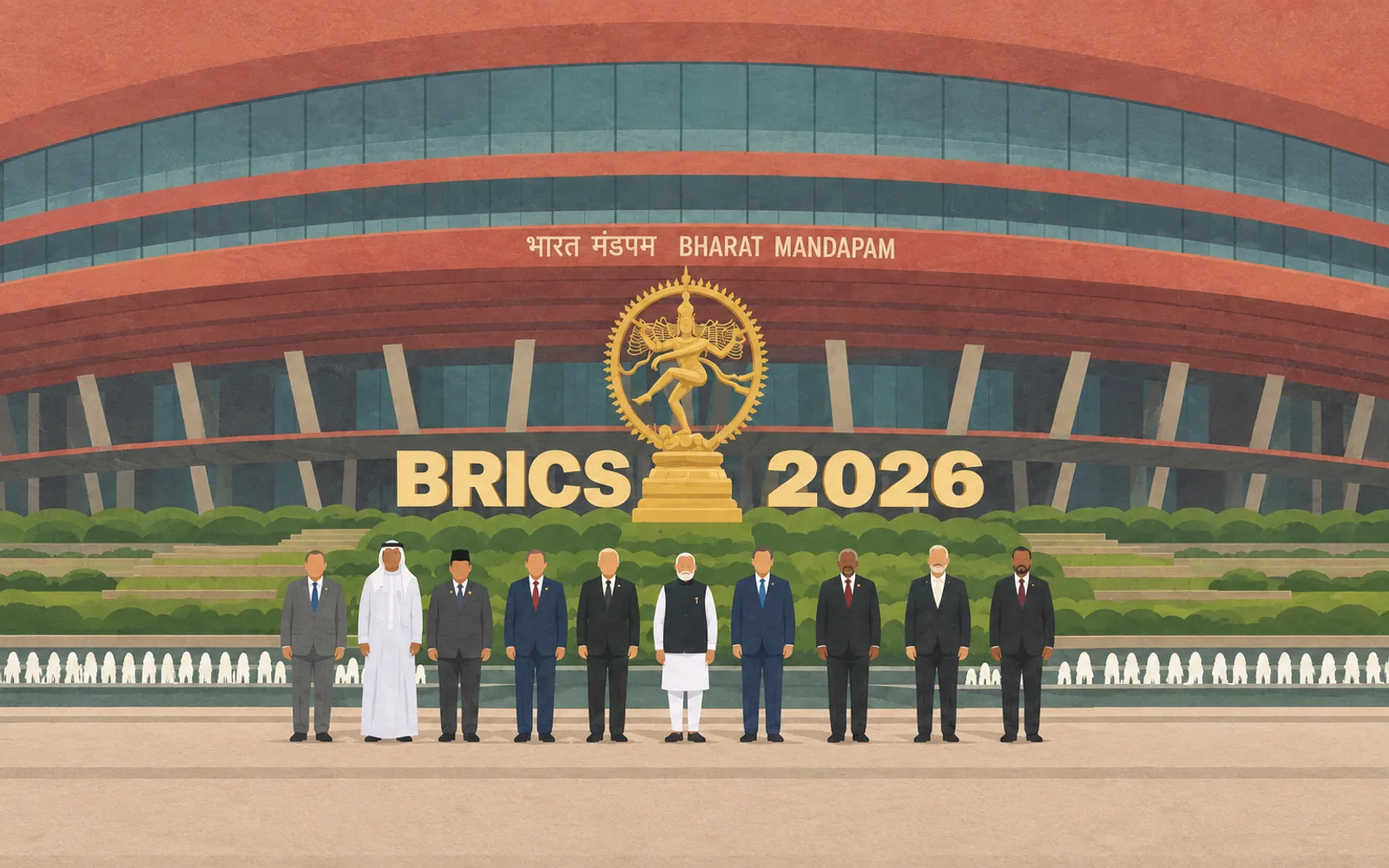
This year’s summit was held in New Delhi on September 12–13 under India’s chairmanship under the theme “Building for Resilience, Innovation, Cooperation and Sustainability”. The summit focused on strengthening the voice of the Global South, reforming global institutions and deepening practical cooperation in areas including trade, finance, digital payments, AI, health, energy and climate.
In a Nutshell:
- BRICS leaders adopted the New Delhi Declaration after difficult negotiations on global governance, conflicts, trade, finance, technology and development. Talks reportedly continued until about 4 a.m. due to differences over geopolitical issues.
- The Iran conflict exposed deep divisions within BRICS. Iran and the UAE, which hold sharply different positions, both signed a statement urging restraint, while the declaration avoided assigning blame.
- Iranian President Masoud Pezeshkian met the UAE Crown Prince on the sidelines, marking a notable high-level contact amid wider Middle East tensions.
- The declaration called for a lasting Gaza ceasefire, unhindered humanitarian access and civilian protection. It backed a two-state solution based on the 1967 borders, with East Jerusalem as Palestine’s capital.
- Prime Minister Narendra Modi and Chinese President Xi Jinping discussed the border dispute, trade and market access. It was Xi’s first visit to India since 2019.
- Xi skipped Modi’s gala dinner after meeting him, prompting speculation reports said he was tired after a long flight and jet-lagged.
- Modi and Putin discussed trade, energy and the effects of the Ukraine and West Asia conflicts. Putin urged BRICS to become a more practical economic platform, less dependent on Western systems.
- Saudi Arabia was represented by its foreign minister, not its head of state. Although invited to join BRICS, Riyadh has yet to formally accept membership.
- BRICS explicitly condemned the Pahalgam terrorist attack, giving India a diplomatic gain. The declaration also called for stronger action against terrorism, terror financing and safe havens.
- The declaration addressed major conflicts but did not name the Russia-Ukraine war or assign blame, reflecting BRICS’ consensus-driven approach and internal divisions.
- BRICS criticised unilateral tariffs, sanctions and trade restrictions. It also called for greater representation of developing countries in global institutions.
- Modi called for replacing the “pyramid of privilege” in global governance with a “platform of partnership.” He proposed a 10-point BRICS reform roadmap to strengthen the Global South’s role.
- The summit promoted practical economic measures, including local-currency trade, interoperable cross-border payment systems and development financing.
- BRICS raised concern over cross-border online scams, scam compounds, illicit virtual-asset flows and payment fraud.
- The group welcomed the Guwahati Declaration by member states’ anti-drug agencies, aimed at improving cooperation against drug production, trafficking and organised crime.
- BRICS endorsed two anti-corruption mechanisms: an expert network on asset recovery and an informal cooperation repository to trace fugitives and support extradition.
- The BRICS Plus Dialogue included partner and invited countries, reflecting the grouping’s effort to expand influence across the Global South.
- China will assume the BRICS chairship in 2027 and host the 19th BRICS Summit.