Humans of the Establishment: Salahuddin Ahmed
"The Humans of the Establishment" is a planned essay series offering intimate snapshots of Bangladesh's prominent political/non-political figures to reveal the human context behind the daily headlines.

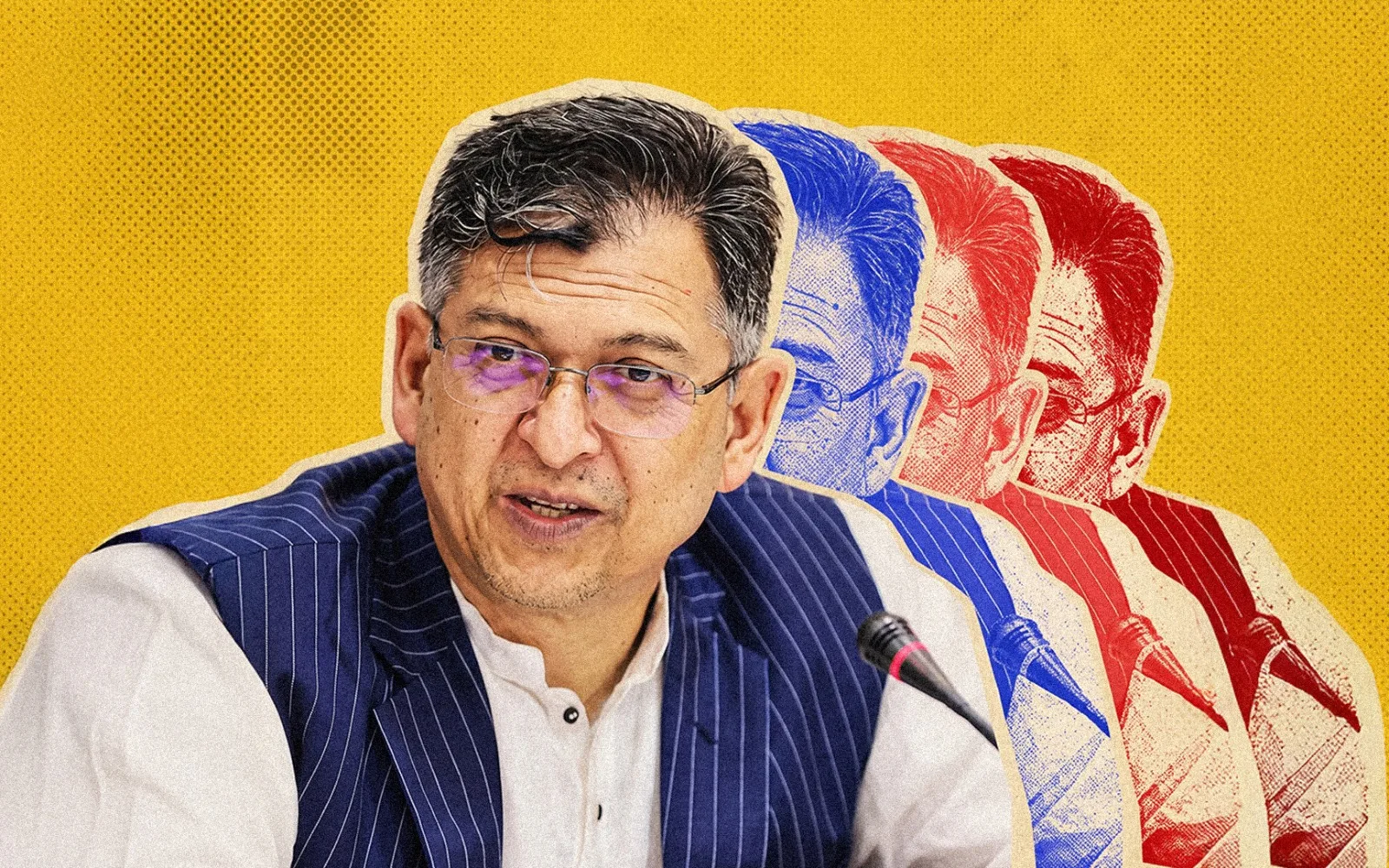
The first time I heard the name Salahuddin Ahmed, I had to Google him.
It was 10 August 2024. Sheikh Hasina had left the country only days earlier, and Bangladesh was still trying to understand what had just happened. The political ground beneath us had shifted almost overnight. New names were suddenly everywhere. People I had never paid much attention to were becoming part of the country’s most important conversations.
One of those names was Salahuddin Ahmed.
I knew almost nothing about him then. I knew he was a senior BNP leader, a member of the party’s Standing Committee, the highest decision-making body after the chairperson, and that he had spent more than nine years stranded in India after disappearing from Dhaka in 2015 and resurfacing in Shillong. I knew he had once been a state minister and that he was expected to return to Bangladesh on 11 August. That was about it.
To understand Salahuddin Ahmed, is also to understand his place within the BNP. He is not merely another party spokesperson or a familiar television face. He has long been among the party’s most consequential political operators: a former aide to Khaleda Zia, a former MP from Cox’s Bazar, a former state minister for communications, and a Standing Committee member who carries the authority of someone trusted with the party’s hardest political moments.
By the time I encountered him, it was already clear that, after the chairperson, he was one of the biggest—perhaps the biggest—talisman in the BNP’s active political universe.
I was sitting in the newsroom, trying to keep up with the madness of those days, when his name came up again.
So I did what journalists usually do when they do not know something. I searched. I read. I looked at photographs, trying to understand who this man was.
A few weeks later, I joined the Interim Government’s Press Wing. And then, suddenly, there he was, the man I had Googled from my newsroom was now walking into the same rooms where I worked.
The first time I saw him was at a National Consensus Commission meeting at the Foreign Service Academy. I was probably one of the youngest people in the room and, because of that, I spent more time watching than speaking. That became a habit during my time in government. I watched people. I watched how they entered rooms, how they greeted one another, whom they listened to, whom they ignored, and whom they found nervous. I remember noticing his height first. He was tall, very tall, at least to me. Six-foot-two, perhaps six-foot-three. But after a while, I realised his height was not what made people notice him. It was what happened around him. When Salahuddin walked in, I watched the room. Nobody announced him, nobody asked anyone to stand up. Yet somehow, people stood.
"Even today, whenever I hear the words “Note of Dissent,” one person immediately comes to mind: Salauddin Ahmed."
That was the first time I noticed the thing I would later struggle to describe. There are people who enter a room and wait for the room to notice them. And then there are people who enter a room and somehow make the room adjust itself. Salahuddin was the second kind.
Even today, whenever I hear the words “Note of Dissent,” one person immediately comes to mind: Salauddin Ahmed.
I watched political leaders interact with him. I watched the younger faces around the table and the way they carried themselves when Salauddin was around. I was mostly silent. I had no reason to think anyone was watching me, and perhaps that was exactly why I could watch everyone else. He was not your regular aura-farming politician. He did not seem interested in manufacturing an impression. He did not need to. He already had one.
And there was something else. Salahuddin had little patience for political theatre. He could cut through posturing, vague formulations and unnecessary speeches with a sentence or two. In rooms where people often tried to sound historic, ideological or profound, he had a way of bringing the conversation back to its actual point in his infamous Chatgaiya accent.
He did not always make the room comfortable. But he made it clear that he was listening.
Within the first minute of watching him engage with his party colleagues, you understood that he was not simply present in the BNP hierarchy. He was one of the people shaping its direction. Others may have had louder voices, more public visibility or longer television appearances. But Salahuddin possessed something different: the confidence of a man who knew his political weight and did not need to advertise it.

During the Interim Government, I gradually came to see him as something of a talisman for BNP inside that ecosystem. There was a kind of weight around him that was difficult to explain unless you had actually been in the room.
People became more careful with their words. People who were usually loud became quieter. People measured their tone. It was subtle, but you could feel it.
I also heard many stories about him from people who had known him much longer than I had. Some were interesting. Some were funny. Some were less flattering. But stories are still stories. Unless I can verify something myself, I do not think I have the right to turn somebody else’s version of a person into my own, so I will not. Because this is not really a story about what everyone else thought of Salahuddin Ahmed. It is about what I saw.
And what I saw was a man who could make you nervous without saying very much.
I had a few chances to interact with him inside Jamuna and at the Foreign Service Academy, but they were never long conversations. Usually, they were just greetings, the sort of brief encounters that happen when one person is a powerful political figure, and the other is a young member of the press team trying very hard not to get in anyone’s way.
One day, he asked me, “How are you? Aren’t you from the Press Wing?”
“Yes, I’m good, bhai. Yes, I’m from the Press Wing.”
Then I corrected myself.
“Sorry, sir. Yes, I’m good.”
I knew I had become nervous.
He knew it too.
He put his hand on my shoulder and, in his unmistakable Chattgaiya accent, told me that most people called him bhai anyway, so I could call him bhai too.
It lasted only a few seconds.
"For a few seconds, the intimidating political figure disappeared. In his place was simply a man trying to make a nervous young person feel less nervous."
Nothing important happened. But I remember that moment because something in my head shifted. For a few seconds, the intimidating political figure disappeared. In his place was simply a man trying to make a nervous young person feel less nervous. It was a small kindness. And sometimes small kindnesses tell you more about people than big speeches do.
There was another moment I remember from one of the consensus meetings.
Salahuddin had asked Apurba Jahangir, then Deputy Press Secretary to the Chief Adviser, for something that had nothing to do with politics. He wanted Professor Muhammad Yunus to sign a copy of Three Zero for his son, Ibrahim Ahmed.
I happened to be there when Salahuddin leaned slightly toward me and asked, almost casually, whether I could take a photograph when Professor Yunus signed the book.
“Yes, sir. I can. I’ll be there.”
That was it. Again, such a small thing. But I remember thinking that this was the side of politicians we rarely see. A father wants an autograph for his son. For a moment, the politician disappeared again. Politics has a way of turning people into categories. People become ministers, advisers, party leaders, MPs and negotiators. People become positions. People become portfolios. After a while, you stop seeing the person and start seeing the title.
But every now and then, something small breaks through. A hand on a shoulder.
A question about where you work. A signed book for a son. And you remember that beneath the title, there is still a human being.
During political party meetings at Jamuna, I often saw Salahuddin with Mirza Fakhrul Islam Alamgir, Moeen Khan, Nazrul Islam Khan and Major (Retd.) Hafiz Uddin Ahmad.
He was rarely a passive presence. He debated, pushed, questioned and challenged.
He moved the conversation. Sometimes the discussions felt constructive. Sometimes they were tense. Sometimes it was obvious that the room was moving in a direction not everyone wanted. But Salahuddin was almost always somewhere in the middle of that movement. That, too, became part of the aura. He wasn’t always right. Not everyone agreed with him. And I certainly have no intention of romanticising him.
Political power is complicated. People in powerful positions should be observed carefully, questioned seriously and judged by what they do.
But there was something fascinating about watching Salahuddin operate. He seemed to understand the room. He knew when to push. He knew when to wait. He knew when an argument needed another argument, and when a conversation simply needed to stop performing and move toward a decision.
For someone like me, who had mostly watched politics from behind a camera or inside a newsroom, it was fascinating to see that process from a few feet away.
When I entered the Interim Government, I came in as someone who had spent years observing politics from the outside. Then suddenly, I was inside those rooms. People I had previously known only through headlines were sitting a few feet away from me.
And Salahuddin was one of the people who made me aware that I was there.
Perhaps that is what I mean when I say aura. It is not exactly charisma. It is not fear. It is not respect alone. It is something harder to name. It is that strange combination of presence, authority and familiarity that makes people instinctively recalibrate when someone walks into a room. You feel it before you understand it.
And now, things have changed again.
Salahuddin Ahmed is no longer simply the BNP leader I watched from across the room during the Interim Government. He is now Home Minister, after returning from India in August 2024 and re-emerging at the centre of Bangladesh’s post-Hasina political order.
The room around him changed. The responsibilities changed. The distance changed.
And yet, when I look back, the image that stays with me is still the same:
A tall man walking into a room. People standing. A young man sitting somewhere near the edge, watching quietly.
Perhaps that is the strange thing about politics. Sometimes the office gives a person an aura. And sometimes the aura is already there, long before the office arrives.
Titles change, ministries change, governments change, and the rooms change with them. But some people carry their presence with them.
Salahuddin Ahmed, at least from where I was standing, was one of them. And that is how I remember him; not just as the Home Minister, not only as the BNP leader, and definitely more than just a man whose name appeared in headlines.
But as the man who walked into a room like a Bengal tiger.
The Humans of the Establishment is a planned series of personal essays about key political figures and policymakers, aimed at highlighting the diverse and changing fabric of the present day political scene in Bangladesh. Presented as snapshots of certain moments and periods, our hope is that our readers will catch a glimpse of individuals beyond the headlines and photo ops and connect with the context in which they operate.