In a Nutshell:
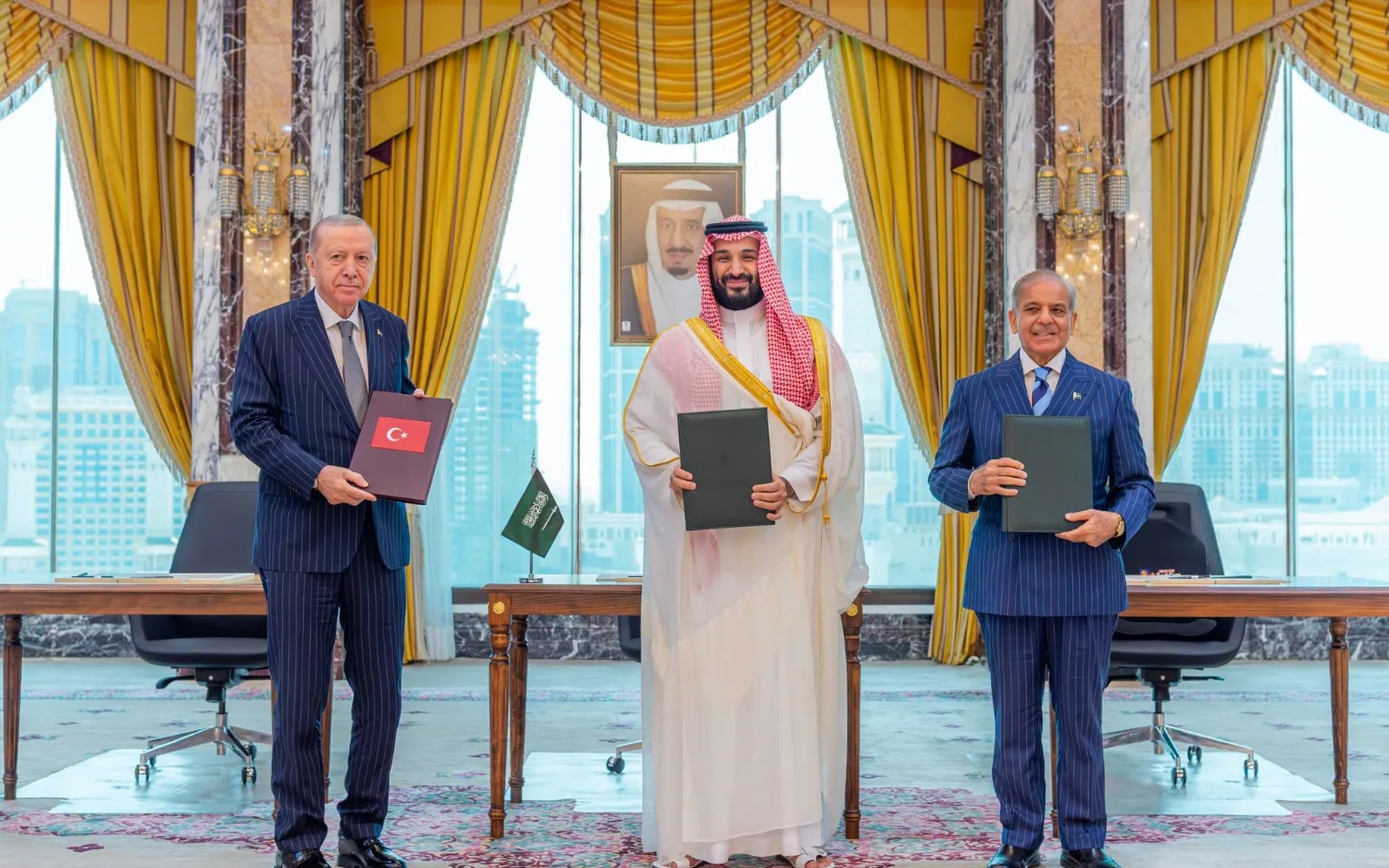
- Saudi Arabia, Turkey and Pakistan signed the “Mecca Joint Defence Agreement” in Mecca on Friday, August 7, 2026.
- The agreement was signed by Saudi Crown Prince Mohammed bin Salman, Turkish President Recep Tayyip Erdogan and Pakistani Prime Minister Shehbaz Sharif.
- Pakistani PM Sharif was accompanied by army chief Asim Munir at the signing .
- The pact states that an armed attack against any of the three states will be treated as an attack on all three .
- It builds on the Saudi-Pakistan mutual defense agreement of September 2025, under which Pakistan had already deployed 8,000 troops, a fighter squadron, and an air defense system to Saudi Arabia .
- The agreement follows roughly a year of negotiations, first reported by Reuters in January 2026.
- It was signed against a backdrop of regional tension, including Iranian missile activity affecting Gulf oil exporters after the U.S.-Israel military action against Iran, and disruptions to shipping through the Strait of Hormuz.
- Turkish officials described the agreement as defensive in nature, stating it is “not aimed at any specific country” and does not supersede existing treaty obligations with other states.
- Analysts characterize it as a framework for closer strategic, military, and defense-industrial coordination rather than a NATO-style mutual defense treaty, and note it remains open to other regional states.
- The signing coincided with separate reports of progress toward a U.S.-brokered arrangement to ease restrictions on Strait of Hormuz shipping.
Why it matters
The pact formalizes closer security coordination among three Muslim-majority states amid heightened regional instability following the U.S.-Israel-Iran conflict and disruptions to Gulf shipping routes . It reflects a broader pattern of Middle Eastern and South Asian states pursuing additional security arrangements alongside existing alliances, partly in response to uncertainty around established security guarantees . The agreement expands Pakistan’s military presence in Gulf security matters, extends Turkey’s regional defense engagement, and may influence future alliance structures and defense-industrial cooperation in the region.
What we think
The Mecca pact shows regional powers building independent security arrangements, rather than relying solely on traditional alliances, driven by fallout from the U.S.-Israel-Iran conflict and Gulf shipping disruptions. Pakistan’s nuclear status raises the stakes of its mutual-defense commitment to Saudi Arabia and Turkey, though Ankara insists the deal doesn’t override existing treaties like NATO membership, suggesting it supplements rather than replaces current structures. Energy markets should watch its link to Strait of Hormuz tensions . Broadly, Western and Asian capitals may read it as Riyadh, Ankara, and Islamabad signaling capacity to coordinate security independently of Washington.