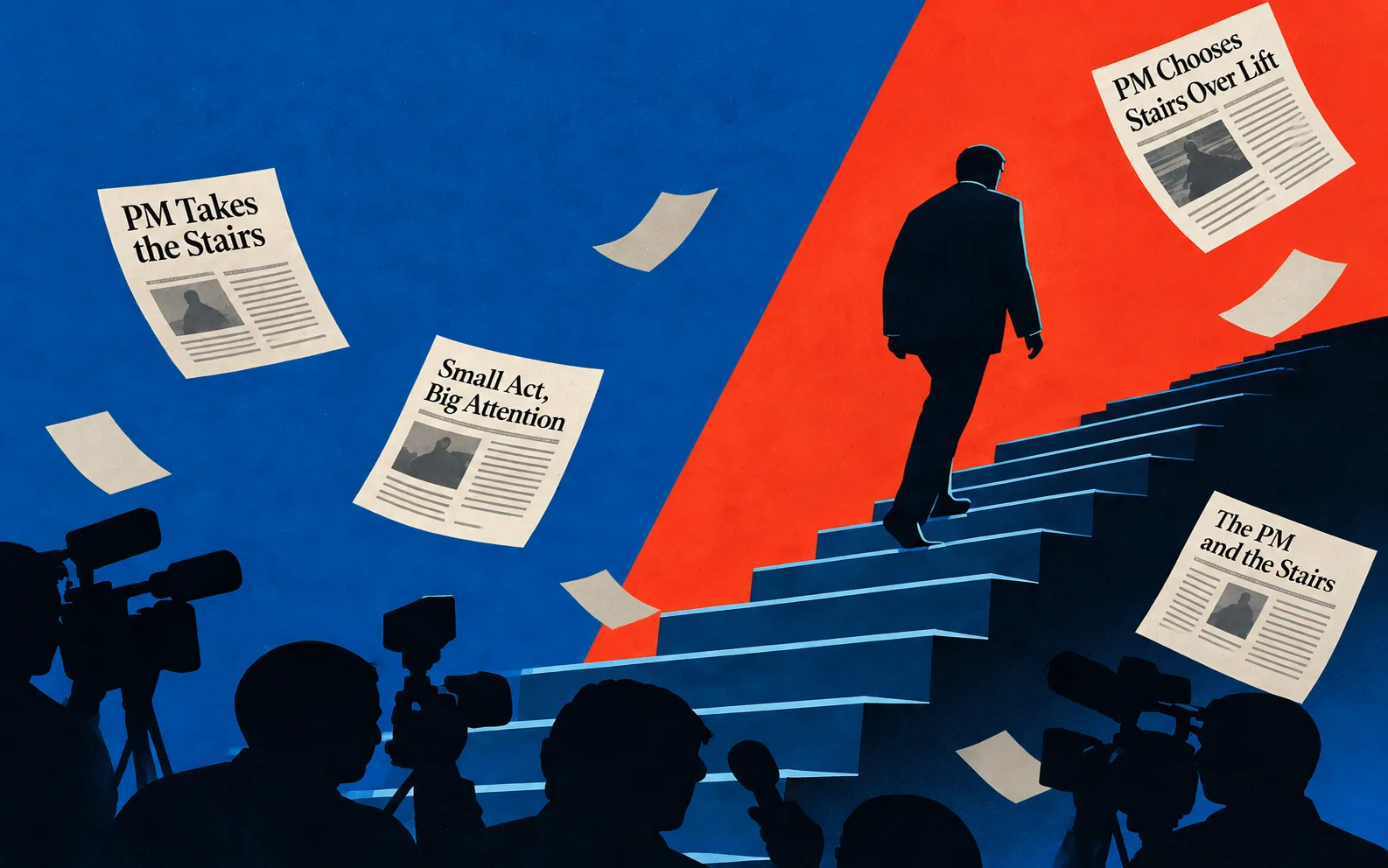
At about 3 pm on Sunday, 13 September, Prime Minister Tarique Rahman left his office at the Secretariat. He walked to Building 4, where a meeting was being held on the sixth floor of the Agriculture Ministry. The lift was working. He took the stairs. By nightfall, the walk had become national news. BSS reported it first. Kaler Kantho, Inqilab, Bhorer Kagoj, Banglanews24, RTV, Jaijaidin and UNB followed. The basic detail was almost identical across the reports: the Prime Minister could have taken the lift but chose to walk up the stairs. Several reports attributed the information to Deputy Press Secretary Jahidul Islam Rony. One added the Prime Minister’s Office’s explanation that the gesture was intended to send a message about saving electricity and fuel. The meeting focused on reducing Bangladesh’s food import bill. That came later. The story was not false. Tarique Rahman did walk up the stairs. But the episode captures something larger about the way Bangladesh’s new Prime Minister is being covered: an ordinary act by a powerful man can become a political story simply because the machinery around him decides it is worth telling. And increasingly, private newsrooms are choosing to tell it.
This Story Began Earlier
The more significant part of the story begins before Tarique Rahman entered office. Our review of the coverage suggests that the press did not suddenly become interested in presenting him as the country’s next leader after the February election. The shift was already visible during the interim government, when BNP coverage began to move beyond routine reporting and toward a more legitimising frame. That bias was visible in both print and digital media. Media Watch Bangladesh found that during the election period, nine print newspapers carried 747 election reports on the BNP, compared with 364 on Jamaat-e-Islami. In the same print sample, the BNP also received 666 photos, compared with 362 for Jamaat. Online, the pattern was similar: BNP received 1,498 reports, compared with 827 for Jamaat. The broader EU monitoring also found that the BNP received the most visibility in the monitored media, while smaller parties were pushed to the margins. During the interim period, the narrative was reinforced by the way Tarique Rahman’s movements were covered. When Muhammad Yunus was preparing to meet him, attention often centred less on the substance of the talks and more on Tarique’s arrival itself.
Footage of his car travelling toward the hotel was circulated as if it were a political event, and a clip of him stepping out of the car was later shared on the Chief Adviser’s official Facebook page. That was not a neutral visual choice. It showed how a political image could move from party politics into official government communication and then into the wider media ecosystem.
Then came the London meeting on 13 June 2025. Muhammad Yunus met Tarique Rahman there, and the joint statement pointed toward an election in the first half of February 2026. The next morning, that agreement between the interim government and one political party was presented across several front pages as something larger: a national political settlement. The effect of that coverage mattered. The BNP was the only party in a multi-party system. Yet, the election timetable was increasingly presented as if it had been set around an understanding between the interim government and Tarique Rahman’s party. A Prothom Alo column later asked whether the BNP had “won” the London talks. At the same time, Jamaat complained that the Chief Adviser’s perceived special affection for one party had damaged his neutrality. The point is not that every newsroom had decided to support the BNP. The point is that the political conversation was increasingly being organised around the BNP’s timetable and Tarique Rahman’s expected return to power.
How the Image Was Built
The stairs story was not isolated. On 7 September, during a parliamentary debate on the gas and power crisis, Opposition Leader Shafiqur Rahman praised Tarique Rahman for keeping his lunch to Tk 100-Tk 150. The Prime Minister responded by inviting him to eat that lunch with him. Three days later, BSS reported that Tarique Rahman’s office had begun implementing a decision to remove the word “Honourable” from his official title. This deserves appreciation. The report also noted that he had begun using the digital attendance system before entering his office. The pattern goes back to his first weeks in power. Many outlets reported on his use of his own car and driver, paying for his own fuel, reducing his motorcade from 13 or 14 vehicles to four, removing police lines from his route, dropping the flag from his car and working on Saturdays. Again, this also deserves appreciation. In April, the PM adviser’s Facebook post about cutting the PMO’s lunch and afternoon snack budget to Tk 150 per person became a news story. There is nothing inherently wrong with reporting any of this. These details may tell citizens something useful about how a Prime Minister chooses to conduct himself. The question is one of proportion. When a Prime Minister’s lunch, car, stairs, attendance system and official title repeatedly become headline material, the coverage begins to construct a particular kind of political character: the powerful man who behaves like an ordinary citizen. That image is accurate, but the image is still being constructed, and much of the construction is happening around him.
The Machinery Around Him
The interesting part of these stories is not necessarily Tarique Rahman’s behaviour. It is the route by which that behaviour becomes news. In the 13 September stairs story, the detail came from the Prime Minister’s press wing and was then reproduced by multiple private outlets. The same basic story travelled through newsroom after newsroom, and that distinction matters. BSS is the state news agency. Its relationship with the government is fundamentally different from that of privately owned newspapers and television channels. A private newsroom does not have to publish a press-wing detail simply because the Prime Minister’s office has supplied it. It chooses to. That does not make the resulting report propaganda.
But it does raise a journalistic question: why does this particular detail deserve prominence, and what does repeated coverage of such details do to the public image of the Prime Minister?
The answer becomes clearer when the stories are placed together. The personal car, the reduced motorcade, the cheap lunch, the removal of “Honourable”, the digital attendance and the stairs are small things on their own. Together, they tell a story. They tell readers that Tarique Rahman is different from the political leaders Bangladesh has become accustomed to: less extravagant, less distant, more disciplined and more like an ordinary person. The Prime Minister may genuinely want to project that image. The important journalistic question is whether newsrooms should automatically help turn every such gesture into evidence of it.
Criticism and Consent
There is an important complication. Tarique Rahman himself has not publicly asked journalists to stop criticising him. At a meeting with the BNP-beat press on 16 June, he told journalists that if he made mistakes, they should tell him. He also warned against sensationalising mistakes in a way that merely increases newspaper sales. In January, when he hosted editors, he again said criticism was necessary, though not criticism for its own sake. Former BNP Secretary General Mirza Fakhrul Islam Alamgir has also publicly warned journalists against sycophancy, saying he no longer wanted to see it. But another senior government voice offered a noticeably different message. State Minister for Information Yaser Khan Chowdhury said in June that if journalists working for media outlets whose owners had links to the previous government highlighted the government’s “good sides and good deeds”, that would constitute courageous journalism. The contradiction is difficult to miss. One message asks journalists to criticise, and another effectively praises them for highlighting the government’s good side. That tension is more important than deciding whether Tarique Rahman personally wants favourable coverage. Political communication is not created only by what a Prime Minister says. It is also created by the officials who speak for him, the institutions that distribute his messages and the newsrooms that decide what to amplify.
The Numbers
This is where the argument moves beyond impressions. Media Watch Bangladesh monitored nine newspapers, five online portals and seven television channels during the election campaign. Between 23 January and 10 February 2026, the nine newspapers carried 747 election reports about the BNP, compared with 364 about Jamaat-e-Islami. The BNP also received 666 photographs in print coverage, compared with 362 for Jamaat. Online, the difference was 1,498 reports to 827. TIB’s monitoring of BTV’s 8 pm bulletin between 1 October 2025 and 12 February 2026 found that BNP election coverage accounted for 59.32% of total election airtime, while Jamaat received 21.59% and the NCP 11.89%. The EU Election Observation Mission also found that the BNP had the most visibility in monitored media, while smaller parties received substantially less coverage. The BNP eventually won 209 of the 297 seats recorded in the EU report. That result does not prove that media coverage caused the victory. But it does show that Tarique Rahman and the BNP already occupied a much larger space in the media environment than their rivals before voters cast their ballots.
The Language of Inevitability
This is perhaps the most revealing part of the story. By December 2025, before the election, Prothom Alo editor Matiur Rahman told a BNP meeting of editors that the BNP was recognised as the country’s largest party and that they could assume it would come to power. Tarique Rahman’s return to Bangladesh days later was covered in similarly consequential language. Bangladesh Pratidin called it a “historic homecoming”. Prothom Alo described an “unprecedented scene of return”. Jugantor called it the beginning of a “new chapter in politics”. The election had not yet taken place. That is why saying the media “made Tarique Rahman Prime Minister” is too simple. But saying the media helped normalise his premiership before a much larger body of evidence supports the vote. The public was not simply being told that Tarique Rahman was one candidate among others. Increasingly, it was being shown what Bangladesh would look like under Tarique Rahman.
After He Came In
The relationship did not end when the BNP won. It became institutional. The Newspaper Owners’ Association met Tarique Rahman in April and agreed to meet him every quarter. The owners raised cases against journalists and unpaid government advertising bills. The Editors’ Council subsequently raised the cases of 282 journalists. Meanwhile, appointments at state media continued. Kader Gani Chowdhury, identified in the report as having previously been installed at East West Media and linked to the BNP Media Cell, became managing director of BSS in August. By May, The Business Standard was reporting that “old pressures” on the media had returned. Bangladesh subsequently fell three places to 152nd in the Reporters Without Borders press freedom index cited in the report. The Committee to Protect Journalists also called on the government to break the cycle of press repression. That is where the danger lies. Not necessarily in Tarique Rahman taking the stairs. But in a political system where taking the stairs can become evidence of virtue before the public has had the opportunity to judge the government on the harder questions. The question for Bangladesh’s media is therefore not whether Tarique Rahman is genuinely modest. It is whether journalists are willing to treat that modesty as one fact about a Prime Minister rather than as a substitute for accountability. Critical reporting has not disappeared. Jugantor has reported concerns over the power and gas sector. The Daily Star has questioned the government’s economic performance. Editors and media organisations have challenged proposed cyber-law amendments. The press is not uniformly pro-government.
But this matter points to something more complicated: a media environment in which favourable political visibility can coexist with critical journalism, while the structural incentives that produced political alignment remain largely intact. The lesson from the Hasina era should not simply be that one leader was glorified. The larger lesson is how easily a country’s media ecosystem can become accustomed to power. The leader changes. The language changes. The political party changes. But the habit of looking up to power can survive. And if Tarique Rahman genuinely wants criticism, the most useful thing the press can do is take him at his word. Not by attacking him. Not by praising him. But by treating him like what he now is: a Prime Minister whose ordinary habits can be reported, but whose government must ultimately be judged by extraordinary standards of public accountability.