July Was Never a Feminist Revolution
Women stood in the front line because a patriarchal society puts its daughters there. When the danger passed, so did their place.
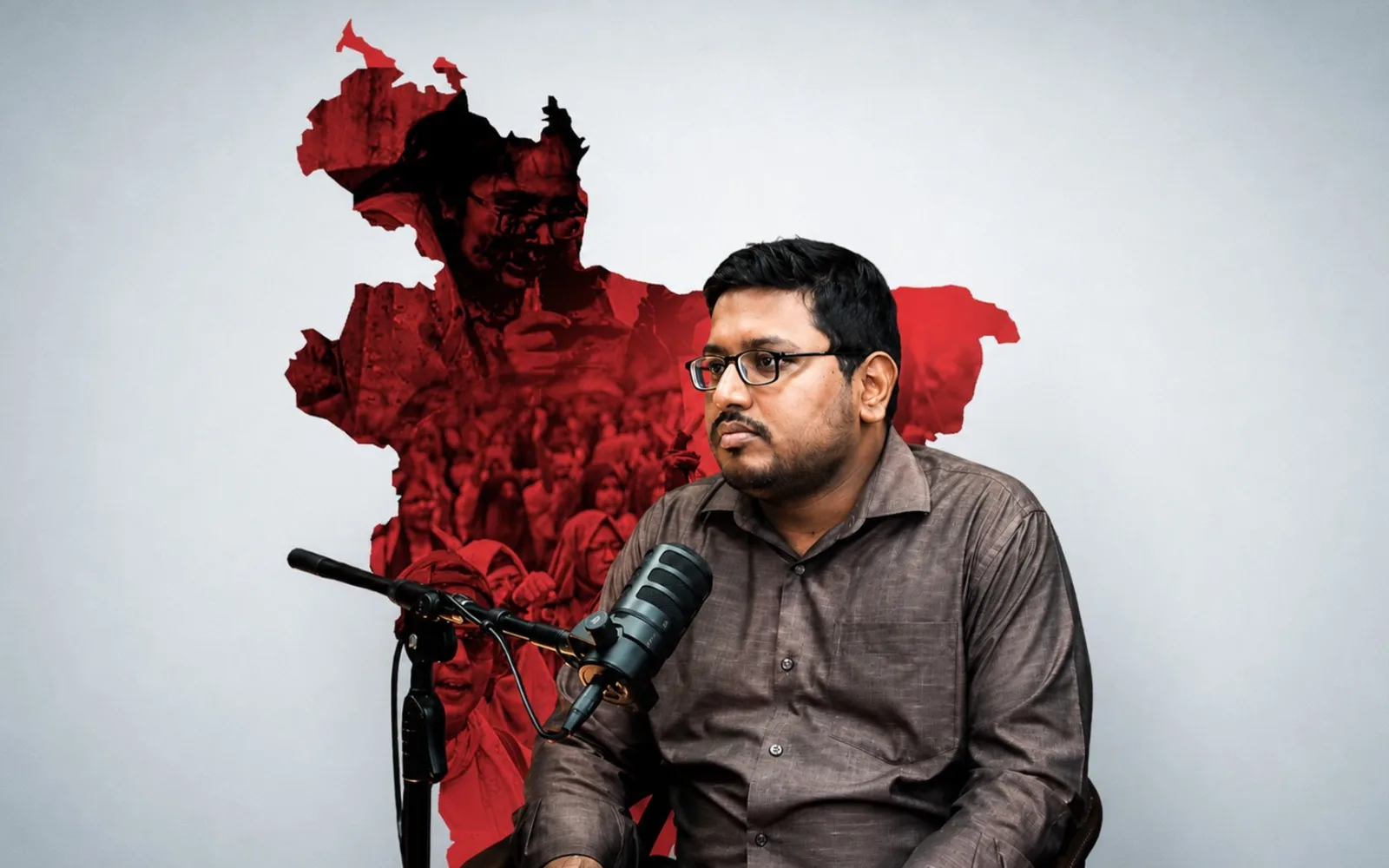
In the summer of 2024, a student protest against government job quotas grew into a national uprising that ended Sheikh Hasina’s fifteen years in power. She fled the country on the fifth of August. A year on, a new complaint has hardened into consensus. The women who filled the streets of that revolt are being written out of it, and the loudest witnesses are the women themselves.
The movement’s first roster of coordinators named only sixteen women among roughly sixty-five . The central committee it unveiled that October was all men but for a single spokeswoman . Once Hasina fell, the women who had led from the front were pushed out of the decisions, and the movement began settling its politics without them in the room .
Women prominent in the streets were harassed online while those in power were accused of doing nothing . The male student leaders walked into top posts in the new government ; the women did not. The reform commissions were assembled with few women on them .
Little known during the uprising, Umama Fatema was made the movement’s spokesperson only after Hasina fell . The press, the NGOs and the embassies followed.
She has since become one of its sharpest critics. She says she was used and then thrown aside , that the sidelining was deliberate and successful , and that when she makes a political point the room goes quiet, while a man making the same point draws applause .
In June 2025 she walked away from the platform altogether , saying the words reform, July and martyr had turned out to be empty, and that all of them had been deceived.
Grant every word of it. Women filled the street and barely reached the leadership’s core, and that gap was there from the first day, not only after Hasina fled.
Nahid Islam read out the single demand for Hasina’s resignation on the third of August. He, Asif Mahmud, Hasnat Abdullah and Sarjis Alam became the household names, took the government posts, and built the party that grew out of the revolt. No woman reached that rank.
The rest of the record runs the same way. When Hasina’s police seized six central student leaders, only one, Nusrat Tabassum, was a woman. Most of the dead were men. And even today the asymmetry is crude but plain: Nahid Islam’s Facebook following runs past two million ; the movement’s post-July spokeswoman commands under two hundred thousand .
So where did the picture of the co-equal revolutionary woman come from? Mostly from afterwards. The ousted party had for years styled itself the guardian of women’s rights and its rivals the enemies of them, and it stood ready to brand the uprising a march of misogynists. A revolution facing that charge had every reason to advertise the women in its ranks.
The same story played well abroad. Foreign coverage celebrated the women of July even as those women complained of being erased, and a movement accused of misogyny had every reason to let the flattering version stand.
Read that way, the celebration of July’s women was less a record than a defence. It is also why the women now call it hollow. They were, they say, a token.
What the women did was real, and it was done on the street. They went to the front row to shield the men, certain the police would not dare strike a woman . When the boys could not come out, the girls came out as a shield.
The regime’s forces beat the boys freely and hesitated before the girls. When they struck the girls anyway, the country erupted.
This was not feminism. A feminist society would have raged as hard for a beaten boy as for a beaten girl. Ours did not. The extra fury over harm to women is the tell. Glick and Fiske gave the reflex a name, benevolent sexism , the gilded cage: protection that prizes the woman in order to keep her in place.
The women were visible in July because a patriarchal society sends its daughters to the front and then rages when they are touched. The visibility was a loan; when the danger passed, it was called in.
The same logic governs women who reach power anywhere. Across the world’s legislatures, they are handed the soft files, welfare and family and health, and kept off the committees that command money and force . Those who press hardest on women’s issues lose the standing and the networks that sit in the budget and foreign-affairs rooms .
The label is the leash. Women’s issues are not a base to build from but a room you are locked into.
That is what happens to the women who enter. Fewer enter at all. In the United States, men are twice as likely as women to want to run for office, and women three times as likely to call themselves unqualified on identical credentials . The gap opens in high school , long before any career. Across dozens of countries, women register lower political interest than men . It holds even where the barriers are lowest.
The reluctance is not written in nature. It is laid down early, by the same order that sends its daughters to the front and keeps its sons in the room.
None of this makes the invisibility of women acceptable, or right. It makes it explicable without a grand conspiracy, or the surge in misogyny that many now allege.
This is an old story here. Women filled the 1971 war and were pushed to the margins once it was won . They carried the quota protests of 2018 and the streets of July, and each time the memory closed over them .
The problem is older and larger than any committee. Women are, on average, less drawn to politics, and no single uprising can undo in a season what generations built.
July, like 1947 and 1971 before it, did not break the patriarchal order, nor did it try to. It was built upon that order and profited from it. The very roles it left untouched are what made a nationwide fury over assaults on women possible.
The women’s shield was raised for a war. When the war ended, lowering it was not a conspiracy. It was the logic of a shield.
There is one more layer, and it turns on the frame itself. Everything so far, the complaint of erasure and the celebration alike, has measured women by men’s yardsticks: the posts, the podiums, the follower counts. Even self-described feminists weigh women’s part in the revolution by what the men did, as though the male role were the standard and the women fell short of it.
But the roles of the mother, the sister, the wife, the girlfriend, the aunt were no less vital, even though they were less visible. The task is to make that quieter work visible, and to value it.
There is also the assumption that women are a monolith. That assumption privileges one kind of woman, and one way of living, over the rest.
Elite conversations on July’s women rarely feature Mim Akter, who with her sister carried their martyred brother’s body through the streets on the day the government fell . Nor do they usually feature Rokeya Begum, mother of the martyred child Ibrahim, now an opposition MP.
Women are silenced, and women also remain silent. Both are real, and Bangladesh must reckon with them. But the politics of women’s empowerment is not innocent either. That is a deeper discussion about feminism’s own contradictions that are yet to be resolved.