Yogi Adityanath: The Monk Who May Inherit Modi’s India
Uttar Pradesh CM Yogi Adityanath, a Hindu monk known for majoritarian politics and economic push, is emerging as a potential successor to Narendra Modi.
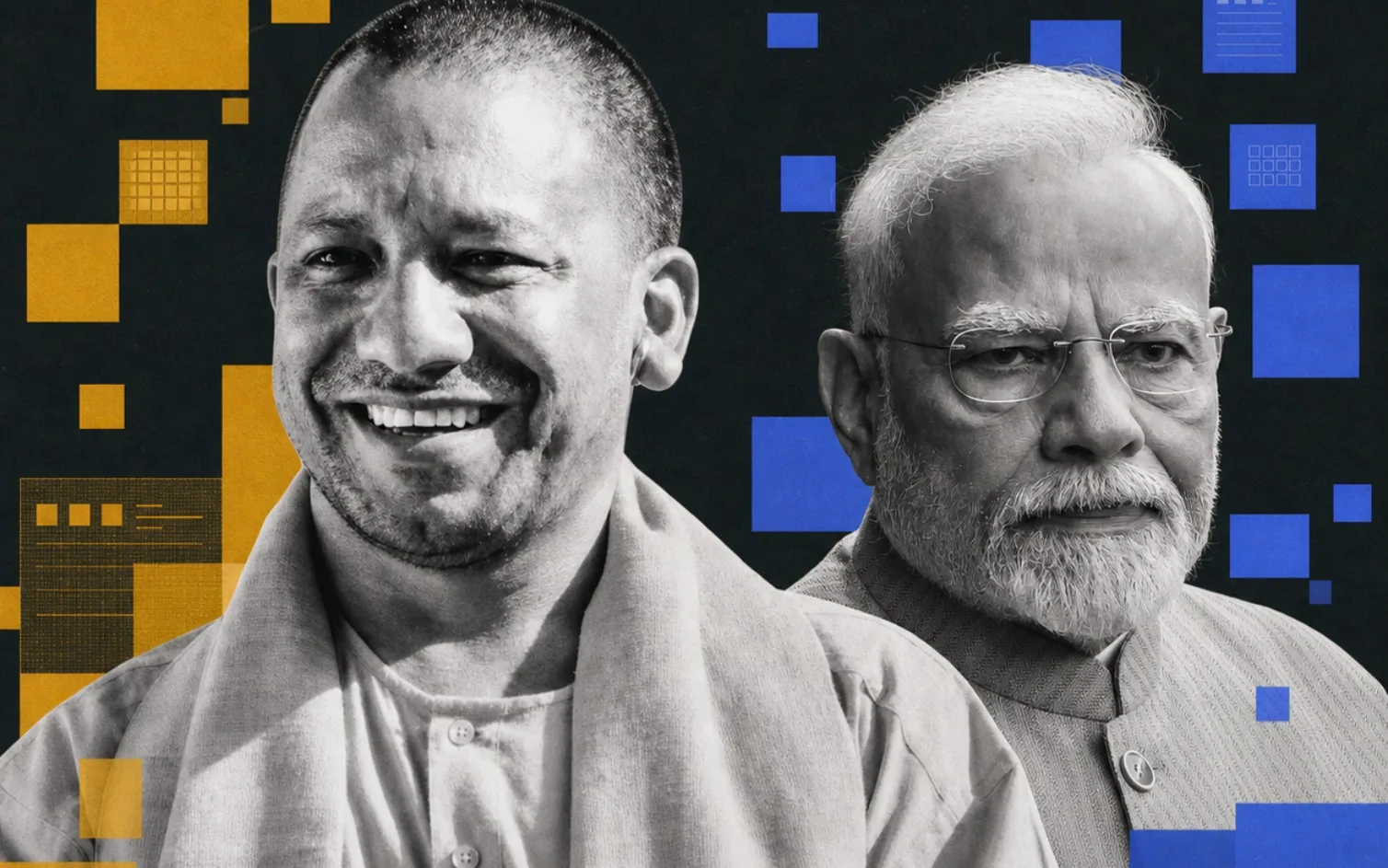
In a Nutshell:
- Uttar Pradesh Chief Minister Yogi Adityanath, a Hindu monk and BJP leader in office since 2017, is increasingly viewed as a leading potential successor to Prime Minister Narendra Modi if he secures a third consecutive state term in the 2027 election.
- Adityanath has built his political identity around a mix of Hindu-majoritarian mobilisation, an assertive law-and-order image, welfare delivery and high-visibility infrastructure and investment promotion.
- His government presents Uttar Pradesh as an economic turnaround story: the state’s GSDP reached an estimated Rs 30.25 lakh crore in 2024–25, while exports reportedly surpassed Rs 2 lakh crore in 2025–26.
- Critics argue that policies and rhetoric concerning Muslims, cow slaughter, interfaith relationships and policing have deepened communal polarisation and weakened equal citizenship in India’s most populous state.
- Adityanath’s independent political base, rooted in Gorakhnath Math and his Hindu Yuva Vahini movement, gives him standing beyond the BJP’s usual organisational ecosystem, but may also complicate his relationship with the party leadership and the RSS.
- His prospects depend heavily on the 2027 Uttar Pradesh election, especially after the BJP’s weaker state performance in India’s 2024 general election.
Context
Yogi Adityanath governs Uttar Pradesh, India’s largest state by population and therefore one of the country’s most important electoral and political arenas. His nine-year tenure has made him a national figure through a distinctive governing formula: religious symbolism, centralised executive authority, visible public works, anti-crime campaigns and the promise of industrialisation. The economic narrative is central to this positioning. Uttar Pradesh’s government says its economy grew from Rs 13.30 lakh crore in 2016–17 to Rs 30.25 lakh crore in 2024–25, while investment-oriented programmes include the defence corridor, electronics clusters, data centres, the One District One Product initiative and the forthcoming Noida International Airport. Yet the political appeal of the “Yogi model” reaches beyond economic indicators: it rests on portraying decisiveness, Hindu identity and public order as mutually reinforcing sources of legitimacy.
Why it matters
Adityanath’s rise matters because it suggests that the post-Modi contest within India’s ruling ecosystem may not be solely about administrative competence or party seniority; it may also hinge on which version of Hindu nationalist politics becomes dominant. His potential elevation would also sharpen the BJP’s choice between a leadership model anchored in New Delhi’s party-state machinery and one grounded in a regional mass base, monastic authority and highly personalised political branding. The contest is consequential because Uttar Pradesh is both a major investment destination and a laboratory for policies that other Indian states may emulate, from aggressive policing and property demolitions to religiously charged governance. Supporters see this as state capacity, improved security and economic modernisation; opponents see a normalisation of majoritarian rule that could further marginalise Muslims and strain India’s constitutional commitment to religious equality. For the region, a stronger Adityanath would signal continuity in India’s strategic direction but also a more ideologically driven domestic political climate, with implications for social cohesion, diplomatic messaging, and the management of minority-related issues.
What we think
Yogi Adityanath’s growing national prominence signals a potentially more radical direction for BJP politics, with his ideological positioning and references to the broader ‘Akhand Bharat’ vision likely to shape debates within the party. His emergence is primarily an indicator of India’s evolving internal political landscape rather than an immediate shift in Bangladesh-India relations. New Delhi’s institutional interests in border stability, trade connectivity, counterterrorism cooperation, energy trade and regional influence are likely to sustain the broad foundations of Bangladesh-India relations regardless of who eventually succeeds Modi. Although Uttar Pradesh does not border Bangladesh, Adityanath’s growing national stature could influence the language and political incentives shaping BJP politics elsewhere.