Notes from a Dhaka Commute
A daily drive from Bailey Road to Gulshan becomes a reflection on Dhaka’s traffic, learned helplessness and the need for leaders to experience the gridlock themselves.
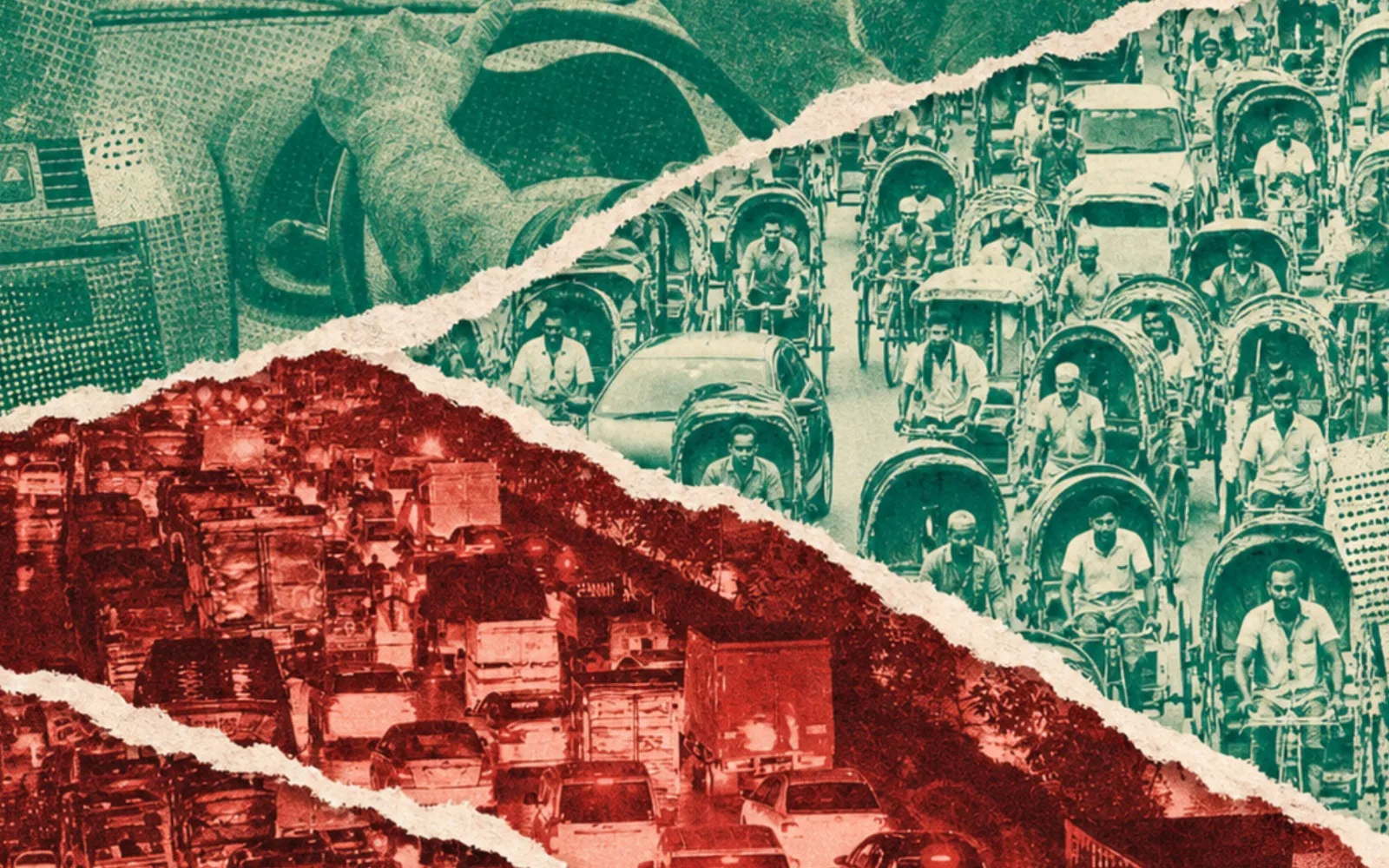
You may remember me from the interim government. I stood at podiums, fielded questions about referendums, occasionally reminded a foreign newsroom that facts are not optional, and generally spent my days trying to keep the country's temperature a few degrees below boiling. Today I am not here to talk about the July Charter. Not Jamaat, not the NCP, and definitely not the BNP. No. Today I am here to talk about something far more corrosive to the average Bangladeshi soul: what it feels like to drive from Bailey Road to Gulshan, every single day, for the rest of one's natural life.
Calling it an "experience" would be generous. Experience implies a beginning, a middle, and an end, some kind of narrative arc, however modest, however small the moral at the finish line. What happens on this route has no arc. It is not an event. It is a state of mind. A loop you enter each morning and never quite leave, the way certain songs lodge themselves in your skull and refuse a peaceful exit no matter how many times you play something else over them. If I'm being honest with myself — and at some point, stuck at a standstill near Mouchak for the fourth consecutive red light, you start being honest with yourself out of sheer boredom — it's less a commute and more a Jedi mind trick. The kind where you tell yourself, with total conviction, that today will be different. It never is. And yet the trick works again the next morning, because the alternative — accepting the truth — is somehow less bearable than the lie.
I take the Mouchak route, through Moghbazar, over Hatirjheel, and down into Gulshan 1. Not because I love it. Nobody loves this stretch the way one loves, say, a properly charred kebab, or a functioning weekend, or a text message that doesn't require three follow-ups to get a reply. I take it because the alternatives are worse, and in Dhaka, "worse" is a genuinely competitive category with multiple serious contenders.
"I genuinely believe the intersection we call Mouchak Mor is where hope goes to die a slow, honking death — one horn blast at a time, each one a small funeral bell for whatever optimism you woke up with."
I genuinely believe the intersection we call Mouchak Mor is where hope goes to die a slow, honking death — one horn blast at a time, each one a small funeral bell for whatever optimism you woke up with. And the timing is never innocent. Time it wrong, and you arrive precisely when a shift ends at Viqarunnesa or Siddeswari Girls School, and suddenly the road is not a road at all. It is a processional route. Guardians triple-park with the unearned confidence of people who have never once received a ticket in their lives. Rickshaws multiply like they're reproducing on the spot. A traffic sergeant blows his whistle with the weary conviction of a man who knows, deep down, that the whistle changes nothing, has never changed anything, and will go on changing nothing long after both of us are dust. And yet he blows it, because ritual outlives result.
Somewhere in this crawl, you start negotiating with yourself. You tell yourself you'll leave fifteen minutes earlier tomorrow. You know, even as the thought forms, that you won't. This is the first and most reliable stage of the Jedi mind trick: denial wearing the costume of planning. You have performed this exact self-deception so many times it has developed its own muscle memory, the way your hand automatically reaches for the horn before your brain has even registered what it's honking at.
"On paper, and in every glossy government brochure ever printed about it, Hatirjheel is Dhaka's redemption arc."
Then, mercifully, deceptively, comes Hatirjheel. On paper, and in every glossy government brochure ever printed about it, Hatirjheel is Dhaka's redemption arc — a shimmering lake, a breezy expressway, proof that the city can occasionally get something right. For about four hundred metres, this is even true. The water glints, the skyline looks almost generous, and you allow yourself, foolishly, to believe the rest of the drive might follow suit.
It does not. Hatirjheel giveth speed and Hatirjheel taketh it away, usually right around the ramps, where four lanes of confidence funnel into one lane of regret. Buses lean into corners like they're auditioning for a stunt reel. Motorcycles thread through gaps that shouldn't exist, piloted by young men who have clearly made peace with mortality in a way I have not. By the time you're off the expressway, the lake has receded from your mind entirely, replaced by the much older, much more familiar sensation of being boxed in on all sides by people who are, technically, going exactly where you're going, just somehow always in your way while doing it.
And then, finally, Gulshan 1, not so much a destination as a change of scenery. The roads widen slightly. The horns soften, marginally, into something almost polite. But by then you haven't so much arrived as survived, the way one survives a long-haul flight in the middle seat: faintly dehydrated, quietly resentful, grateful mainly that it's over, already dreading the reverse leg in eight hours.
"Traffic is just the symptom that's easiest to complain about over tea."
Here's where, as more than one writer/journalist/editors have reminded me over the years, I'm meant to stop reflecting and actually say something. So here it is: this was never really about traffic. Traffic is just the symptom that's easiest to complain about over tea. What we've actually built, brick by brick, horn by horn, between Bailey Road and Gulshan and everywhere else of Dhaka is an infrastructure of learned helplessness — a daily rehearsal in accepting dysfunction as weather, as something that simply happens to you, rather than something that competent planning, honest enforcement, and a functioning school pickup policy could very obviously fix.
I told you at the very top of this piece that I wasn't here to talk about the BNP. I meant it when I wrote it, roughly four hundred words and one Hatirjheel ramp ago. But here we are, and I'm about to break that promise in real time. I love it when I see Tarique Rahman drive. Here is my one hope for the man, offered in good faith and with zero irony: that he gets stuck, properly stuck, outside Mouchak Mor at exactly the hour Viqarunnesa lets out. Not for spite. For science. Because there is a particular kind of policy clarity that only arrives when you're the one sweating through your third red light, watching a school van double-park at a forty-five-degree angle, wondering why the sergeant's whistle has achieved precisely nothing for the eleventh year running. Every minister, every mayor, every acting chairman who has ever promised to "fix Dhaka's traffic" should be legally required to sit in it first, windows down, AC off, no outrider in sight. A man who buys his own car and drives it every day doesn't need a briefing paper to understand Mouchak or Mirpur, or Old Dhaka. He needs twenty minutes in the actual gridlock. I am, for once, rooting for a politician to have a genuinely miserable commute — because if he survives it the way the rest of us do, daily, uncomplaining, he might finally be annoyed enough to solve it.
We spend enormous energy drafting charters that promise to remake the nation's entire political architecture, and I don't say that cynically and some of that work matters enormously, and I've sat in rooms where it happened. But nobody drafts a charter for Mouchak Mor. Nobody holds a press conference about a school gate that swallows an intersection twice a day, every single school day, without fail. And so the loop continues, not because it has to, but because we have, somewhere along the way, collectively agreed that an hour lost between Bailey Road and Gulshan is simply the cost of living in this city.
It isn't a law of nature. It's just the one problem we've all quietly stopped being angry about.