Humans of the Establishment: Ahmed Bin Quasem Arman
The Humans of the Establishment is a planned series of personal essays about key political figures and policymakers, aimed at highlighting the diverse and changing fabric of the present day political scene in Bangladesh.
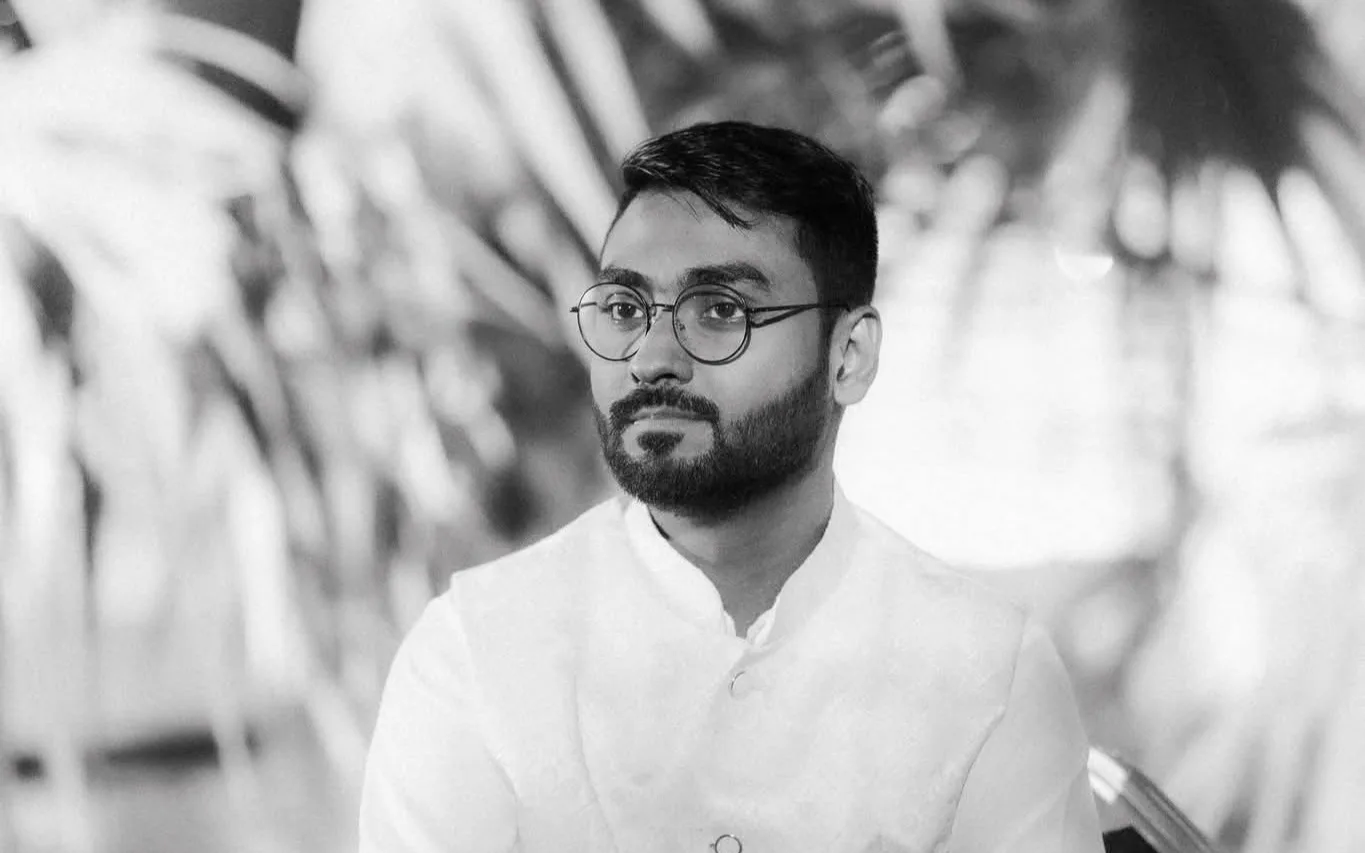
Today, I choose to write about Barrister Ahmed Bin Quasem Arman, and honestly, I have found this one difficult to write. There is no dearth of things one could say about him. His life before Aynaghar, his father's trial, his disappearance, the eight years he spent away from the world, his release, and now his presence in Parliament. But the difficulty is in trying to write about the human cost of what happened to him without pretending that I can understand it. I've never met Arman, never spoken to him, and I still haven't had a proper conversation with him. I have only seen him from a distance. Yet, somehow, two very brief moments of seeing him have stayed with me. Before his disappearance, Arman was known primarily as a barrister and as part of the legal defence team for his father, Mir Quasem Ali, a senior Jamaat-e-Islami leader who was prosecuted by the International Crimes Tribunal. Arman got involved in his father's legal defence, while also speaking publicly about the tribunal proceedings and raising questions about the trial process. On 9 August 2016, he was taken away from his home by men in plain clothes. For the next eight years, his family did not know where he was. Human rights organisations, including Amnesty International, raised concerns about his disappearance. But for the most part, he simply became one more name in Bangladesh's long and painful story of enforced disappearances. I remember seeing the news before I joined the government that Barrister Arman had been released from Aynaghar. After Sheikh Hasina fled Bangladesh on 5 August 2024, a video of Arman walking along a road towards Ibn Sina Hospital went viral on social media. He looked like someone who had suddenly been returned to the world after years of being absent from it. I remember seeing that video, but I don't remember what exactly I thought at the time. By the time we were going into the press conference, I already knew the broad outline of Arman's story. I knew that he had been taken away in 2016, that his family had spent years looking for him, and that he had finally returned after the fall of the previous government. I had also seen the videos of his release, like everyone else. But if I am being completely honest, I knew him more as a name from the news than as a person. “Barrister Arman” was a name attached to a disappearance, to Aynaghar, to a story that had become part of the larger political history of Bangladesh. I had not yet made the connection between that name and the human being who had actually lived through those years. I knew what had happened to him in broad terms, but I don't think I had understood what those eight years might have done to him as a human being. It was early February 2025 when we learned that we would be accompanying Chief Adviser Muhammad Yunus to several places associated with Aynaghar. I specifically remember talking to Django (Apurba bhai) about it. I told him, “As a photographer, it is a privilege to visit Aynaghar and photograph something that had become such a significant part of Bangladesh's recent history. But at the same time, I feel scared, nervous and anxious.” Django said he felt a little scared, too. We were going to Aynaghar, after all. We both knew the word, but I don't think either of us really knew what it would feel like to physically stand inside those places.
The next day, we left Jamuna and visited several locations associated with secret detention, including the RAB-2 office in Agargaon, the DGFI facility at Kachukhet and the RAB-1 headquarters in Uttara. I had gone there with a photographer's instinct. I was looking for frames, details, things that could tell a story through pictures. But the experience was much more difficult than I expected. I felt claustrophobic throughout the visit. There was something about the rooms, the narrow spaces and the knowledge of what had happened there that made it difficult to remain comfortable. By the time we reached the RAB-1 headquarters in Uttara, where Arman had been kept, I became physically sick and vomited. I still find it difficult to properly describe what I felt that day. The easiest word is probably “horrible”, although it doesn't really explain anything. It was at the Uttara facility that I saw Arman for the first time. Muhammad Yunus was visiting the detention centre, and Arman was there, standing inside the very place where he had once been held. He was explaining things to the Chief Adviser, describing the rooms and what had happened to him. The place was crowded with officials, journalists and cameras. Everyone was moving around, listening, photographing and trying to document the moment. I was doing the same thing. I saw him from a distance and took one photograph. I didn't speak to him. I didn't introduce myself. I don't even know if he noticed me. At that point, I had no idea that I would remember another image of him much more clearly than the photograph I took that day. Then came the press conference. By that point, the atmosphere had changed. We were no longer simply walking through rooms and looking at walls. Arman was standing there. I remember feeling uncomfortable in a way that was difficult to explain. Before that, I had been nervous about visiting Aynaghar. During the press conference, that nervousness turned into something heavier.
Somehow, during all the movement, I had left my CAO ID card inside the facility. When I realised it was missing, I started looking around. One of the military personnel from the Chief Adviser's Office told me I had probably left it in Barrister Arman's room because it had been particularly crowded. So I went back there.
Everyone else was preparing for the press conference, and I entered the room looking for my ID. And then I saw him again. Arman was standing there in the dark. I don't remember exactly how long I saw him. It couldn't have been very long. I didn't say anything to him, and he didn't say anything to me. Maybe he saw me; maybe he didn't. I was simply looking for my ID card while he was standing in that room. There was no dramatic conversation, no exchange of words, nothing that would normally make a moment memorable. I don't know what he looked like in his own mind at that moment. I don't know whether he was tired, emotional, uncomfortable or simply waiting for the press conference to begin. I don't want to put emotions into his face that I couldn't possibly know. What I remember is the stillness of that moment. In the middle of all the movement outside, he was simply standing there. For a few seconds, he wasn't the barrister who had survived Aynaghar or the man everyone had come to hear. He was simply a person standing in a place where he had once been imprisoned. I still think about why he was standing there. Was he remembering the years he had spent in that room? Was he looking at the walls and remembering what his life had been like there? Was he thinking about his family, or about the years that had passed without him? Or maybe he was thinking about nothing at all. Perhaps he was simply waiting for the press conference to begin. I will never know. But later, when I heard Arman speak about his years in captivity, that image became heavier for me. In interviews after his release, he spoke about how lonely those years had been. One thing he said has remained with me more than almost anything else. He talked about speaking to ants, cockroaches and lizards because there was nobody else to talk to. He would ask them how their day had been, how many children they had. I don't know why that particular detail affected me so much. Perhaps because we often describe enforced disappearance through numbers: eight years, one person, one family, one case. But that small detail makes the loneliness feel real. He had started having conversations with insects because there was no human being around to speak to. Standing inside that room, I had only a very small taste of what the place could do to a person. I was there for a few hours and became physically sick. Arman had been there for years. That difference is something I cannot get out of my head. I could leave. I had a car waiting outside, a phone in my pocket, colleagues around me, and a government ID card to lose and eventually find again. He did not have any of those things. For him, that room was not a historical site. It was his life for years. I don't think I fully processed that day when I left. I went back to Jamuna, looked at the photographs, continued with work, and life moved on. But that room kept coming back to me. Especially Arman standing there alone. For me, it was a place I visited for a few hours as part of my work. For him, it had been his world for years. That is probably why I don't think of Arman first as the parliamentarian I see today. When I see him in Parliament, I still sometimes see the man standing in that dark room. It is strange to think about the journey between those two places. A barrister who was fighting a legal battle for his father became a disappeared person, spent eight years in secret detention, returned to his family and eventually entered Parliament. I don't know what kind of parliamentarian Arman will become. I don't think surviving enforced disappearance automatically makes someone a good politician, and I don't want to romanticise suffering either. But I hope he carries something from those years with him.