Gas supply starts bouncing back as Maheshkhali LNG terminal restarts operations
The Maheshkhali LNG terminal has resumed gas supply after a fire shut operations for nearly two weeks, easing pressure on a national gas system already struggling with shortages. The disruption cut gas availability for industries, power generation, CNG transport and households, prompting the government to fast track plans for a separate new LNG terminal at Kutubjom.
Reading
In a Nutshell:
- The Excelerate Energy operated floating LNG terminal at Maheshkhali resumed supply on 6 August after shutting down on 21 July following a fire during an LNG transfer operation.
- The terminal restarted with around 100 million cubic feet of gas per day and will gradually return to its full 500 million cubic feet daily capacity.
- Bangladesh relied only on Summit Group’s LNG terminal during the shutdown, which supplied around 500 million cubic feet per day to the national grid.
- The Cabinet Committee on Economic Affairs approved a proposal on 28 July to fast track a separate Kutubjom FSRU at Maheshkhali under a Bangladesh China government to government arrangement.
- The gas shortage hit Chattogram hardest, with supply falling to 194 million cubic feet per day against demand of over 300 million cubic feet.
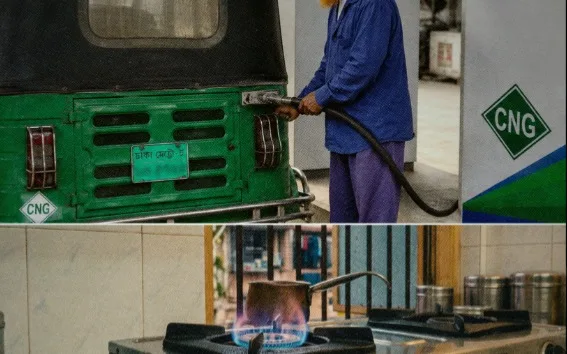
- The shortage caused more than 3,000 MW of power generation shortfall, long queues at CNG stations and production cuts across garment, dyeing, cement, ceramic and chemical factories.
Why it matters
The Maheshkhali shutdown exposed how dependent Bangladesh’s economy has become on a fragile LNG supply chain. After the outage cut around 450 to 500 million cubic feet of gas from the national grid, total supply fell to around 2,700 million cubic feet per day against demand of about 3,800 million cubic feet, creating shortages across industries, transport and households. The crisis pushed electricity generation shortfall above 3,000 MW, while CNG stations saw gas pressure fall from 7 to 8 psi to 0 to 1 psi, forcing drivers to spend hours at a time in long queues. In Narayanganj, at least 85 dyeing factories and 65 garment factories were affected, with some reporting production losses of up to 80 to 90 percent. BGMEA said garment factories were operating at around 40 percent of normal production capacity, with manufacturers warning that delayed shipments could damage relationships with international buyers and affect future orders. Meghna Group said several manufacturing units were operating at one third capacity or remained idle, while its cement plant output fell from a 30,000 tonnes per day capacity to below 5,000 tonnes due to power shortages. The restart of the Maheshkhali terminal will gradually restore up to 500 million cubic feet of gas supply daily, easing pressure on industries, power plants, CNG stations and households as Bangladesh works to recover from the shortage
What we think
While the government is gradually restoring gas supply after the Maheshkhali terminal shutdown, the crisis should be a bigger wake up call for authorities to reduce Bangladesh’s dependence on a few LNG terminals and invest more in domestic energy production. The two week shortage did not only hurt the economy by forcing crucial industries like garment factories to cut working hours and reduce production; it also affected ordinary working people. Amid a severe gas crisis, CNGs became difficult to find as drivers were forced to wait in long queues at filling stations instead. Commuters, in turn, had to take more expensive options like Uber and Pathao which are not affordable transport options on a daily basis for most young students and office workers. Families too have had to rely on costly LPG for cooking at home. All of this points to a need for a more reliable energy system that can protect industries, workers and households when one part of the supply chain fails.